Economic Pulse Net | Sources: World Bank World Development Indicators, Government Sources | 2026
Key Takeaways
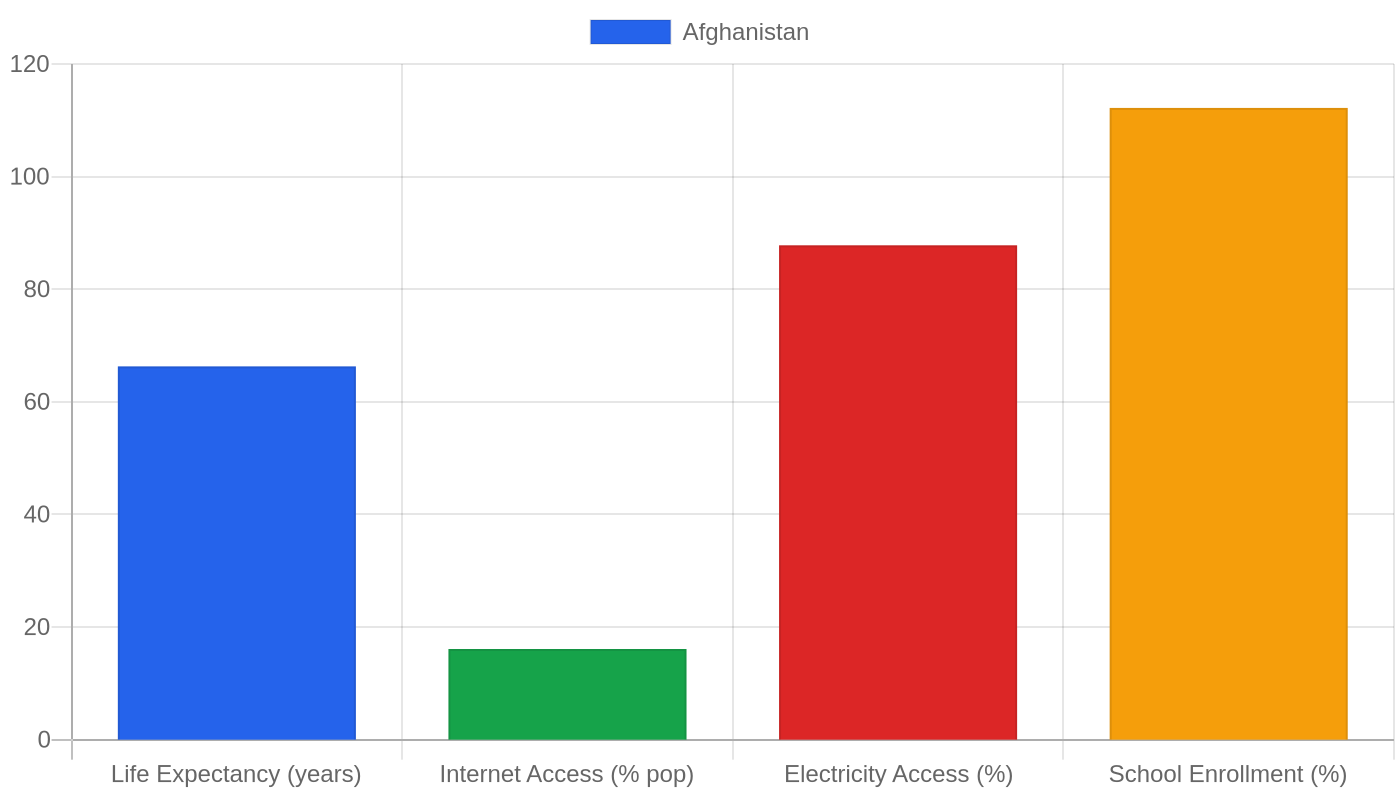
– Afghanistan’s economy operates in a near-total data vacuum, with the World Bank reporting no measurable figures for GDP growth, inflation, unemployment, or per capita income — a stark indicator of institutional collapse and international isolation.
– The country is classified as a “closed autocracy” in the V-Dem Democracy Indices, ranking 176th and 177th out of 179 nations globally, placing it among the most politically repressive environments on earth.
– Only the Russian Federation has recognized the Taliban’s Islamic Emirate as the de jure government as of July 2025, leaving Afghanistan in a diplomatic and economic limbo with limited access to international finance, trade agreements, or development aid.
– Despite the absence of formal economic data, a handful of companies — including Afghanistan International Bank, Afghan Wireless, and Ariana Afghan Airlines — continue to operate, suggesting a fragile but persistent private sector clinging to life.
– The political landscape remains defined by the 2021 Taliban takeover and the collapse of the Islamic Republic, with no clear path toward normalization, reconstruction, or re-engagement with global markets.
The Invisible Economy — What We Don’t Know Tells Us Everything
When the World Bank’s latest data release for Afghanistan returns a string of “N/A” entries across GDP growth, inflation, unemployment, and per capita income, it is not a clerical oversight. It is a statement. The absence of numbers is itself the most telling statistic available. Afghanistan’s economy has effectively fallen off the map of measurable global commerce.
The World Bank, which typically tracks economic indicators for nearly every country on earth, has been unable to produce reliable figures for Afghanistan since the Taliban’s 2021 offensive brought the Islamic Republic to a sudden and chaotic end. This data vacuum reflects a deeper reality: the institutions that once collected, verified, and published economic statistics have been dismantled, abandoned, or rendered non-functional.
Without a recognized central bank integrated into the global financial system, without functioning customs authorities, without reliable survey mechanisms, the very concept of “GDP” becomes almost meaningless.
What we do know is that Afghanistan’s economy was never robust. Even before the Taliban takeover, the country relied heavily on foreign aid — approximately 40% of its GDP came from international assistance. That spigot has been largely turned off.
The main industries that once sustained the economy — agriculture, carpet weaving, small-scale manufacturing, and a modest services sector — now operate in a regulatory vacuum, with no clear legal framework, no access to international credit, and no protection from the arbitrary enforcement of Taliban edicts.
The unemployment rate is officially listed as N/A, but anecdotal reports from humanitarian organizations suggest that joblessness is catastrophic, particularly among women who have been systematically excluded from the workforce. The inflation figure is similarly unknown, but the collapse of the afghani in the immediate aftermath of the takeover, followed by a fragile stabilization, hints at extreme volatility that has eroded purchasing power for ordinary Afghans.
The GDP per capita (PPP) and GNI per capita figures are also blank. In a functioning economy, these numbers tell you about living standards. In Afghanistan, their absence tells you that living standards cannot be meaningfully measured because the economy has ceased to function as a coherent system. The country is not growing, contracting, or inflating in any measurable sense — it is surviving, day by day, on remittances, informal trade, and the diminishing returns of a subsistence agricultural base.
The Cost of Bare Existence — Living in a Cash Economy Without a Price Tag
Housing costs in Afghanistan are impossible to quantify with any precision, but the broad contours are grim. In Kabul, what little formal housing market remains has been distorted by displacement: millions of Afghans fled the country during and after the 2021 takeover, leaving behind empty homes that were quickly occupied by internally displaced families or seized by Taliban officials.
Rent, where it exists, is paid in cash — often in Pakistani rupees or Iranian tomans, as the afghani’s reliability remains questionable.
For the vast majority of Afghans, the concept of “buying” a home is a distant fantasy. Property rights, never strong under the Islamic Republic, have become even more precarious under the Taliban’s ad hoc legal system. Land disputes, long a source of conflict in Afghan society, now go through Taliban-run courts that offer no consistent jurisprudence and no right of appeal.
The idea of a mortgage is laughable — there is no functioning banking system capable of offering long-term credit, and interest is forbidden under the Taliban’s interpretation of Sharia law.
Daily expenses tell a story of grinding scarcity. Basic food items — wheat flour, cooking oil, sugar, tea — consume the vast majority of household income for most families. The World Food Programme has repeatedly warned that Afghanistan faces one of the worst humanitarian crises on the planet, with millions of people experiencing acute food insecurity. Compare this to regional averages: in neighboring Pakistan, a basket of basic goods might consume 40-50% of a low-income household’s budget.
In Afghanistan, that figure is likely far higher, though no official data exists to confirm it.
Utilities are unreliable. Electricity in Kabul comes from a mix of domestic generation and imports from Uzbekistan and Tajikistan, but outages are frequent and prolonged. Heating in winter — a matter of life and death in a country where temperatures regularly drop below freezing — depends on access to firewood or coal, both of which have become more expensive as supply chains fracture. The cost of living in Afghanistan is not measured in currency; it is measured in survival.
Business in a Vacuum — The Companies That Remain
Against this bleak backdrop, a handful of companies continue to operate, their names appearing on lists of Afghanistan’s top enterprises as if the country still had a functioning economy. Afghan Telecom and Afghan Wireless provide telecommunications services in a market where mobile phones remain a lifeline for remittances and information.
Afghanistan International Bank and Azizi Bank represent the financial sector, though their operations are severely constrained by the lack of correspondent banking relationships and the freezing of central bank reserves abroad.
Ariana Afghan Airlines and Bakhtar Afghan Airlines continue to fly, maintaining a tenuous connection between Kabul and a few international destinations. Their survival is remarkable — airlines are capital-intensive enterprises that require fuel, maintenance, insurance, and international regulatory approvals, all of which are difficult to secure when your country is unrecognized by most of the world.
Afghan Film and Ariana TV represent the media and cultural sector, though their output is heavily censored and their editorial independence nonexistent under Taliban rule.
The business climate is, by any objective measure, hostile. There is no functioning legal system to enforce contracts, no independent judiciary to resolve disputes, no predictable regulatory environment for foreign investment. The companies that survive do so through a combination of informal connections, cash transactions, and sheer determination. They are not thriving; they are enduring.
Sectors to watch, if one could watch them, would include telecommunications — where demand remains high and the Taliban has shown some willingness to allow private operators to function — and perhaps mining, given Afghanistan’s untapped mineral wealth. But without security, without rule of law, without international recognition, these remain theoretical opportunities rather than practical ones.
Politics as Economic Destiny — The Closed Autocracy
The V-Dem Democracy Indices rank Afghanistan among the lowest in the world, placing it at 176th and 177th out of 179 countries as a “closed autocracy.” This is not a political classification that exists in isolation; it is the fundamental determinant of Afghanistan’s economic reality.
When a country is ruled by a government that tolerates no opposition, no free press, no independent civil society, and no meaningful participation by half its population (women), the economy cannot function in any normal sense.
The political landscape is defined by the events of 2021. The collapse of the Islamic Republic during the Taliban offensive was swift and total. The Taliban declared the country an Islamic Emirate, and a caretaker government was announced on 7 September 2021. Since then, the international community has largely withheld recognition. As of July 2025, only the Russian Federation has recognized the Islamic Emirate as the de jure government of Afghanistan.
This diplomatic isolation has profound economic consequences: no access to International Monetary Fund lending, no World Bank development projects, no bilateral trade agreements, no foreign direct investment worth mentioning.
Crime and safety indices are listed as N/A, but the security situation is complex. The Taliban has imposed a brutal form of order — street crime in Kabul has reportedly declined compared to the chaotic final years of the Islamic Republic, but this “safety” comes at the cost of systematic state violence, arbitrary detention, and the complete absence of legal protections for women, minorities, and political dissidents.
The safety index, if it could be calculated, would measure not the safety of citizens from crime, but their safety from the state itself.
Quality of life is abysmal by any measure. Afghanistan consistently ranks at the bottom of global happiness reports, though no specific data is provided here. The combination of economic collapse, political repression, humanitarian crisis, and the systematic exclusion of women from public life creates a society where basic human flourishing is impossible for the vast majority of the population.
The Frozen Present — Afghanistan in Mid-2025
As of mid-2025, Afghanistan exists in a state of suspended animation. The caretaker government announced in September 2021 remains in place, with no elections, no constitutional process, and no timeline for either. The Russian Federation’s recognition, while diplomatically significant, has not translated into meaningful economic engagement. No other major power has followed Moscow’s lead.
The humanitarian situation remains dire. International aid organizations continue to operate under difficult conditions, but funding has declined as global attention shifts to other crises. The Taliban’s restrictions on female aid workers have further complicated relief efforts. The economy, such as it is, runs on cash, informal trade, and remittances from the Afghan diaspora — a diaspora that grows larger with each passing month as those with means find ways to leave.
There are no reforms to report, no policy shifts, no new development initiatives. The Taliban has shown no interest in the kind of economic liberalization that might attract investment or aid. Their priorities are ideological consolidation and internal security, not economic growth. Inflation trends are unknown, employment data is absent, and business development is limited to the bare minimum required for the regime to maintain basic functions.
The most significant development of the past year is not economic at all: it is the continued absence of international recognition and the normalization of Afghanistan’s isolation. The country has become a black box in the global economy — data goes in, but nothing comes out.
The Bottom Line
Afghanistan is not a country for investors, traders, or tourists. It is a country for humanitarian organizations, geopolitical analysts, and those with a professional interest in state collapse and authoritarian governance. The absence of data is the story — it tells us that Afghanistan has fallen out of the global economic system entirely. Anyone watching Afghanistan should be watching for signs of political change, not economic recovery.
Until the question of recognition is resolved, until the Taliban’s governance model evolves or collapses, the economy will remain invisible, unmeasurable, and fundamentally broken.
Sources & Methodology
This article is authored by Economic Pulse Net for informational and research purposes. Economic Pulse Net sources its data from multilateral institutions, national statistics bureaus, and proprietary databases. All data is believed to be current as of the date of publication.
Published: July 17, 2026 | Category: Research — Afghanistan
Use these signals in your own platform
Economic Pulse publishes its live signal feed through a documented, read-only API. Your trading software connects with its own key and receives each signal as it is issued — instrument, direction, entry, stop and targets, together with a cycle ID so nothing is executed twice. The feed is independent of this website and cannot change it.
Signals are informational only and are not financial advice.