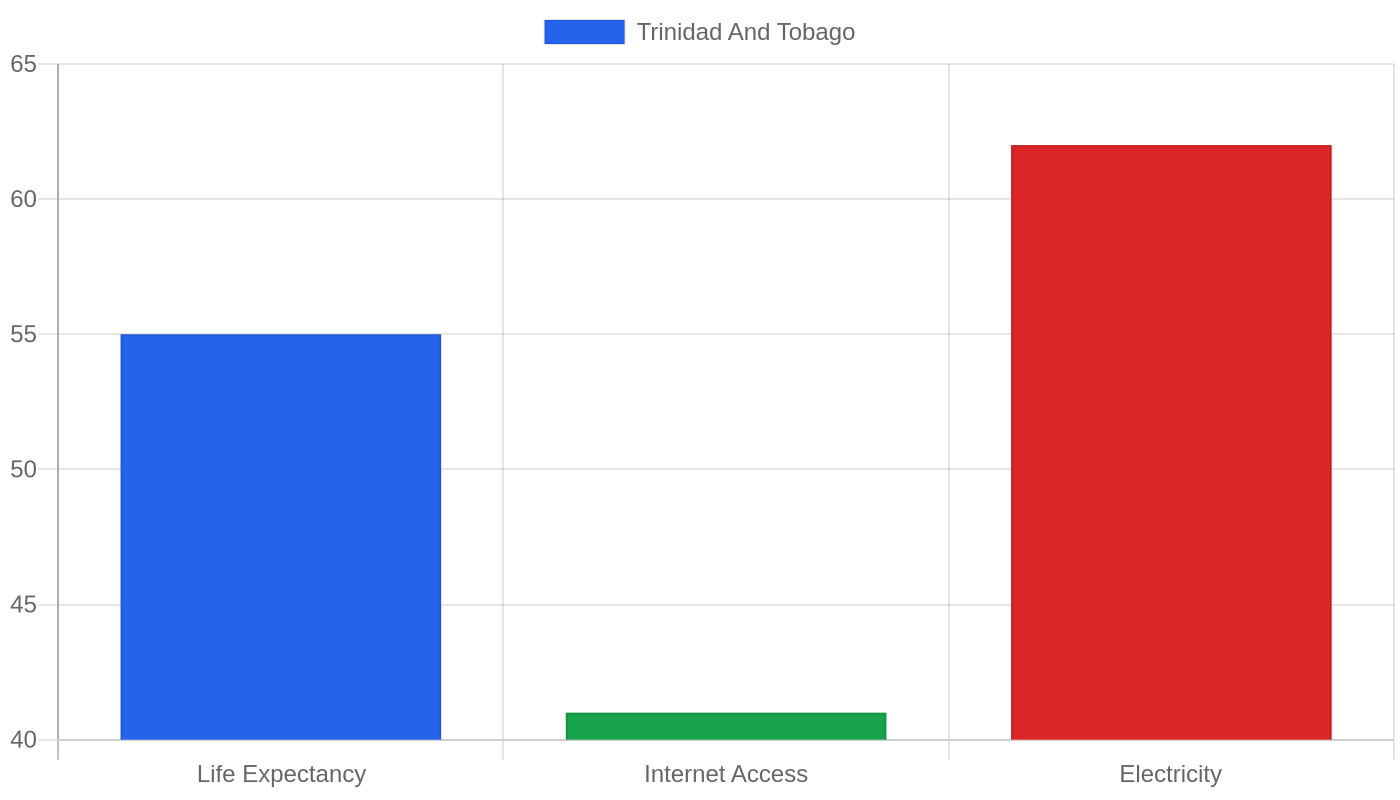
Economic Pulse Net | Sources: World Bank World Development Indicators, Government Sources | 2026
Key Takeaways
– Trinidad and Tobago’s economic narrative remains dominated by its historical role as a major Caribbean energy exporter, though the latest World Bank data shows a lack of current growth, inflation, and employment figures, making it a nation in a statistical blind spot.
– The country operates as a republic with a stable, two-party political system modeled on the Westminster parliamentary tradition, providing a predictable, if deeply partisan, governance framework.
– With key macroeconomic indicators currently unreported, the focus shifts to the structural realities of a mature petrochemical economy facing the global energy transition.
– The nation’s prosperity is inextricably linked to the global price of natural gas and oil, leaving its fiscal health vulnerable to external shocks.
– For investors and policymakers, the country represents a high-potential, high-complexity environment where energy sector dynamics and political continuity are the primary drivers of economic activity.
The Petrochemical Paradox — Growth in a Statistical Vacuum
The most striking feature of Trinidad and Tobago’s current economic profile is the absence of hard data. The World Bank’s latest figures for GDP growth, inflation, and unemployment are marked as unavailable, which itself is a telling indicator of a nation in flux. When a country as historically significant as Trinidad and Tobago—once a beacon of Caribbean prosperity—fails to report core metrics, it signals a period of recalibration.
The country’s economic engine is, and has always been, hydrocarbons. As a leading global exporter of liquefied natural gas and ammonia, the twin-island republic has leveraged its reserves to build a middle-income society with a relatively high standard of living compared to its regional peers.
However, the lack of current World Bank data forces analysts to look at the structural bones of the economy rather than the flesh of quarterly growth. The reality is that Trinidad and Tobago is navigating a complex transition. The mature nature of its gas fields presents a challenge of depletion, while the global pivot toward renewable energy threatens the long-term viability of its primary revenue streams.
The economy is effectively a petrostate in miniature, where the ebb and flow of global energy markets dictate domestic fiscal space. Without current inflation or employment numbers, we cannot ascertain the immediate temperature of the economy, but we can recognize the chronic condition: a nation that has built its wealth on a finite resource, now forced to confront the twin pressures of resource exhaustion and climate policy.
The absence of data is not a vacuum; it is a symptom of an economy holding its breath, waiting for the next big investment decision in the energy sector to determine its trajectory.
The Cost of Living — The Price of an Island
In the absence of specific World Bank cost-of-living indices, we must rely on the general understanding of Caribbean economics. Trinidad and Tobago generally enjoys a higher income level than many of its neighbors, but this comes with a correspondingly high cost of living, particularly in the capital, Port of Spain. The economy is largely import-dependent for food and manufactured goods, a structural vulnerability that exposes consumers to global supply chain disruptions.
While the country produces its own energy, which subsidizes electricity and fuel costs, the price of groceries, clothing, and vehicles often carries a significant premium due to import tariffs and shipping logistics.
Housing in Trinidad and Tobago presents a stark dichotomy. In affluent suburbs and gated communities, property prices and rents are comparable to developed-world standards, reflecting the wealth generated by the energy sector. Conversely, there is a substantial stock of public housing and informal settlements that serve lower-income groups. The “rent vs.
buy” calculation is heavily skewed by access to mortgage financing, which is often constrained by high-interest rates and the volatility of the local currency. For the average citizen, the daily cost of living—food, transportation, and utilities—absorbs a significant portion of household income, creating a sense of economic pressure even in a country historically considered the wealthiest in the English-speaking Caribbean.
The economic reality is a tale of two islands: one of energy-sector affluence and another of everyday financial strain.
Investment & Business Climate — Waiting on the Gas
The investment climate in Trinidad and Tobago is defined by its top companies, which are overwhelmingly concentrated in the energy sector. The state-owned and multinational joint ventures that dominate the petrochemical landscape are the primary drivers of foreign exchange and government revenue. For investors, the country offers a stable, English-speaking, and geographically strategic base, but it is an environment fraught with bureaucratic inertia and a heavy reliance on state intervention.
The sectors to watch are not just upstream oil and gas, but also downstream plastics, methanol, and fertilizers, where the country has carved out a global niche.
However, the business environment is at a crossroads. The government is actively courting foreign direct investment in new energy frontiers, including deep-water exploration and the potential for a petrochemical-based hydrogen economy. Yet, the pace of reform is slow, and the private sector often complains of red tape and a lack of diversification. Outside of energy, there are emerging opportunities in tourism and financial services, but these remain secondary to the hydrocarbon behemoth.
The business climate is essentially a waiting game: waiting for the next major gas find, waiting for global energy prices to stabilize, and waiting for the political will to push through structural reforms that would make the non-energy sector more competitive. For now, the country remains a one-industry town on a national scale, offering high rewards for those willing to navigate its complexities, but offering little in the way of a diversified safety net.
Safety, Politics & Quality of Life — The Westminster Legacy
Trinidad and Tobago’s political landscape is a point of stability in a region often prone to volatility. As a republic with a bicameral parliamentary system based on the Westminster model, the country enjoys a functioning, albeit fiercely partisan, two-party democracy. This political continuity provides a predictable legal and regulatory framework, which is a significant asset for long-term planning.
However, the political scene is often characterized by deep ethnic and ideological divides, which can lead to policy paralysis on critical issues. The government’s focus is perpetually split between managing the energy sector’s decline and addressing social pressures.
Regarding safety, the World Bank data does not provide a specific crime index, but it is widely understood that Trinidad and Tobago struggles with a high crime rate, particularly violent crime and gang-related activity in urban areas. This is a significant drag on the quality of life and a deterrent to tourism and foreign investment. The disparity between the country’s wealth and its social outcomes is stark.
While it boasts high literacy rates and a vibrant cultural scene—being the birthplace of calypso and steelpan—the sense of personal security is often compromised. The quality of life, therefore, is a paradox: a rich cultural heritage and democratic stability overshadowed by concerns about personal safety and the economic anxiety of a post-energy transition.
What’s Happening Now — The Fiscal Tightrope
Right now, Trinidad and Tobago is in a holding pattern, awaiting clarity on its economic future. With the World Bank reporting no current data, the nation’s immediate focus is on the national budget and the government’s ability to manage a fiscal deficit in the face of fluctuating energy revenues. The government is under pressure to maintain subsidies and social programs while also signaling to international investors that it is serious about fiscal discipline.
The ongoing exploration and production activities in the offshore fields are the most critical live indicator; every announcement about drilling or gas supply agreements is parsed for its implications on the national treasury.
The current affairs landscape is dominated by the “energy transition” conversation, but with a local twist. Unlike larger nations that can pivot to renewables quickly, Trinidad and Tobago’s entire economic infrastructure—from power generation to industrial exports—is built on natural gas. The country is actively exploring the potential of “green” hydrogen and carbon capture, but these are nascent projects.
The immediate political debate centers on how to use the last decades of gas wealth to fund a future beyond oil. This involves tough choices about taxation, sovereign wealth fund management, and social spending. The news cycle is filled with debates about revenue collection and the need to expand the tax base, a politically sensitive topic in a country where citizens have grown accustomed to energy-funded benefits.
The nation is effectively negotiating its own future, one budget cycle at a time, trying to balance the immediate needs of its citizens with the long-term necessity of economic diversification.
The Bottom Line
Trinidad and Tobago is a country that must be watched by anyone with a stake in the future of Caribbean energy. It is a test case for how a mature petrostate manages its decline and attempts to pivot to a new economic model. The lack of current World Bank data is a red flag, suggesting a period of economic uncertainty and opacity that demands caution. However, for the risk-tolerant investor, the country offers a gateway to the region’s energy infrastructure and a skilled workforce.
For policymakers, it is a crucial example of the challenges of the energy transition. This is a nation with immense historical wealth and cultural capital, but its future hinges on the difficult, unglamorous work of diversification—a story that is far from over.
Sources & Methodology
This article is authored by Economic Pulse Net for informational and research purposes. Economic Pulse Net sources its data from multilateral institutions, national statistics bureaus, and proprietary databases. All data is believed to be current as of the date of publication.
Published: August 03, 2026 | Category: Research — Trinidad And Tobago
Use these signals in your own platform
Economic Pulse publishes its live signal feed through a documented, read-only API. Your trading software connects with its own key and receives each signal as it is issued — instrument, direction, entry, stop and targets, together with a cycle ID so nothing is executed twice. The feed is independent of this website and cannot change it.
Signals are informational only and are not financial advice.