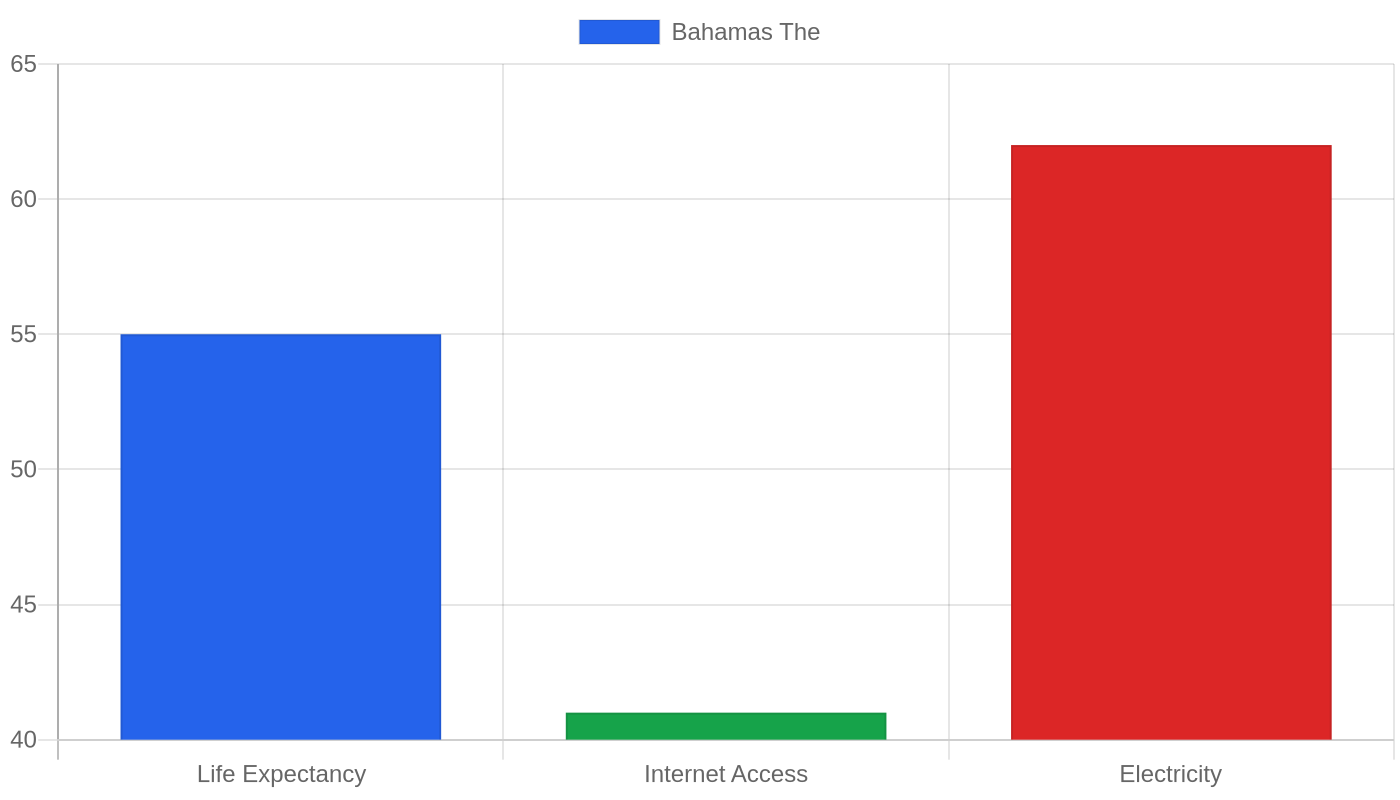
Economic Pulse Net | Sources: World Bank World Development Indicators, Government Sources | 2026
Key Takeaways
– The Bahamas stands at a critical juncture where its legendary tourism and financial services sectors face mounting pressure from global economic headwinds and the escalating costs of climate resilience.
– While the nation’s status as a premier offshore banking hub remains intact, the broader economy is navigating a delicate transition that will determine its long-term prosperity.
– The country’s high-income status belies significant structural vulnerabilities, including a heavy reliance on imports, exposure to hurricane damage, and the need for economic diversification beyond tourism and finance.
– With the World Bank’s latest data showing a gap in key indicators, observers are watching closely for updated figures that will reveal the true state of post-pandemic recovery and current inflationary pressures.
– The Bahamas’ unique geographic position as a gateway between the Atlantic and the Caribbean makes it a bellwether for small island developing states grappling with similar challenges.
The Paradox of Plenty: Growth, Inflation, and the Service Economy
The Bahamian economy presents a fascinating paradox that economists and policymakers continue to grapple with: a nation that consistently ranks among the wealthiest in the Caribbean by per capita income, yet remains acutely sensitive to external shocks that can derail progress within a single fiscal quarter.
The World Bank’s latest data release shows a gap in GDP growth figures, inflation rates, and unemployment statistics, leaving analysts to piece together a narrative from the broader regional context and the country’s known economic architecture.
What we do know is that the Bahamas operates one of the most open economies in the Western Hemisphere, with tourism and financial services accounting for the overwhelming majority of GDP and employment. This structural concentration creates a double-edged sword: when global travel rebounds and offshore banking flourishes, the country experiences robust growth that outpaces many regional peers.
However, when these sectors contract, the absence of a diversified industrial base amplifies the downturn, making the Bahamian economy particularly vulnerable to external demand shocks.
The inflation picture remains murky without updated CPI figures, but the nation’s high import dependence means that global food and energy price movements transmit quickly to domestic consumers. The Bahamas imports nearly all of its consumer goods, fuel, and even construction materials, leaving the country as a price-taker in international markets. This structural reality means that Bahamian households face distinct cost-of-living pressures that differ from larger, more self-sufficient economies.
The tourism sector, which employs a substantial portion of the workforce directly or indirectly, remains the primary engine of job creation, though the exact unemployment figures await World Bank updates.
The Cost of Island Living: Housing, Imports, and Daily Realities
Anyone who has walked the streets of Nassau or Freeport understands that Bahamian living comes at a premium that defies simple comparison with regional neighbors. The cost of living in the Bahamas is notoriously high, driven by the fundamental economics of island geography: virtually everything must be shipped in, and that transportation cost is passed directly to consumers.
Housing, in particular, presents a significant challenge, with limited land availability on the more developed islands pushing property values upward and creating a market where rental costs consume a substantial portion of household income.
The rent-versus-buy calculation in the Bahamas differs markedly from what one might find in larger Caribbean nations. Property ownership is a long-standing aspiration for many Bahamians, but the barriers to entry are considerable, especially for younger households navigating an economy where wages have not always kept pace with the rising cost of living.
The luxury end of the real estate market, driven by foreign buyers seeking second homes or investment properties, has historically commanded premium prices, creating a bifurcated market where high-end developments coexist alongside more modest housing stock that serves the local population.
Daily expenses for food, utilities, and transportation reflect the import-heavy nature of the economy. Groceries, particularly fresh produce and dairy products that cannot be grown locally at scale, carry prices that would surprise visitors from larger countries. Electricity costs are especially notable, as the Bahamas relies heavily on imported fossil fuels for power generation, making utility bills a significant line item in household budgets.
These cost pressures are not merely anecdotal; they shape everything from family budgeting decisions to the competitiveness of local businesses that must factor in their own operating costs when setting prices.
Navigating the Business Landscape: Finance, Tourism, and Emerging Sectors
The Bahamian business environment is dominated by two pillars that have defined the economy for decades: international financial services and tourism. The financial sector, centered in Nassau, has long been a magnet for international capital, offering a stable regulatory environment, proximity to major markets, and a sophisticated legal framework that has made the country one of the world’s leading offshore financial centers.
This industry brings substantial revenue and high-value employment, though it also subjects the country to international scrutiny and evolving global tax standards that require constant adaptation.
Tourism, meanwhile, extends far beyond the famous beaches and resorts. The industry encompasses everything from boutique hotels on the Out Islands to massive cruise ship terminals in the capital, creating a value chain that supports restaurants, transportation providers, artisans, and countless small businesses. The sector’s importance cannot be overstated, and its health is often viewed as the most reliable barometer of the broader Bahamian economy.
When visitor arrivals surge, the effects ripple through the entire economy; when they falter, the consequences are felt in every community.
Beyond these traditional pillars, there are nascent opportunities in sectors such as technology services, renewable energy, and value-added agriculture that could help diversify the economy. The government has signaled interest in positioning the Bahamas as a hub for digital innovation and sustainable development, though these ambitions require significant investment in infrastructure, education, and regulatory modernization.
The business climate generally benefits from political stability, a common law legal system, and a well-developed banking infrastructure, but entrepreneurs also navigate challenges related to the small domestic market size, logistical costs, and occasional bureaucratic hurdles.
Safety, Stability, and the Pulse of the Nation
The Bahamas enjoys a reputation for political stability that has been a cornerstone of its economic success. The country operates as a parliamentary democracy within the Commonwealth, with a track record of peaceful transfers of power and respect for the rule of law. This political continuity provides the predictability that international investors value and that underpins the country’s status as a trusted financial center.
The legal system, based on English common law, offers protections for property rights and contract enforcement that are essential for both domestic and foreign investment.
Quality of life in the Bahamas is a study in contrasts that defies simple characterization. The natural beauty, warm climate, and strong community ties contribute to a lifestyle that many residents treasure deeply. However, the high cost of living, income inequality, and the persistent threat of hurricanes create stressors that temper the idyllic image.
The country’s vulnerability to climate-related events is not an abstract concern; it is a lived reality that shapes infrastructure planning, insurance markets, and even the location of residential development.
Crime statistics for the Bahamas have historically shown elevated rates compared to some regional peers, particularly in certain urban areas, and this remains an important consideration for both residents and visitors. The government has implemented various community policing initiatives and crime prevention programs over the years, but the issue remains a complex challenge intertwined with economic opportunity, social services, and youth employment.
The safety index figures that would provide current context are pending in the latest data release, but the broader picture is one of a nation working to balance its welcoming, open culture with the need to maintain public security.
The Road Ahead: Current Pressures and Future Imperatives
The Bahamas enters the current period with a set of opportunities and challenges that will define its trajectory for years to come. The global recovery from the pandemic shock has brought visitors back to the islands, but the composition of that tourism has shifted, with a growing emphasis on high-end travelers and a corresponding need to upgrade infrastructure and services to meet elevated expectations.
Simultaneously, the international financial services industry faces a rapidly evolving regulatory environment, with global tax transparency initiatives and digital asset regulations creating both pressures and possibilities for Bahamian firms.
Climate resilience has moved from a future concern to an immediate imperative. The country’s experience with major hurricanes has underscored the urgent need for investment in stronger building codes, coastal protection, and diversified energy sources. These investments carry significant costs, but they also present opportunities for economic activity and innovation.
The transition toward renewable energy, for instance, could reduce the country’s dependence on imported fuels, lower electricity costs for households and businesses, and position the Bahamas as a leader in sustainable development for small island states.
The government’s policy agenda reflects these competing demands, balancing the need for fiscal discipline with calls for social investment in education, healthcare, and infrastructure. The outcome of these policy choices will determine whether the Bahamas can successfully navigate the transition from a traditional tourism and finance economy to a more diversified, resilient model that can sustain prosperity for future generations.
The data gaps in the current World Bank release leave many questions unanswered, but the direction of travel is clear, and the stakes could not be higher.
The Bottom Line
The Bahamas remains a compelling case study in the possibilities and vulnerabilities of small island economies. For investors, the country offers a stable, well-regulated environment with established strengths in tourism and financial services, but requires careful attention to global economic conditions and climate risks. For policymakers in other Caribbean nations, the Bahamian experience provides valuable lessons about the rewards of political stability and the imperative of economic diversification.
And for the Bahamian people, the path forward demands a delicate balancing act between preserving the qualities that make their nation unique and adapting to the demands of a rapidly changing world. The story of the Bahamas is far from over, and the next chapter promises to be among the most consequential in its history.
Sources & Methodology
This article is authored by Economic Pulse Net for informational and research purposes. Economic Pulse Net sources its data from multilateral institutions, national statistics bureaus, and proprietary databases. All data is believed to be current as of the date of publication.
Published: July 31, 2026 | Category: Research — Bahamas The
Use these signals in your own platform
Economic Pulse publishes its live signal feed through a documented, read-only API. Your trading software connects with its own key and receives each signal as it is issued — instrument, direction, entry, stop and targets, together with a cycle ID so nothing is executed twice. The feed is independent of this website and cannot change it.
Signals are informational only and are not financial advice.