Economic Pulse Net | Sources: World Bank World Development Indicators, Government Sources | 2026
Key Takeaways
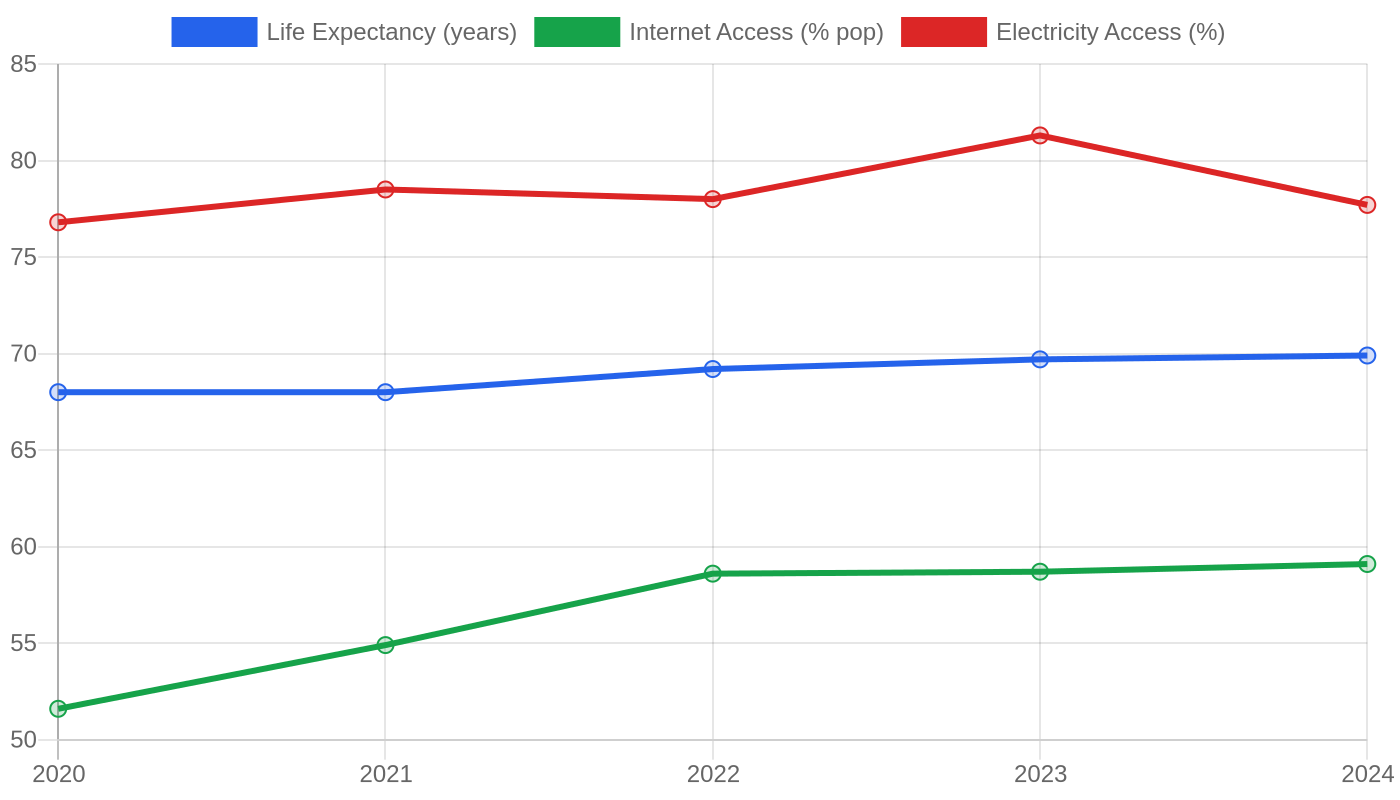
– St Martin’s French side operates as a unique economic microcosm, heavily dependent on tourism and cross-border flows with the Dutch side of the island, yet official macroeconomic data from the World Bank remains conspicuously absent for GDP growth, inflation, unemployment, and per capita income.
– The territory’s economic identity is defined by its dual-nation island status, where French administrative structures and EU affiliation coexist with a Caribbean tourism economy that has historically driven local livelihoods.
– Without published World Bank data on key indicators, analysts must rely on qualitative assessments of the territory’s service-sector economy, infrastructure resilience, and the ongoing challenge of rebuilding after Hurricane Irma’s devastation in 2017.
– The cost of living and business climate are shaped by St Martin’s status as an overseas collectivity of France, meaning EU regulations and French social systems apply, but the island’s remote location and import dependence create unique price pressures.
– Political stability is anchored in French governance, but the territory faces structural vulnerabilities including hurricane risk, seasonal tourism volatility, and the complexities of managing a border with the Dutch side that is both economically vital and administratively porous.
The Invisible Economy — What the Missing Data Tells Us
The World Bank’s economic database for the French part of St Martin is, in a word, empty. No GDP growth figure. No inflation rate. No unemployment percentage. No GDP per capita, no GNI per capita, no population estimate. On paper, this is a statistical void. But in practice, this absence of data is itself a revealing piece of economic intelligence. It signals that St Martin (French Part) operates below the threshold where international financial institutions typically invest in granular data collection.
This is not a large emerging market or a significant industrial hub—it is a small island territory with a population likely measured in the tens of thousands, whose economic footprint is too modest to register in the World Bank’s global statistical machinery.
Yet the economy of St Martin’s French side is far from insignificant to those who live there. The territory’s main industries, while not enumerated in the provided data, are widely understood to center on tourism, hospitality, and retail trade—sectors that cater to cruise ship passengers, luxury travelers, and day-trippers crossing from the Dutch side’s bustling port of Philipsburg.
The French side, with its capital Marigot, offers a distinctly Gallic flavor of Caribbean life: open-air markets selling French cheeses and baguettes alongside tropical fruits, boutique hotels, and restaurants serving créole cuisine with a French accent. This is an economy built on service, not manufacturing; on experience, not extraction.
The absence of inflation data from the World Bank does not mean prices are stable. On a small island where nearly everything is imported—from building materials to food staples to fuel—inflationary pressures can be acute and sudden. Global shipping disruptions, fuel price spikes, or supply chain bottlenecks hit St Martin harder than they hit mainland economies, because there is no domestic production to fall back on.
The territory’s economic managers, operating through the French prefecture and local government, must constantly navigate these external shocks without the cushion of diversified industry or large-scale domestic markets.
Employment patterns on the French side are similarly opaque in official data, but the reality is that jobs are seasonal, informal, and often split between the two sides of the island. Many residents work in tourism during the high season (December to April) and scramble for alternative income during the quiet summer months. Cross-border labor is common, with French-side residents working in Dutch-side casinos, hotels, and construction, and vice versa.
This fluidity makes accurate unemployment statistics exceptionally difficult to compile—and perhaps explains why the World Bank has not attempted to do so.
The Price of Paradise — Living Costs in a French Caribbean Enclave
Housing costs on St Martin’s French side reflect the territory’s dual identity as both a French overseas collectivity and a Caribbean island paradise. Property prices in desirable coastal areas like Grand Case, known as the “restaurant capital of the Caribbean,” or around Marigot Bay, are driven by demand from French expatriates, wealthy retirees, and second-home buyers from Europe.
For local residents, however, the housing market presents a stark challenge: wages in the tourism and service sectors rarely keep pace with real estate values inflated by foreign capital.
The cost of living more broadly is shaped by the island’s near-total dependence on imports. Everything from a baguette to a bottle of wine to a washing machine arrives by container ship, and those shipping costs are passed directly to consumers. Compared to mainland France, prices for basic goods on St Martin are significantly higher—a phenomenon familiar to residents of island territories worldwide.
Utility costs, particularly electricity, are also elevated, as power generation relies on imported diesel rather than the nuclear or renewable sources that serve metropolitan France.
Renting is the dominant housing arrangement for much of the working population, with apartments in Marigot or smaller villages commanding rents that would be considered moderate by Parisian standards but steep relative to local incomes. The rental market is largely informal, with many properties let through word-of-mouth rather than formal agencies, which can leave tenants vulnerable to sudden rent increases or eviction.
For those seeking to buy, the market is bifurcated: high-end villas with ocean views sell for premium prices to overseas buyers, while more modest inland properties remain within reach of some local families, though financing options are limited and mortgage rates reflect the risk profile of a small island economy.
Business in a Borderland — Investment Climate on a Divided Island
The top companies operating on St Martin’s French side are not listed in the provided data, but the business landscape is dominated by small and medium enterprises—family-run hotels, restaurants, tour operators, and retail shops—rather than multinational corporations. The largest formal employers are likely the French administration itself, the local hospital, and educational institutions. There is no major manufacturing sector, no export-oriented industry, and no financial services hub.
The private sector is overwhelmingly oriented toward serving tourists and the local population.
For investors considering the French side, the business climate offers both advantages and obstacles. The territory benefits from French legal and regulatory frameworks, which provide stability, property rights protection, and access to EU funding for infrastructure and development projects. The euro is the official currency, eliminating exchange rate risk for European investors.
However, the same French bureaucracy that provides stability can also be cumbersome for small business owners, with complex permitting processes, high social charges on employment, and strict labor laws that discourage hiring during slow seasons.
The sectors to watch on the French side are those that leverage the territory’s unique position. Niche tourism—culinary tourism, eco-tourism, and luxury villa rentals—has room for growth, as does the renovation and redevelopment of properties damaged by Hurricane Irma in 2017, which still scars parts of the island.
Cross-border commerce also presents opportunities: businesses that can serve both the French and Dutch sides, particularly in logistics, construction materials, and professional services, benefit from a combined market of roughly 70,000 residents plus hundreds of thousands of annual visitors. The main constraint is scale: the territory is simply too small to support large-scale industrial or agricultural investment, meaning that most viable business opportunities are in services, hospitality, and trade.
Safety, Stability, and the French Connection — Life on the Island
Crime and safety indices for St Martin’s French part are not available in the provided data, but the territory’s security situation is generally understood to be better than on the Dutch side, where tourism-related crime—including theft, fraud, and occasional violent incidents—has been a recurring concern. The French side benefits from the presence of the French national police (gendarmerie) and a more established administrative apparatus, which tends to keep petty crime at lower levels.
However, like any small island community, St Martin faces challenges with drug trafficking, given its location along Caribbean smuggling routes, and with property crime targeting unoccupied vacation homes.
The political landscape, while not detailed in the provided data, is defined by St Martin’s status as an overseas collectivity of France. The territory elects a Territorial Council and sends representatives to the French National Assembly and Senate in Paris. This arrangement provides substantial autonomy in local affairs while guaranteeing French citizenship, social security, and public services to residents.
The political stability this affords is a significant asset—there is no risk of coup, currency collapse, or sovereign default. But it also means that the territory’s economic fate is largely determined in Paris and Brussels, not in Marigot. Local politicians have limited control over tax policy, trade agreements, or monetary policy, which are set by the French government and the European Central Bank.
Quality of life on the French side is a study in contrasts. The natural environment is stunning—white sand beaches, turquoise waters, lush hillsides—and the pace of life is relaxed by European standards. French infrastructure, including schools, healthcare, and roads, is generally good for a Caribbean island.
But the territory’s vulnerability to hurricanes is a constant source of anxiety, and the rebuilding process after Irma exposed weaknesses in construction standards, insurance coverage, and disaster preparedness. For residents, the trade-off is clear: they accept the risks and costs of island life in exchange for a setting that millions of tourists pay handsomely to visit for a week.
The Long Shadow of Irma — St Martin’s Ongoing Recovery and Future Prospects
What is happening right now on St Martin’s French side is a slow, uneven, and often invisible recovery from the devastation of Hurricane Irma in September 2017. That storm, one of the most powerful Atlantic hurricanes on record, flattened entire neighborhoods, destroyed the island’s airport, and left thousands homeless.
More than eight years later, the physical scars have largely healed—roofs have been replaced, hotels have reopened, and the beaches are as beautiful as ever—but the economic and social recovery remains incomplete.
The territory’s rebuilding effort has been complicated by the COVID-19 pandemic, which shut down the tourism that is the lifeblood of the economy for much of 2020 and 2021, and by the subsequent global inflation surge, which raised the cost of construction materials and imported goods.
The French government has provided substantial reconstruction aid, but the process of disbursing funds, approving projects, and completing repairs has been slow, hampered by bureaucratic procedures and the sheer logistical difficulty of rebuilding on a small island with limited contractor capacity.
Today, the tourism sector is operating but not fully recovered. Cruise ship calls have returned, and the high season sees healthy occupancy rates at hotels and villa rentals. However, the mix of visitors has shifted, with more European travelers and fewer from the United States, reflecting changing travel patterns and economic conditions. The French side is also grappling with the challenge of diversifying its economy beyond tourism, a goal that has been discussed for decades but never achieved.
There is talk of developing the territory as a hub for marine research, sustainable agriculture, or digital nomad services, but these remain aspirations rather than concrete projects.
The most pressing current issue is the cost of living. Residents report that prices for food, fuel, and housing have risen sharply, outpacing any increases in wages or social benefits. This has led to growing discontent, with some families struggling to make ends meet despite the island’s image as a tropical paradise.
The local government has called for increased French subsidies and price controls on essential goods, but the structural drivers of inflation—import dependence, limited competition, and the small size of the market—are not easily addressed by policy interventions.
The Bottom Line
St Martin’s French side is a territory that defies easy economic categorization—it is neither a developing country nor a fully developed European economy, but something in between, shaped by its island geography, its French institutional framework, and its dependence on tourism. For investors, it offers a stable but limited opportunity in hospitality and cross-border services. For travelers, it remains a uniquely appealing destination that blends French culture with Caribbean warmth.
And for economists, it serves as a case study in how small island territories navigate the challenges of data invisibility, climate vulnerability, and economic monoculture. The story of St Martin is not written in World Bank spreadsheets, but in the daily lives of its residents, who continue to build a living on the edge of paradise.
Sources & Methodology
This article is authored by Economic Pulse Net for informational and research purposes. Economic Pulse Net sources its data from multilateral institutions, national statistics bureaus, and proprietary databases. All data is believed to be current as of the date of publication.
Published: July 18, 2026 | Category: Research — St Martin French Part)
Use these signals in your own platform
Economic Pulse publishes its live signal feed through a documented, read-only API. Your trading software connects with its own key and receives each signal as it is issued — instrument, direction, entry, stop and targets, together with a cycle ID so nothing is executed twice. The feed is independent of this website and cannot change it.
Signals are informational only and are not financial advice.