Economic Pulse Net | Sources: World Bank World Development Indicators, Government Sources | 2026
The Solomon Islands sits at a crossroads of immense possibility and profound fragility. As a constitutional monarchy navigating the complexities of the 21st century, this Melanesian nation of hundreds of islands is rarely the headline—yet its political and economic trajectory carries weight far beyond its shores.
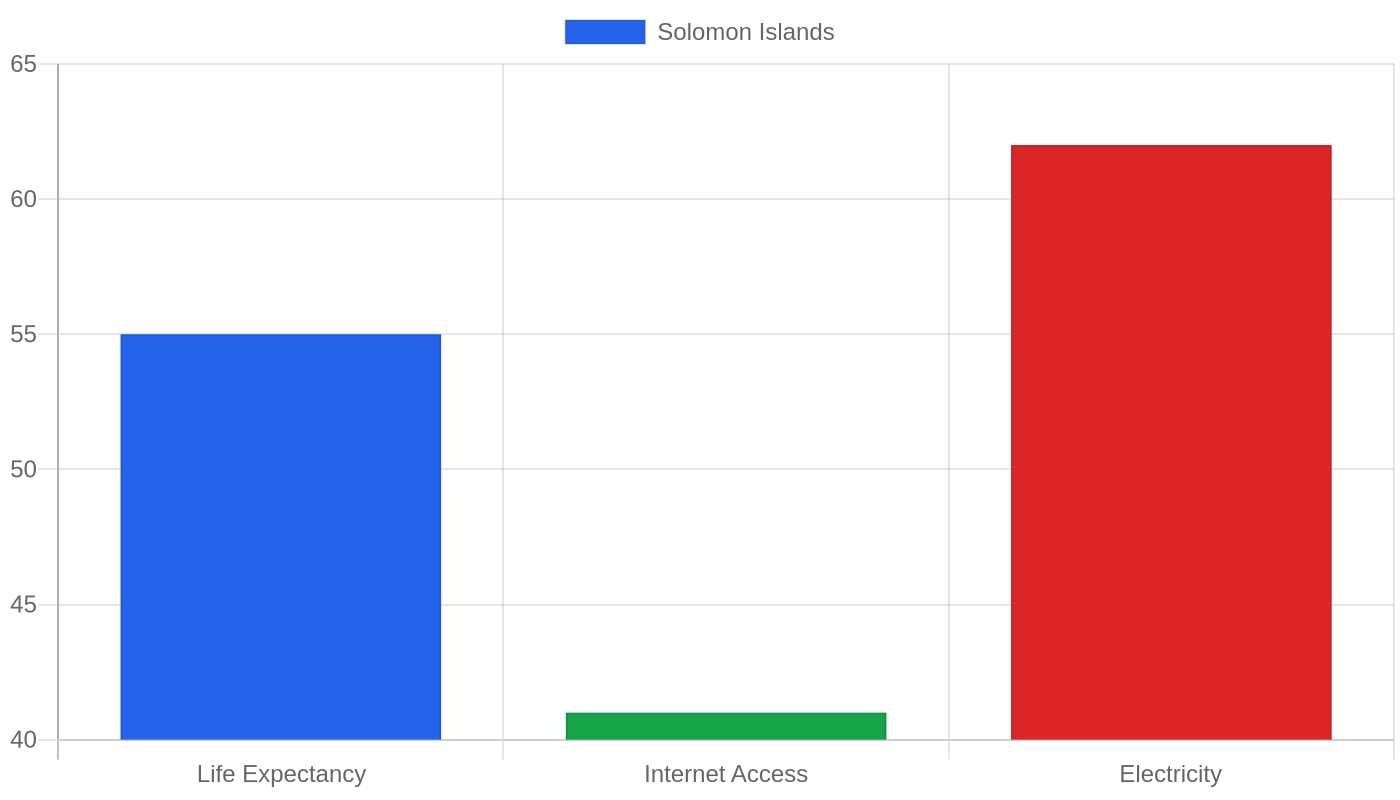
With a parliamentary system anchored by King Charles III as head of state and a Governor-General representing the Crown, the country is attempting to balance deep-rooted customary traditions with the demands of modern governance. The data available paints a picture of a nation in flux, where the absence of hard economic figures speaks volumes about the challenges of data collection and formal economic structure in a dispersed island nation.
This feature looks at the machinery of state, the cost of daily life, and the critical choices facing the Solomon Islands as it seeks its footing in a rapidly changing Pacific region.
Key Takeaways
– Political Stability is the Prism: As a constitutional monarchy with a 50-member unicameral Parliament, the Solomon Islands’ governance is defined by a delicate balance of power. The ability of Parliament to dissolve itself before a four-year term concludes highlights a political landscape prone to shifts and realignment.
– Economic Data is Scarce, but the Structure is Clear: Key metrics like GDP growth, inflation, and unemployment are not currently available from the World Bank, underscoring the challenges of formal economic measurement in a nation where subsistence agriculture and informal trade play a massive role.
– A Nation of Islands, A Dispersed Economy: The Solomon Islands is not a single, unified market but a sprawling archipelago.
This geography dictates that economic activity, infrastructure, and public services are fragmented, creating high costs and logistical hurdles.
– The Head of State is a Symbol of Continuity: The constitutional framework, with King Charles III as the symbolic sovereign, provides a layer of institutional continuity that exists alongside—and sometimes in tension with—the dynamic, often volatile, world of elected politics.
The Economic Engine: An Informal Archipelago in a Formal World
To understand the Solomon Islands economy, one must first acknowledge what is not on the balance sheet. The World Bank currently lists GDP growth, inflation, and unemployment as N/A, which is not an oversight but a reflection of a profound reality: the formal, measured economy is only a fraction of the nation’s true productive activity.
The vast majority of the population lives in rural, dispersed communities across the archipelago, where livelihoods are rooted in subsistence agriculture, fishing, and small-scale barter. This “custom economy” is resilient and provides a social safety net that no government program could replicate, but it also remains largely invisible to international financial institutions and investors.
When economists speak of the Solomon Islands, they speak of a dual economy. On one side, there is the formal sector—logging, fishing, and a nascent tourism industry—which generates the foreign exchange and government revenue that pays for public services. On the other side, there is the informal sector, which provides food and shelter for the majority but generates little taxable income. This bifurcation makes headline economic data less meaningful than in a typical industrialised nation.
The N/A figures from the World Bank are a stark reminder that the country’s true economic health cannot be captured by GDP alone; it must be measured in food security, community resilience, and the sustainability of natural resources, which are currently the nation’s most valuable—and most vulnerable—assets.
The Price of Paradise: Cost of Living and the Housing Hurdle
For those in the formal workforce—government employees, NGO staff, and workers in the logging and fishing industries—the cost of living in the Solomon Islands presents a significant challenge, particularly in the capital, Honiara. Without specific CPI data from the World Bank, we can infer from the nation’s structural conditions that the cost of imported goods is exceptionally high.
The Solomon Islands imports the vast majority of its manufactured goods, fuel, and even some food staples, and the logistical expense of shipping these items across vast ocean distances is passed directly to the consumer. This makes daily necessities like rice, tinned fish, and cooking oil significantly more expensive than in nearby producer nations.
Housing is perhaps the most acute pressure point. In Honiara, land is scarce, and the formal housing market is small and expensive, catering to a limited pool of expatriates and wealthy locals. The vast majority of Solomon Islanders do not participate in a traditional rent-or-buy housing market; instead, they live on customary land, where access is governed by traditional ownership and kinship ties rather than by monetary transactions.
This customary system is a crucial buffer against homelessness, but it also limits the development of a formal mortgage market and creates friction for urban migration. The cost of living, therefore, is not just a matter of money—it is a matter of access to land, which is the ultimate currency in this society.
The Business Climate: Navigating the Tides of Investment
The investment landscape in the Solomon Islands is not for the faint-hearted. It is a market dominated by a few key extractive industries, primarily logging and fishing, which are often managed by foreign companies under government license. The “top companies” list is not populated by household names but by concession holders in these sectors, operating in a business environment where political connections can be as important as capital.
For the domestic entrepreneur, the barriers to entry are high: poor infrastructure, unreliable utilities, and a small, dispersed consumer market make scaling a business difficult. The formal economy is a series of islands, both literally and figuratively, with limited interconnectivity.
However, this challenging environment also presents unique opportunities. There is a growing global demand for sustainable and traceable commodities, and the Solomon Islands is richly endowed with the natural resources to meet this—if managed correctly.
The future of the business climate lies not in replicating the industrial models of larger nations but in leveraging the country’s unique assets: pristine marine environments for high-value, low-impact tourism; premium timber and fish products for niche markets; and the potential for climate finance and carbon credits.
The government’s ability to create a stable, transparent regulatory framework will determine whether these opportunities are seized by local businesses and international partners or squandered through short-term extraction. The potential is immense, but so is the risk of a race to the bottom.
Safety, Politics, and the Quality of Life: A Balancing Act
The Solomon Islands’ political landscape is a fascinating, and sometimes turbulent, theatre. As a constitutional monarchy, it possesses a veneer of British-style parliamentary stability, but the reality is a highly fluid system where allegiances shift and governments can fall on a single vote. The fact that Parliament may be dissolved by a majority vote of its members before completing its four-year term is not a theoretical clause; it is a recurring feature of the nation’s political life.
This creates a governance environment where long-term policy planning is often sacrificed for short-term political survival, and where the focus can drift towards patronage and constituency-level politics rather than national economic strategy. The absence of a crime index and safety data from the World Bank makes it difficult to quantify social stability, but the political fluidity suggests a society where formal institutions are still competing with traditional authority and regional loyalties.
Quality of life in the Solomon Islands is a paradox. On one hand, it offers a lifestyle that many in the industrialised world would envy: a strong sense of community, deep cultural traditions, and a natural environment of breathtaking beauty. On the other hand, these benefits are offset by significant challenges: limited access to quality healthcare and education outside of Honiara, vulnerability to climate change and natural disasters, and the daily grind of economic scarcity.
The political system, with its frequent upheavals, is a reflection of a nation still negotiating its identity—balancing the legacy of colonial rule, the influence of regional powers, and the powerful pull of customary life. It is a delicate balancing act, and the outcome will define the nation’s character for decades to come.
The Current Moment: A Nation at a Political Precipice
Right now, the Solomon Islands is in a period of intense political recalibration. The most pressing narrative is the country’s shifting foreign policy alignment, which is redefining its place in the Pacific. While the World Bank data on current affairs is not provided, the political structure itself is the news. The potential for a parliamentary vote to dissolve the government and trigger early elections is a constant undercurrent.
This creates a sense of urgency and unpredictability that impacts everything from investor confidence to the delivery of public services. The current government is operating in a high-stakes environment where every parliamentary session could bring a change in leadership, forcing the nation’s development agenda to be constantly renegotiated.
This political fluidity is not merely a domestic matter; it has profound implications for the entire Pacific region. The Solomon Islands is a sovereign nation making sovereign choices, and its decisions on international partnerships are being watched closely by its neighbours and global powers. The government is navigating a path that seeks to maximise economic benefits and security guarantees, but this strategy carries inherent risks.
Domestically, the central challenge remains the same: how to translate the nation’s natural wealth and political autonomy into tangible improvements in the lives of its people. The coming months will be critical in determining whether the Solomon Islands can find a new equilibrium—one that delivers the stability and prosperity that its citizens deserve while maintaining the unique cultural identity that defines this remarkable archipelago.
The Bottom Line
The Solomon Islands is not a country for those seeking predictable charts and steady growth curves; it is a country for those who understand that true economic and social resilience is often found in the spaces where formal data does not reach. This is a nation to watch for its political evolution, its strategic importance in the Pacific, and its potential as a steward of some of the world’s most valuable natural ecosystems.
For investors, it represents high risk with the potential for high, albeit niche, rewards. For policymakers, it is a critical test case in balancing sovereignty, development, and diplomacy. For the casual observer, it is a reminder that the global economy is not a monolith but a mosaic of unique, complex, and deeply human stories. The Solomon Islands is writing its next chapter now, and the world would do well to read it.
Sources & Methodology
This article is authored by Economic Pulse Net for informational and research purposes. Economic Pulse Net sources its data from multilateral institutions, national statistics bureaus, and proprietary databases. All data is believed to be current as of the date of publication.
Published: August 01, 2026 | Category: Research — Solomon Islands
Use these signals in your own platform
Economic Pulse publishes its live signal feed through a documented, read-only API. Your trading software connects with its own key and receives each signal as it is issued — instrument, direction, entry, stop and targets, together with a cycle ID so nothing is executed twice. The feed is independent of this website and cannot change it.
Signals are informational only and are not financial advice.