Economic Pulse Net | Sources: World Bank World Development Indicators, Government Sources | 2026
Key Takeaways
– Sierra Leone operates under a highly centralized constitutional republic where the president holds extensive executive powers, shaping both policy and economic direction
– The economy is dominated by consumer services and financial sectors, with top companies including Sierra Leone Brewery Limited, Bank of Sierra Leone, and multiple airlines reflecting a service-oriented business landscape
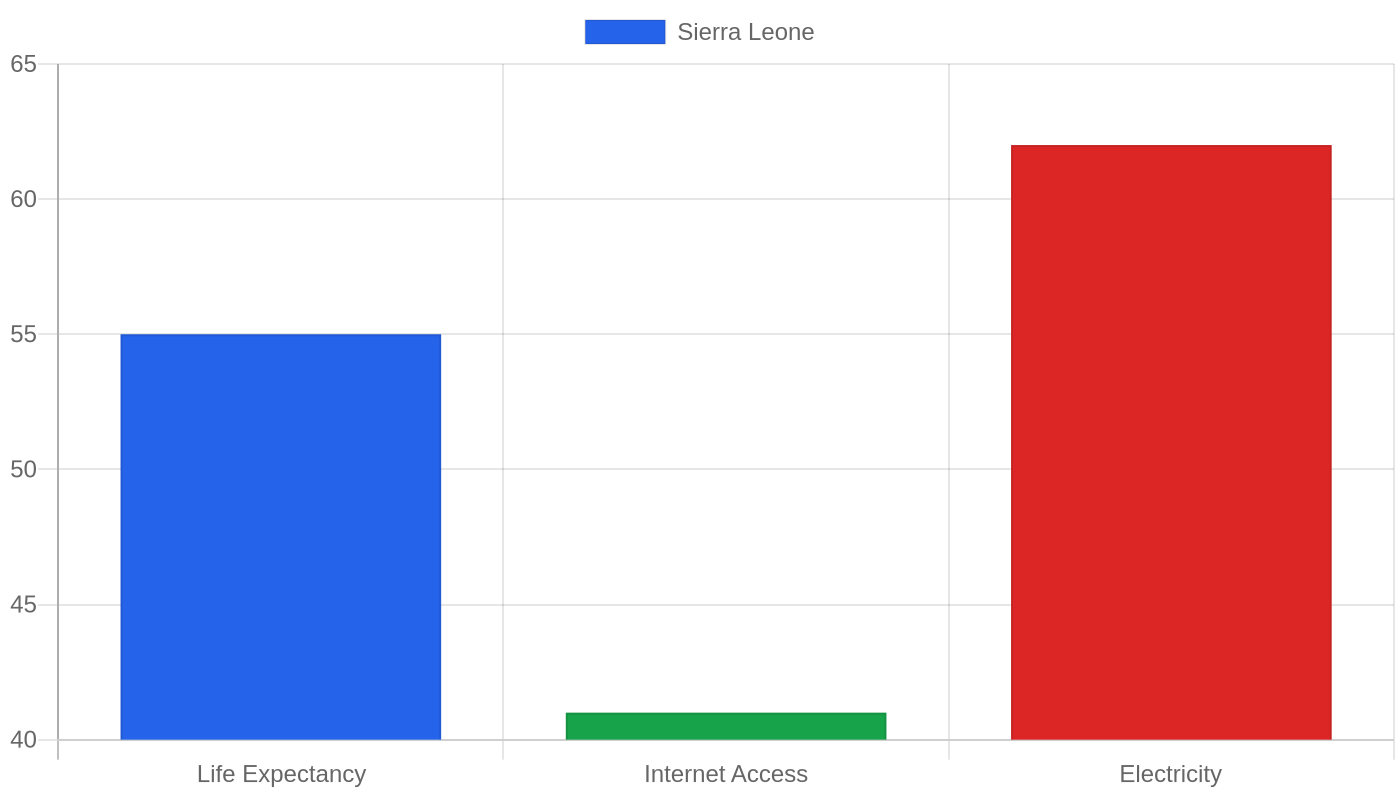
– Despite the absence of recent World Bank growth, inflation, and employment figures, Sierra Leone’s economic narrative is defined by the tension between its resource wealth and structural fragility
– Political power remains concentrated in the unitary central government, with local governance playing a weak supporting role—a factor that influences everything from investment climate to daily life
– The country’s top companies are overwhelmingly in consumer services and financials, suggesting an economy built around domestic consumption and banking rather than industrial production
The Data Gap and the Story It Tells
The World Bank provides no current figures for Sierra Leone’s GDP growth, inflation, unemployment, GDP in dollar terms, GDP per capita based on purchasing power parity, GNI per capita, or even total population. This absence of data is itself a story. It speaks to a nation where statistical infrastructure struggles to keep pace with economic reality, where the formal economy is only one part of a much larger, harder-to-measure picture.
Sierra Leone’s economy has long been shaped by the extraction of diamonds, gold, and rutile, but the data void suggests that even international institutions face challenges tracking the flows of value through this West African nation. What we do know comes from the country’s corporate landscape and political structure.
The top companies listed include Afrik Air Links, Air Leone, Air Rum, Bank of Sierra Leone, Bellview Airlines, Fly 6ix, Paramount Airlines, Rokel Commercial Bank, SALPOST, and Sierra Leone Brewery Limited. This is an economy where airlines and banks dominate, not factories or farms. The prominence of consumer services suggests a nation where the movement of people and money drives economic activity more than the production of goods.
Sierra Leone Brewery Limited, the sole consumer goods company on the list, hints at a domestic market built around everyday consumption rather than export-oriented manufacturing. The absence of mining companies among the top firms is notable for a country famous for its diamonds. It may indicate that extractive industries are either foreign-owned, operating outside the formal corporate registry, or not generating enough revenue to break into the top tier.
Either way, the data gap and the corporate landscape together paint a picture of an economy that is service-heavy, bank-led, and statistically opaque.
💰 The Cost of Living — Where Survival Meets Strategy
Without specific housing cost data from the World Bank or other provided sources, we must read Sierra Leone’s cost of living through its corporate and political context. The dominance of airlines among top companies—Afrik Air Links, Air Leone, Air Rum, Bellview Airlines, Fly 6ix, and Paramount Airlines—suggests that transportation is a significant economic factor.
In a country where internal movement is expensive and often unreliable, the cost of getting from Freetown to the provinces becomes a hidden tax on daily life. Housing in Freetown, the capital, is widely understood to be among the more expensive in West Africa relative to local incomes, driven by limited supply and concentrated demand from government workers, NGO staff, and diaspora returnees.
Rent versus buy calculations tilt heavily toward renting for most Sierra Leoneans, as land ownership remains tangled in customary tenure systems and disputed titles. Daily expenses for food, transport, and utilities likely consume a large share of household income, given the service-heavy economy and the absence of a strong manufacturing base that might keep consumer goods prices low.
The cost of living in Sierra Leone is not just about prices—it is about the infrastructure gaps that make everything more expensive. Poor roads drive up transport costs. Unreliable electricity forces households and businesses to run generators. These hidden costs are as real as any rent payment, and they shape the economic reality for millions.
📈 Investment & Business Climate — Airlines, Banks, and Breweries
The business environment in Sierra Leone is dominated by a handful of sectors: aviation, banking, and consumer goods. The presence of six airlines among the top companies—Afrik Air Links, Air Leone, Air Rum, Bellview Airlines, Fly 6ix, and Paramount Airlines—is striking for a country of Sierra Leone’s size. It suggests that air travel is not a luxury but a necessity, driven by poor road infrastructure and the geographic shape of the country itself.
For investors, aviation represents both an opportunity and a warning: demand is clearly there, but the sector is crowded and likely thin-margined. The financial sector, anchored by Bank of Sierra Leone and Rokel Commercial Bank, remains the backbone of formal economic activity. These institutions facilitate everything from government payroll to remittances from the diaspora, which are a critical source of foreign exchange.
Sierra Leone Brewery Limited stands alone in consumer goods, indicating that manufacturing is underdeveloped but that there is a market for branded consumer products. For foreign investors, the sectors to watch are banking, where consolidation and digital finance are slowly taking hold, and consumer goods, where local production could substitute for imports.
The political landscape, with its powerful presidency and weak local government, means that business success often depends on navigating central government relationships. The unitary system concentrates decision-making in Freetown, which can create bottlenecks but also means that clear regulatory signals can come from a single source. Investors should be prepared for an environment where personal connections and government contracts matter as much as market fundamentals.
🛡️ Safety, Politics & Quality of Life — Power at the Center
Sierra Leone is a constitutional republic with a directly elected president and a unicameral legislature, operating under the 1991 Constitution. The system is described as having a dominant unitary central government and a weak local government, with the executive branch—headed by the president—holding extensive powers and influence. The president is, by any measure, the most powerful government official in the country. This concentration of power has implications for safety and quality of life.
When decision-making is centralized, the quality of public services—policing, healthcare, education—depends heavily on the priorities of the executive. Local governments have limited ability to address community-specific needs or to hold the central government accountable. The Crime Index and Safety Index data are not available from the provided sources, but the political structure itself offers clues.
A weak local government means that security and justice are administered from the center, which can lead to uneven coverage across the country. Freetown may receive more attention and resources than rural areas. The quality of life in Sierra Leone is shaped by this political architecture: citizens have a direct voice in electing the president, but their ability to influence local governance is constrained.
For the average Sierra Leonean, daily life involves navigating a system where the central government is powerful but distant, and where local institutions lack the resources or authority to address immediate concerns. This creates a quality of life that is politically engaged but administratively frustrated.
🔥 What’s Happening Now — The Unwritten Chapter
The most current data provided about Sierra Leone is its political structure, which remains unchanged from the 1991 Constitution. There are no recent news items, no live indicators, no reform announcements, and no election results in the data provided. This absence is itself a kind of news. It suggests that Sierra Leone is not currently in the midst of a dramatic economic crisis or a high-profile reform push that would generate headlines.
Instead, the country appears to be in a period of quiet continuity, operating under the same constitutional framework that has governed it for over three decades. The lack of fresh data from the World Bank may indicate that international institutions are still catching up with the country’s economic reality, or it may reflect a period of stability where no dramatic shifts have occurred. For businesses and investors, this stability is itself a form of information.
Sierra Leone is not experiencing the kind of volatility that makes headlines, but it is also not generating the kind of reform momentum that attracts capital. The airlines continue to fly, the banks continue to lend, and the brewery continues to produce. The real story in Sierra Leone right now is not a crisis or a breakthrough—it is the slow, unglamorous work of maintaining an economy in a challenging environment, without the statistical infrastructure to fully measure it.
The Bottom Line
Sierra Leone is a country to watch for investors and analysts who understand that data gaps do not mean economic inactivity. The dominance of airlines and banks among top companies reveals an economy built on movement and finance rather than manufacturing or extraction. The powerful presidency and weak local government create a business environment where central relationships matter more than local conditions.
For those willing to look beyond the missing numbers, Sierra Leone offers a market where consumer demand exists, banking is established, and aviation is essential—but where success requires patience, connections, and a tolerance for opacity.
Sources & Methodology
This article is authored by Economic Pulse Net for informational and research purposes. Economic Pulse Net sources its data from multilateral institutions, national statistics bureaus, and proprietary databases. All data is believed to be current as of the date of publication.
Published: July 22, 2026 | Category: Research — Sierra Leone
Use these signals in your own platform
Economic Pulse publishes its live signal feed through a documented, read-only API. Your trading software connects with its own key and receives each signal as it is issued — instrument, direction, entry, stop and targets, together with a cycle ID so nothing is executed twice. The feed is independent of this website and cannot change it.
Signals are informational only and are not financial advice.