Economic Pulse Net | Sources: World Bank World Development Indicators, Government Sources | 2026
Key Takeaways
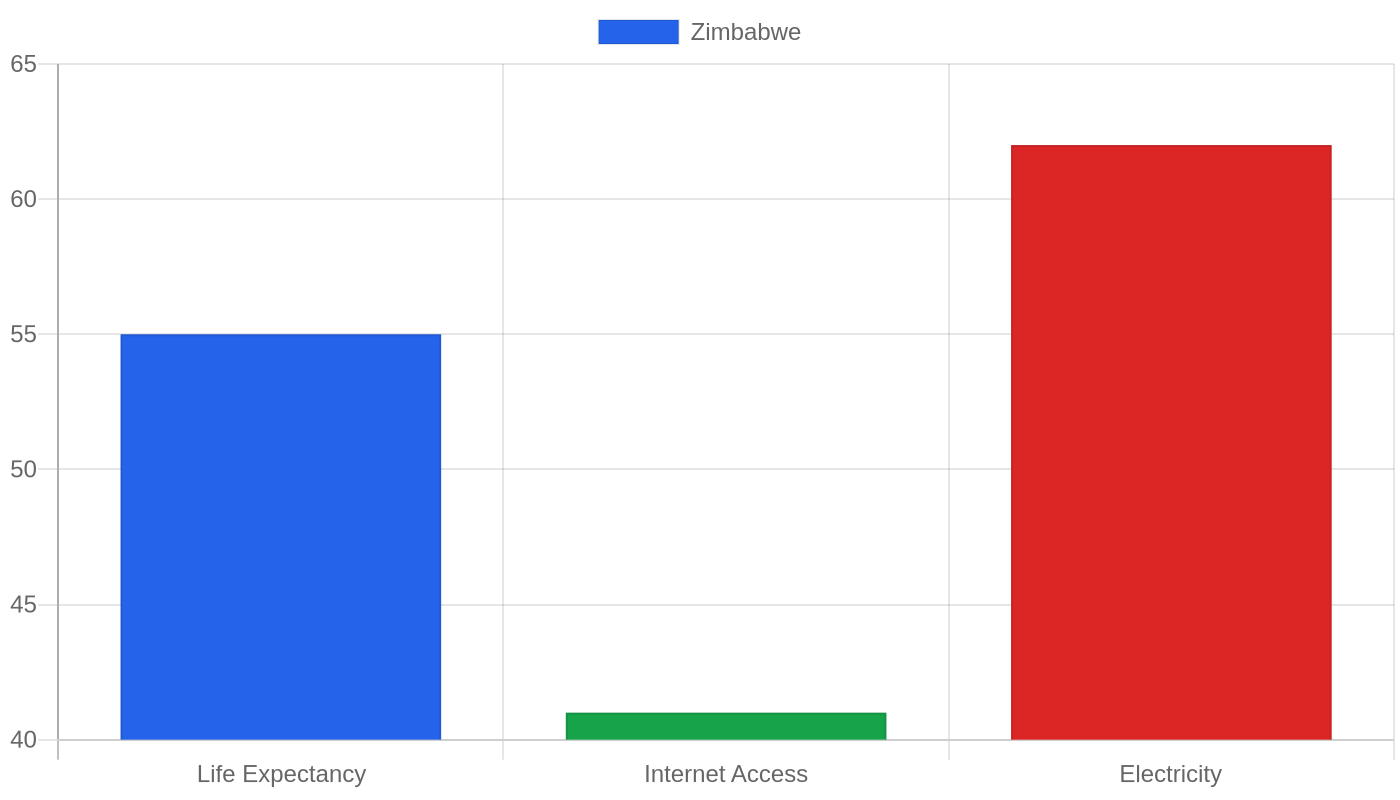
– Zimbabwe’s economy remains in a state of profound uncertainty, with the World Bank reporting no current data on GDP growth, inflation, or unemployment — a telling indicator of the statistical opacity that continues to cloud the nation’s economic picture.
– The financial sector shows surprising resilience, with major institutions like CBZ Holdings and CBZ Bank Limited maintaining a significant presence despite decades of economic turbulence.
– The country’s industrial base remains diversified but fragile, spanning basic materials (Bindura Nickel, ART Holdings), consumer goods (African Distillers, Cairns Holdings), and critical infrastructure (Beitbridge Bulawayo Railway).
– Zimbabwe’s political system has undergone significant constitutional evolution, transitioning from a semi-presidential to a presidential system following the 2013 referendum — a structural shift with profound implications for governance and economic policy.
– Despite persistent challenges, the presence of established financial institutions and industrial companies suggests underlying economic potential that remains largely untapped.
The Statistical Vacuum — What We Don’t Know About Zimbabwe’s Economy
The World Bank’s latest data on Zimbabwe presents an unusual challenge for economic analysts: a complete absence of figures across every major indicator. GDP growth, inflation, unemployment, GDP per capita, GNI per capita — all return no data. This statistical silence is itself a story, one that speaks volumes about the difficulties of economic measurement in a country that has experienced hyperinflation, currency instability, and prolonged economic contraction over the past two decades.
What we do know is that Zimbabwe’s economy is built on a foundation of significant natural resources and agricultural potential. The country’s main industries span both extraction and production, with companies like Bindura Nickel Corporation and ART Holdings representing the basic materials sector, while African Distillers and Cairns Holdings anchor consumer goods.
This industrial diversity suggests an economy that, at its core, possesses the building blocks for recovery — if the right conditions can be established.
The financial sector deserves particular attention. CBZ Holdings and CBZ Bank Limited stand as pillars of the banking system, alongside the Agricultural Development Bank of Zimbabwe. The very existence of these institutions, maintaining operations through years of economic turmoil, indicates a level of institutional persistence that foreign observers often underestimate.
Air Zimbabwe’s continued presence in the consumer services sector, despite well-documented operational challenges, similarly speaks to the resilience — or perhaps the inertia — of state-linked enterprises.
The Cost of Living Puzzle — Navigating an Unquantifiable Crisis
Without official data on housing costs, rental rates, or daily expenses, any analysis of Zimbabwe’s cost of living must proceed with caution. What can be said is that the country’s economic history — particularly the hyperinflationary episode that peaked in 2008-2009 — has fundamentally altered how Zimbabweans interact with money, prices, and savings.
The widespread adoption of foreign currencies for everyday transactions, while not officially documented in the provided data, has been a defining feature of the post-crisis economy.
The presence of major consumer goods companies like African Distillers and Cairns Holdings suggests that domestic production continues to meet some portion of local demand, though the scale and pricing of these goods remain unclear. For ordinary Zimbabweans, the cost of living crisis is not an abstract statistical question but a daily reality shaped by currency volatility, supply chain disruptions, and the persistent gap between formal employment opportunities and the informal economy that sustains many households.
Investment Landscape — Institutional Pillars in Shifting Sands
For investors considering Zimbabwe, the landscape presents a paradox. On one hand, the country offers established companies with regional reach and experience navigating difficult conditions. The Beitbridge Bulawayo Railway represents critical infrastructure, connecting Zimbabwe’s industrial heartland to regional trade routes. Border Timbers and ART Holdings offer exposure to natural resources and basic materials that could benefit from global commodity cycles.
On the other hand, the absence of reliable economic data makes fundamental analysis exceptionally difficult. The World Bank’s inability to report GDP figures, inflation rates, or employment statistics creates a due diligence vacuum that would give any prudent investor pause.
The financial sector’s survival — CBZ Holdings, CBZ Bank, and the Agricultural Development Bank — provides some institutional stability, but the broader investment climate remains constrained by factors that cannot be quantified from the available information.
Governance and Security — The Political Architecture of Recovery
Zimbabwe’s political system has undergone notable structural evolution. The country operates as a republic with a presidential system under a unitary framework, following the abolition of the semi-presidential arrangement through a 2013 constitutional referendum. This shift consolidated executive power and simplified the governance structure, though its economic implications remain a subject of ongoing assessment.
The reinstatement of the Senate in 2005 and the continued functioning of the House of Assembly as the lower chamber indicate a parliamentary structure that, at least formally, maintains the institutions of representative government. The political landscape remains a critical factor for economic recovery — investors and citizens alike understand that governance quality, rule of law, and policy predictability will ultimately determine whether Zimbabwe’s economic potential can be realized.
Current Affairs — The Battle for Economic Visibility
The most pressing issue in Zimbabwe today is not any single policy or reform, but rather the fundamental challenge of economic visibility. When the World Bank cannot report basic statistics, the country operates in a policy vacuum where decisions are made without reliable data. This affects everything from monetary policy to poverty alleviation programs, from infrastructure investment to social services.
The persistence of major financial institutions through this period of statistical darkness suggests that economic activity continues, but its scale, direction, and sustainability remain opaque. The presence of companies like Air Zimbabwe in the consumer services sector indicates that state-linked enterprises continue to operate, though their financial health and service quality cannot be assessed from available data.
For the international community, development partners, and potential investors, the immediate priority must be supporting Zimbabwe’s capacity to produce reliable economic statistics. Without this fundamental infrastructure of economic governance, all other reform efforts operate in the dark.
The Bottom Line
Zimbabwe remains one of Africa’s most complex economic stories — a nation of significant resources and institutional persistence operating without the statistical infrastructure necessary for modern economic management. The presence of established companies across multiple sectors suggests underlying potential, but the complete absence of World Bank data creates a risk profile that most investors cannot responsibly assume.
This is a country to watch for those with long time horizons, deep local knowledge, and a willingness to look beyond conventional due diligence frameworks. For everyone else, Zimbabwe represents a reminder that economic development requires not just resources and institutions, but also the basic capacity to measure progress.
Sources & Methodology
This article is authored by Economic Pulse Net for informational and research purposes. Economic Pulse Net sources its data from multilateral institutions, national statistics bureaus, and proprietary databases. All data is believed to be current as of the date of publication.
Published: August 05, 2026 | Category: Research — Zimbabwe
Use these signals in your own platform
Economic Pulse publishes its live signal feed through a documented, read-only API. Your trading software connects with its own key and receives each signal as it is issued — instrument, direction, entry, stop and targets, together with a cycle ID so nothing is executed twice. The feed is independent of this website and cannot change it.
Signals are informational only and are not financial advice.