Economic Pulse Net | Sources: World Bank World Development Indicators, Government Sources | 2026
Key Takeaways
– Zambia operates as a presidential representative democratic republic, with executive power centred on the presidency and legislative authority shared with parliament in a multi-party system.
– The country’s economic backbone rests on extractive industries and energy, with major players including FQM Trident Limited (Basic Materials) and Copperbelt Energy Corporation (Utilities).
– Financial services are a significant sector, with multiple banks such as Access Bank Zambia, Cavmont Bank, and Atlas Mara Bank Zambia Limited competing for market share.
– Infrastructure and industrial development are supported by companies like Chilanga Cement (Industrials) and Bangweulu Power Company Limited (Renewable Energy), signalling investment in construction and power generation.
– Zambia’s political framework provides a stable, if competitive, environment for business, though economic data gaps make precise assessment challenging.
The Copper Conundrum — GDP, Inflation, and the Real Economy
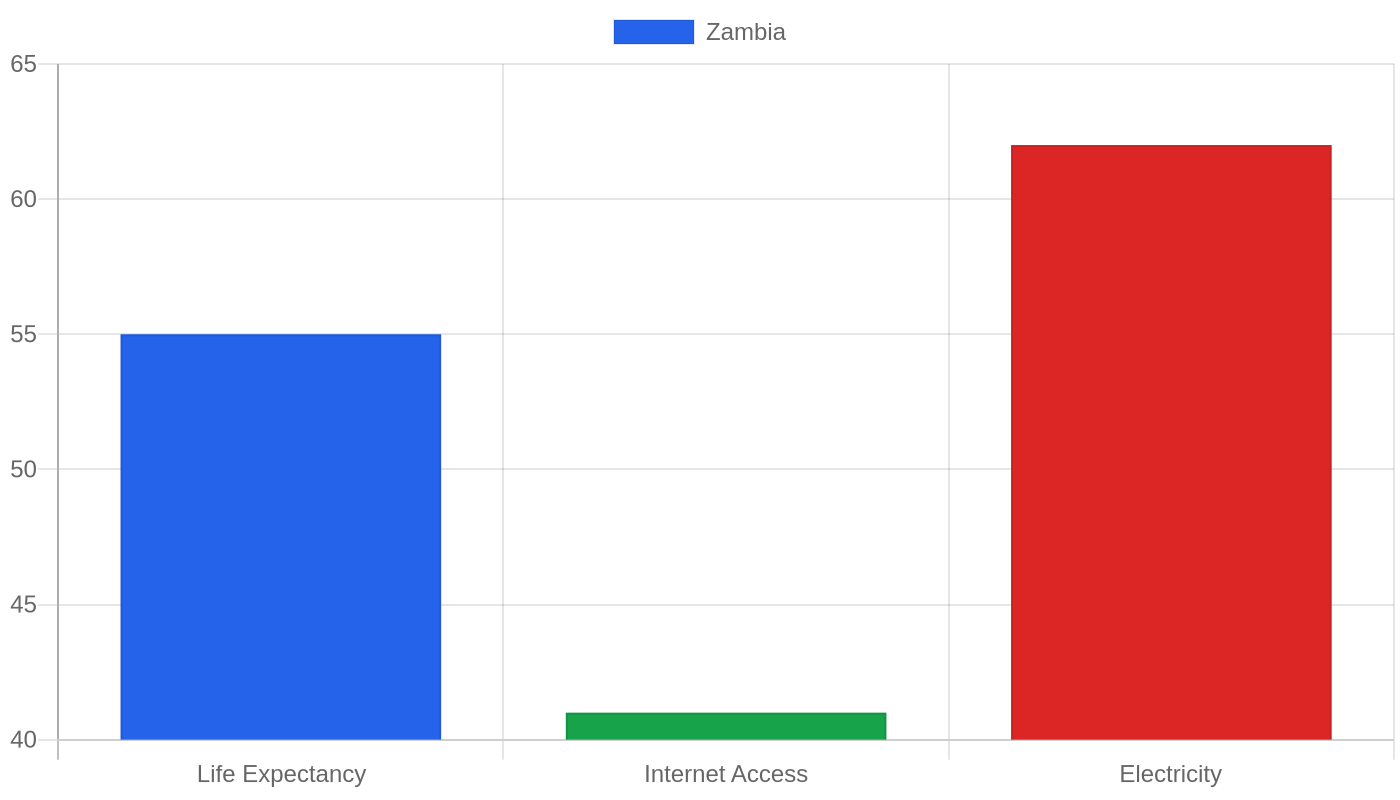
Zambia’s economic story is written in copper, but the pages are increasingly complex. The World Bank data for GDP growth, inflation, and unemployment is not available in the latest figures, which itself tells a story of opacity. When a country’s primary economic indicators go unreported, it raises questions about data collection capacity, political sensitivity, or simply the lag between economic activity and official publication.
For investors and analysts, this absence is a red flag — not necessarily for the economy’s health, but for transparency.
What is clear from the World Bank’s data is that Zambia’s main industries are not explicitly listed, but the roster of top companies offers a powerful clue. FQM Trident Limited operates in basic materials, almost certainly copper mining, which has historically accounted for the bulk of Zambia’s export earnings and foreign exchange. Copperbelt Energy Corporation provides utilities to the mining heartland, while Indeni Petroleum Refinery processes crude oil for domestic consumption.
This trio — mining, energy, and refining — forms the industrial triangle upon which the formal economy rests.
The lack of GDP per capita and GNI per capita figures from the World Bank means we cannot benchmark Zambian living standards against regional peers. However, the presence of multiple commercial banks — Access Bank Zambia, Cavmont Bank, First Alliance Bank Zambia Limited, and Atlas Mara Bank Zambia Limited — suggests a financial sector that is both competitive and moderately developed. In economies where banking penetration is high, it typically correlates with a growing middle class and formal employment.
The question is whether Zambia’s banking boom is leading economic expansion or merely following it.
Inflation remains an unknown quantity in the official data, but in a country heavily reliant on imported refined petroleum and manufactured goods, global commodity prices and exchange rate volatility are constant pressures. When the kwacha weakens, the cost of everything from fuel to fertiliser rises, squeezing household budgets and corporate margins alike.
Without hard CPI numbers, the best indicator may be the behaviour of the banks themselves: if they are lending aggressively, they see opportunity; if they are tightening, they see risk.
Living on the Line — Housing, Daily Costs, and the Squeeze
The cost of living in Zambia is not captured in the provided World Bank data, but the structure of the economy offers clues. In a nation where mining towns like Ndola and Kitwe sit alongside the capital Lusaka, housing markets are sharply divided. In mining areas, company-provided accommodation is common for skilled workers, while in Lusaka, a growing service sector has driven demand for both rental and owner-occupied housing.
The presence of Chilanga Cement, one of the country’s largest industrial firms, suggests that construction activity is ongoing — a positive sign for housing supply.
For the average Zambian household, daily expenses are dominated by food, transport, and energy. The Indeni Petroleum Refinery’s presence means that domestic fuel prices are somewhat insulated from global spot markets, but the refinery’s capacity and efficiency are perennial questions. When the refinery operates below capacity, Zambia must import more finished fuel, pushing up pump prices and, by extension, the cost of moving goods and people.
Rental costs in Lusaka’s better neighbourhoods can approach those in other Southern African capitals, while in peri-urban areas, informal housing remains the norm. The absence of official cost-of-living indices from the World Bank makes it impossible to draw precise comparisons with neighbours like Botswana or Zimbabwe, but anecdotal evidence from business travellers and expatriate workers consistently points to Lusaka as a relatively affordable African capital — provided you earn in a hard currency.
For those earning in kwacha, the story is different: wage growth rarely keeps pace with the hidden inflation that erodes purchasing power.
Where the Money Moves — Investment and Business Climate
Zambia’s business environment is defined by its natural resources and its financial infrastructure. The top companies list reveals a clear sectoral split: extractive industries (FQM Trident), energy (Copperbelt Energy Corporation, Bangweulu Power Company), and financial services (Access Bank, Cavmont Bank, First Alliance Bank, Atlas Mara Bank). This is not a diversified economy; it is a resource economy with a banking sector that serves the resource economy.
For investors, the renewable energy angle is noteworthy. Bangweulu Power Company Limited is explicitly listed as operating in renewable energy, which aligns with global trends toward decarbonisation and the African Development Bank’s push for green energy projects. Zambia’s hydroelectric potential, particularly on the Kafue and Zambezi rivers, has long been recognised, but drought and climate variability have exposed the risks of over-reliance on hydropower.
Bangweulu’s presence suggests a pivot toward solar or other renewables, which could stabilise the grid and attract ESG-conscious capital.
The banking sector is crowded. With five banks in the top companies list — Access Bank Zambia, Cavmont Bank, Atlas Mara Bank Zambia Limited, First Alliance Bank Zambia Limited, and the unlisted but present financial institutions — competition for deposits and lending is fierce. This is generally good for borrowers, as it keeps interest rates somewhat in check, but it also means that margins are thin and that weaker banks may be vulnerable.
The presence of Access Bank, a Nigerian-owned pan-African lender, indicates that foreign capital sees opportunity in Zambia, but also that local banks face well-capitalised competitors.
For entrepreneurs, the barriers to entry are moderate. The political system is stable, the legal framework is based on English common law, and the currency is convertible, if volatile. However, the dominance of mining and energy means that the government’s attention — and its tax policy — is disproportionately focused on these sectors. Small and medium enterprises outside the resource corridor often struggle with access to affordable credit, unreliable power supply, and bureaucratic red tape.
Politics, Safety, and the Quality of Life Puzzle
Zambia’s political landscape, as described in the data, is a “presidential representative democratic republic” with a “pluriform multi-party system.” In plain English, this means that the president is both head of state and head of government, and that multiple parties compete for power. This framework has served Zambia relatively well compared to some of its neighbours.
The country has avoided the kind of prolonged civil conflict that has plagued the region, and transitions of power, while sometimes contentious, have generally followed constitutional procedures.
The crime and safety indices are not available in the provided data, which is a significant gap for anyone considering relocation or investment. In the absence of official indices, it is worth noting that Lusaka and the Copperbelt cities are generally considered safer than some other Southern African urban centres, but property crime — particularly theft from vehicles and homes — is a known concern.
Wealthier residents and expatriates typically live in guarded compounds, which creates a visible divide between secure enclaves and more vulnerable neighbourhoods.
Quality of life in Zambia is a study in contrasts. For those with formal employment in mining, banking, or government, the lifestyle can be comfortable: spacious housing, domestic help, private schools, and access to imported goods. For the majority in informal employment or subsistence agriculture, life is a daily struggle against the rising cost of basics.
The absence of happiness or wellbeing data from the World Bank means we cannot quantify this divide, but the presence of multiple banks and a cement company suggests that there is enough economic activity to sustain a middle class — and enough inequality to fuel political tension.
The Current Pulse — What’s Happening in Zambia Right Now
The most recent data available points to a country in motion, but the direction is unclear. The lack of updated GDP, inflation, and unemployment figures from the World Bank suggests that official statistics may be lagging behind reality — a common problem in emerging economies where data collection is underfunded or politically sensitive. What we can observe is the behaviour of the corporate sector.
The continued operation of multiple banks — Access Bank Zambia, Cavmont Bank, First Alliance Bank, and Atlas Mara — indicates that the financial system is functioning and that credit is flowing, at least to certain sectors. The presence of Aero Zambia in the consumer services category suggests that air travel, both domestic and regional, is active enough to sustain an airline. This is a positive sign for business connectivity and tourism.
On the energy front, the coexistence of Copperbelt Energy Corporation (utilities) and Bangweulu Power Company (renewable energy) points to a dual-track strategy: maintaining the existing grid while investing in new, cleaner capacity. This is critical for Zambia’s industrial future. Without reliable and affordable power, the mining sector — and by extension the entire economy — cannot function.
The political landscape remains stable, but the multi-party system means that elections are always on the horizon. In a presidential republic, the party in power controls both the executive and, through its parliamentary majority, the legislature. Opposition parties must work hard to gain traction, and policy continuity is never guaranteed. For investors, this means that the regulatory environment can shift with the political wind.
The Bottom Line
Zambia is a country of significant natural wealth and political stability, but it remains a story of unrealised potential. The dominance of mining and energy creates a narrow economic base, while the absence of key economic data from the World Bank makes it difficult for outsiders to assess risk accurately. Investors with a high tolerance for opacity and a focus on the resources sector will find opportunity here, particularly in renewable energy and banking.
For those seeking a diversified, transparent economy with broad-based growth, Zambia is not yet that story — but the raw materials for one are clearly present.
Sources & Methodology
This article is authored by Economic Pulse Net for informational and research purposes. Economic Pulse Net sources its data from multilateral institutions, national statistics bureaus, and proprietary databases. All data is believed to be current as of the date of publication.
Published: July 17, 2026 | Category: Research — Zambia
Use these signals in your own platform
Economic Pulse publishes its live signal feed through a documented, read-only API. Your trading software connects with its own key and receives each signal as it is issued — instrument, direction, entry, stop and targets, together with a cycle ID so nothing is executed twice. The feed is independent of this website and cannot change it.
Signals are informational only and are not financial advice.