Economic Pulse Net | Sources: World Bank World Development Indicators, Government Sources | 2026
Zambia sits at a crossroads. The landlocked southern African nation is blessed with vast mineral wealth, a young population, and a political system that has seen peaceful transfers of power. Yet its economy remains heavily exposed to the global commodity cycle, and its infrastructure and financial sectors are evolving to meet the demands of a new era. As the world pivots toward renewable energy and electric vehicles, Zambia’s copper deposits have never been more strategically important.
This feature examines the country’s economic foundations, its cost of living, the business landscape, and the political framework that holds it all together.
Key Takeaways
– Copper is king: Zambia’s economy is anchored by its mining sector, with major players like FQM Trident Limited (Basic Materials) leading the charge. Global demand for copper, driven by the energy transition, positions Zambia as a critical supplier.
– Energy transition is underway: The presence of Bangweulu Power Company Limited (Renewable Energy) and Copperbelt Energy Corporation (Utilities) signals a push toward diversifying power generation and securing supply for industrial use.
– Financial sector is modernizing: A wave of commercial banks, including Access Bank Zambia, Cavmont Bank, and Atlas Mara Bank Zambia Limited, indicates a competitive and evolving banking landscape.
– Political stability is a foundation: Zambia operates as a presidential representative democratic republic, with executive power exercised by the government and legislative power shared with parliament. This framework provides a predictable environment for policy-making.
– Industrial diversification is a work in progress: While mining dominates, the presence of Chilanga Cement (Industrials) and Indeni Petroleum Refinery (Energy) shows efforts to build out domestic manufacturing and energy capacity.
The Copper Engine and the Quest for Growth
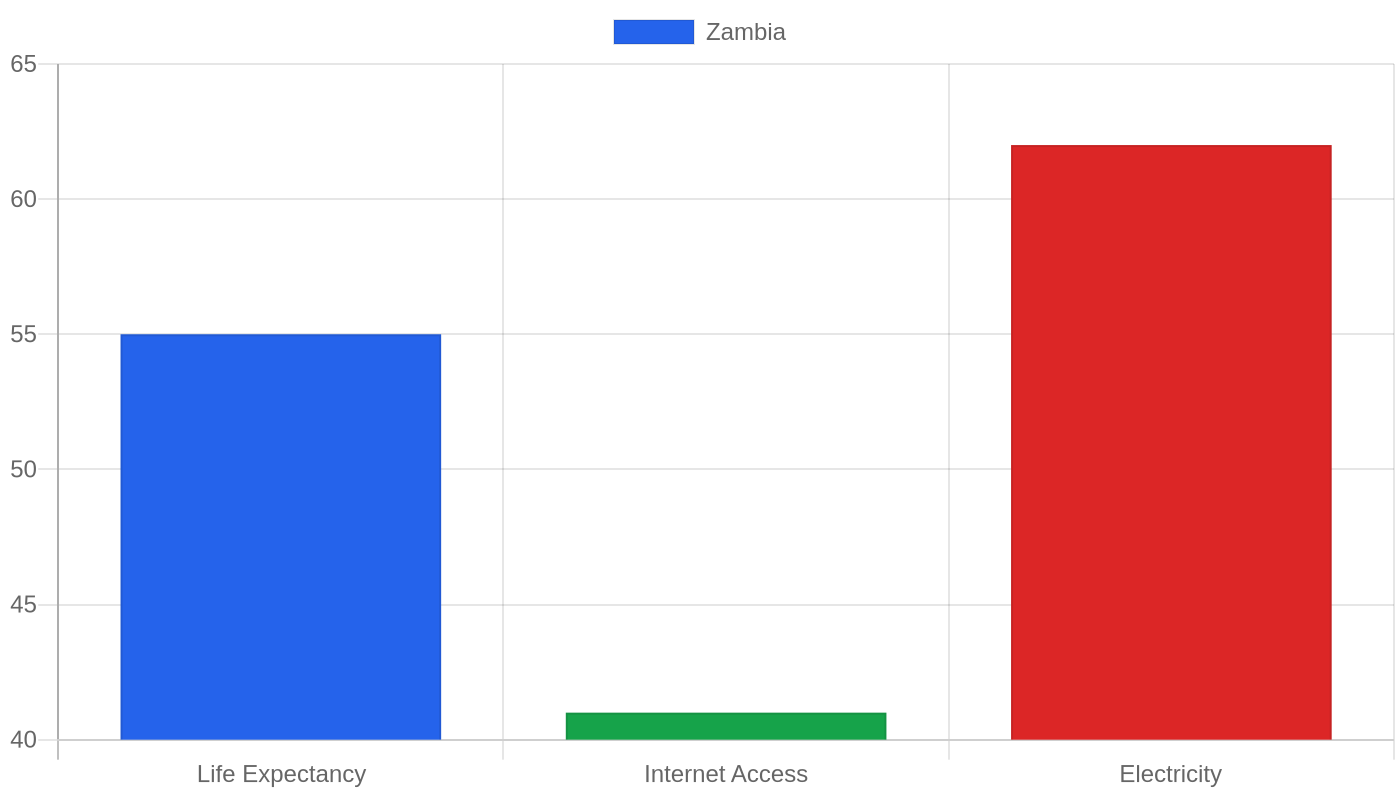
According to the World Bank, headline figures for Zambia’s GDP growth, inflation, and unemployment are not currently available, making it difficult to paint a precise statistical picture. However, the structural composition of the economy tells a compelling story. Zambia is historically one of Africa’s largest copper producers, and the metal remains the lifeblood of its export earnings. The presence of FQM Trident Limited in the Basic Materials sector underscores the scale of mining operations.
When global copper prices rise, Zambia’s fiscal revenues swell; when they fall, the national budget tightens. This dependency is the core challenge for policymakers seeking to stabilize the economy.
Inflation, while unquantified in the latest World Bank data, is a perennial concern for Zambian households. The kwacha’s performance is closely tied to copper prices and agricultural output. The mining sector’s demand for electricity also creates a unique dynamic: the Copperbelt Energy Corporation (Utilities) is central to ensuring that mines have reliable power, but this can strain the national grid, affecting residential consumers.
The World Bank’s lack of updated numbers does not diminish the reality that Zambia’s growth trajectory is intrinsically linked to commodity markets and the health of its energy infrastructure. The country is not just digging for minerals; it is attempting to build a more resilient economic base.
Employment in Zambia is largely informal, with agriculture and small-scale trade absorbing the majority of the workforce. The formal sector, dominated by mining, banking, and construction, offers higher wages but limited job creation relative to the population. The government’s ability to generate employment hinges on attracting investment beyond the mining enclave.
Until the data is refreshed, the qualitative picture remains clear: Zambia is a nation in transition, working to transform its resource wealth into broad-based prosperity.
The Cost of Living — Urban Pressures and Rural Realities
Without specific cost-of-living indices from the World Bank, a precise comparison to regional averages is not possible. However, the composition of Zambia’s top companies offers clues about daily life. The prominence of financial institutions like Access Bank Zambia and First Alliance Bank Zambia Limited suggests a growing urban middle class with access to credit and banking services.
In cities like Lusaka and Kitwe, housing costs are a significant burden, with demand for quality accommodation outstripping supply. Rent for a modest apartment in the capital consumes a large share of a middle-income salary.
For everyday goods, Zambia is heavily reliant on imports for manufactured products, which drives up prices due to transport costs and logistics challenges. Food prices are volatile, dependent on rainfall and agricultural yields. The presence of Indeni Petroleum Refinery (Energy) is critical, as fuel prices directly influence the cost of transportation and, consequently, the price of goods in the market.
While the data does not provide specific figures, the structural reality is that Zambian households face a high cost of living relative to average incomes, particularly in urban centers. The gap between the formal and informal economies is stark, and economic shocks are felt most acutely by the urban poor.
Investment and Business — A Landscape of Opportunity and Challenge
Zambia’s business environment is characterized by a mix of established conglomerates and emerging players. The financial sector is notably vibrant, with multiple banks vying for market share. The presence of Cavmont Bank and Atlas Mara Bank Zambia Limited, alongside Access Bank Zambia, indicates a competitive market that is attractive to regional and international investors.
This is a positive signal for the business climate, as a well-functioning banking sector is essential for entrepreneurship and capital allocation.
The energy sector is another focal point for investment. Bangweulu Power Company Limited (Renewable Energy) represents a forward-looking bet on solar and other clean sources. This is a strategic move for Zambia, as it seeks to diversify its energy mix away from hydroelectric power, which is vulnerable to drought. Copperbelt Energy Corporation remains a key player in the industrial power market, ensuring that mining operations run smoothly.
For investors, the opportunities lie in value-added processing — moving from exporting raw copper to producing refined metals and manufactured goods. The World Bank’s data does not provide a specific ease-of-doing-business ranking, but the presence of international banks and power companies suggests a market that is open to foreign participation, albeit with bureaucratic hurdles that remain a challenge.
Safety, Politics, and the Quality of Life
Crime and safety indices for Zambia are not available in the World Bank data, but the political landscape is well-defined. Zambia is a presidential representative democratic republic, with the president serving as both head of state and head of government within a multi-party system. This political framework has historically provided a degree of stability that is not universal in the region. The government exercises executive power, while legislative power is vested in both the government and parliament.
This separation of powers is a healthy sign for democratic governance and the rule of law.
Quality of life in Zambia is a tale of two worlds. For those employed in the formal sector, particularly in banking and mining, the standard of living is comfortable. For the majority, however, access to quality healthcare, education, and reliable public services remains limited. The political stability is a crucial asset, as it allows for long-term planning and international investment. The peaceful transfer of power in past elections has bolstered Zambia’s reputation as a stable democracy.
While social challenges are significant, the political foundation provides a platform for gradual improvement.
What’s Happening Now — Zambia’s Energy Transition and Financial Evolution
The current moment in Zambia is defined by a dual transformation. On one hand, the energy sector is undergoing a significant shift. The presence of Bangweulu Power Company Limited (Renewable Energy) is not just a corporate entity; it is a symbol of Zambia’s efforts to attract private investment into clean power generation. This is happening against a backdrop of climate change, which has made the country’s traditional reliance on hydroelectric power increasingly risky.
Droughts have periodically reduced water levels in the Kariba Dam, threatening both residential power supply and the mining sector’s operations. The push for solar and other renewables is therefore not just an environmental choice; it is an economic necessity.
On the other hand, the financial sector is consolidating and modernizing. The presence of multiple banks, including Access Bank Zambia and Cavmont Bank, suggests a wave of mergers, acquisitions, and digital innovation. This is a positive development for businesses seeking capital and for individuals looking for financial services. The government’s focus is likely on stabilizing the currency and managing debt, though specific policy shifts are not detailed in the current data.
What is clear is that Zambia is not standing still. The corporate landscape is evolving, with a mix of established players like Chilanga Cement (Industrials) and Indeni Petroleum Refinery (Energy) working alongside newer entrants in the renewable energy space. The country is actively positioning itself for a future where copper and clean energy go hand in hand.
The Bottom Line
Zambia is a country to watch for investors and analysts interested in the intersection of natural resources and the global energy transition. Its political stability provides a solid foundation, while its corporate sector shows signs of dynamism, particularly in banking and renewable energy. The challenges are real — economic diversification, infrastructure gaps, and the high cost of living — but the opportunities are equally significant.
For those looking at Africa’s future, Zambia offers a case study in how a resource-rich nation can attempt to navigate the complexities of the 21st century. It is not a story of boom or bust, but of gradual, determined evolution.
Sources & Methodology
This article is authored by Economic Pulse Net for informational and research purposes. Economic Pulse Net sources its data from multilateral institutions, national statistics bureaus, and proprietary databases. All data is believed to be current as of the date of publication.
Published: August 23, 2026 | Category: Research — Zambia
Use these signals in your own platform
Economic Pulse publishes its live signal feed through a documented, read-only API. Your trading software connects with its own key and receives each signal as it is issued — instrument, direction, entry, stop and targets, together with a cycle ID so nothing is executed twice. The feed is independent of this website and cannot change it.
Signals are informational only and are not financial advice.