Economic Pulse Net | Sources: World Bank World Development Indicators, Government Sources | 2026
Key Takeaways
– Uganda’s economy is undergoing a structural transition, with financial services emerging as the dominant private sector force, as evidenced by the concentration of major companies in banking and telecoms
– The political system remains highly centralized under a president who serves as both head of state and head of government, creating a business environment shaped by executive authority
– Cost of living pressures are mounting across East Africa, and Uganda’s position as a landlocked economy adds structural costs that affect everything from consumer prices to business logistics
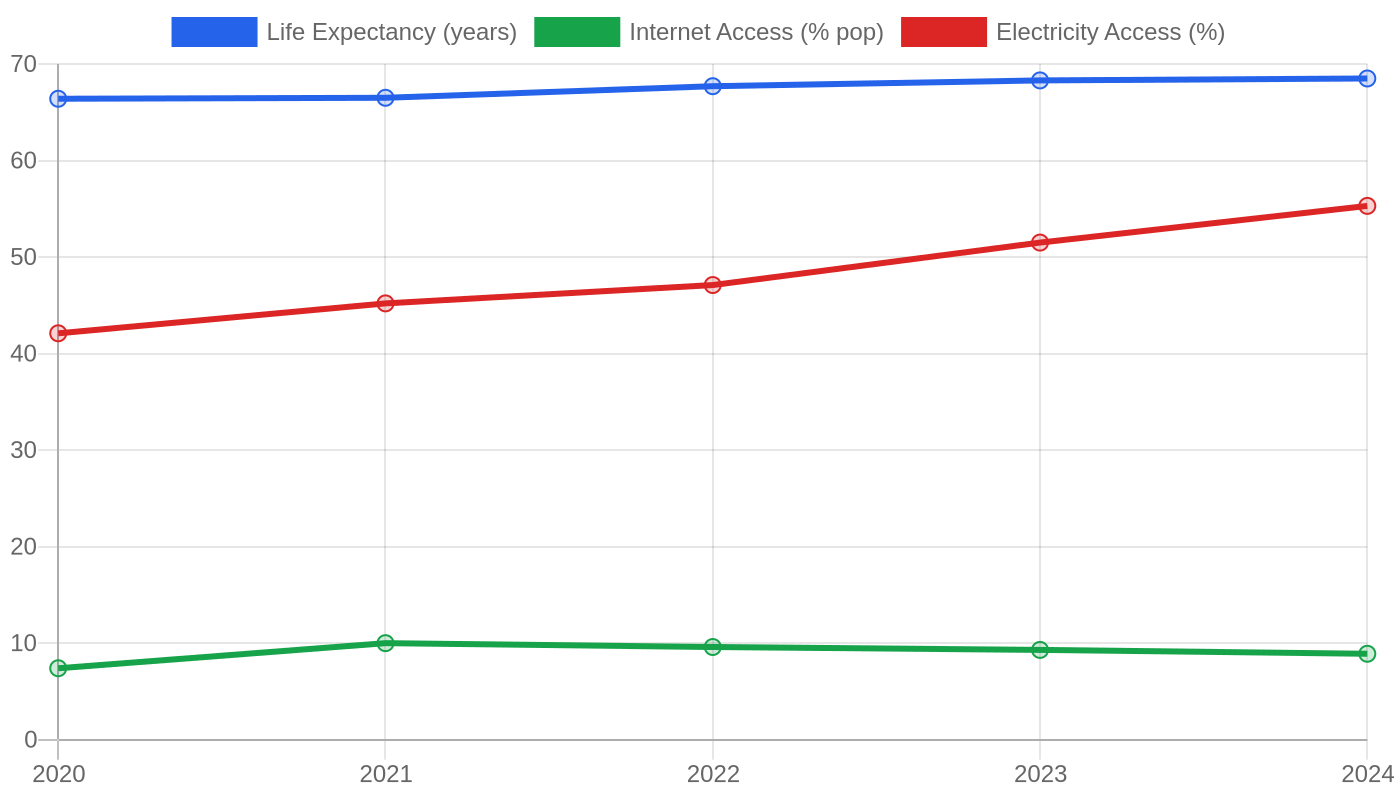
– The absence of recent World Bank macroeconomic data points to potential reporting gaps or delayed statistical releases, making independent verification of economic performance challenging
– With no major extractive industries listed among top companies, Uganda’s economic story is increasingly one of services, finance, and domestic consumption rather than resource extraction
The Numbers Gap — What the Data Silence Tells Us
The World Bank’s latest economic indicators for Uganda present an unusual puzzle. GDP growth, inflation, unemployment, GDP in dollar terms, GDP per capita on a purchasing power parity basis, GNI per capita, and even total population are all listed as “N/A” in the most recent dataset. This statistical vacuum is itself a story worth examining.
For a country that has historically been one of East Africa’s more consistent growth stories — averaging around 5-6% expansion in pre-pandemic years according to previous World Bank reports — the absence of fresh data raises questions about institutional reporting capacity, potential methodological revisions, or simply the lag between data collection and publication.
What we do know, from the broader regional context, is that Uganda’s economy has long been characterized by a large informal sector, significant remittance inflows, and a heavy reliance on agricultural exports including coffee, tea, and fish.
The lack of inflation data is particularly noteworthy. Across East Africa, consumer price pressures have been a dominant economic narrative, driven by supply chain disruptions, currency depreciation against the dollar, and rising energy costs. Without official CPI figures, analysts and investors are left to triangulate using anecdotal evidence, regional trends, and the pricing behavior of the financial institutions that dominate Uganda’s corporate landscape.
Employment data is similarly absent. In an economy where the majority of workers operate outside formal wage employment — in smallholder agriculture, street vending, motorcycle taxi services, and casual labor — official unemployment statistics have always been imperfect. But the complete gap in the latest World Bank release means we cannot even make the usual caveats about informal sector absorption.
The Banking Bazaar — Uganda’s Financial Sector Dominance
A glance at the list of Uganda’s top companies reveals something striking: of the ten largest firms in the country, eight are banks. ABC Bank (Uganda), Bank of Africa Uganda Limited, Bank of Baroda Uganda Limited, Bank of India (Uganda), Bank of Uganda (the central bank), Barclays Bank of Uganda, BRAC Uganda Bank Limited, and Cairo International Bank form a veritable wall of financial institutions.
The remaining two — Africell in telecommunications and Aya Group in conglomerates — are the only non-banking entities to break the top ten.
This concentration tells us several things about Uganda’s economic structure. First, the financial sector is deep and competitive by regional standards, with a mix of domestic, pan-African, Indian, and Middle Eastern players all vying for market share. Second, the dominance of banks suggests that capital intermediation — the business of taking deposits and making loans — remains the most lucrative and formalized sector of the economy.
Third, the presence of so many international banking groups indicates that Uganda is seen as a viable market for financial services, with relatively stable regulatory oversight compared to some neighbors.
The telecommunications sector, represented by Africell, points to Uganda’s growing digital economy. Mobile money services, which have revolutionized financial inclusion across East Africa, are a critical bridge between the formal banking sector and the unbanked population. The interplay between traditional banks and mobile network operators in providing payment services is one of the most dynamic areas of the Ugandan economy.
Aya Group’s presence as a conglomerate suggests that diversified business groups — those with interests in real estate, hospitality, manufacturing, or agriculture — can achieve significant scale. But the fact that only one conglomerate makes the top ten list also indicates that Uganda’s private sector remains relatively fragmented, with few homegrown multinationals of the kind seen in Kenya or South Africa.
The Cost of Living Conundrum — Landlocked and Pricey
Housing costs in Uganda, particularly in the capital Kampala, reflect the classic East African urban dilemma: a rapidly growing population chasing a limited supply of formal housing. The city’s geography — built on seven hills with constrained road infrastructure — pushes up land values in accessible areas.
Rent for a modest two-bedroom apartment in a reasonable Kampala neighborhood can consume a significant portion of formal sector salaries, while informal settlements on the city’s periphery house the majority of the urban population.
The cost of building materials in Uganda is structurally higher than in coastal economies due to transport costs. Cement, steel, and roofing materials must travel long distances from ports in Kenya or Tanzania, with fuel costs and road tolls adding to the final price. This makes homeownership a distant goal for many middle-income Ugandans, who instead rent indefinitely or build incrementally over years, room by room, as savings allow.
Daily expenses for food staples — matooke (green bananas), maize flour, beans, and cooking oil — have been subject to the same regional inflationary pressures seen across East Africa. Uganda’s agricultural sector, while productive, faces challenges from erratic weather patterns, post-harvest losses due to inadequate storage infrastructure, and the high cost of inputs like fertilizer.
The result is that even basic nutrition consumes a large share of household budgets, particularly for the urban poor who cannot grow their own food.
Transportation costs in Kampala are another major expense. The city’s notorious traffic congestion — ranked among the worst in Africa — means that workers spend hours commuting, often on overcrowded minibus taxis (matatus) or boda boda motorcycles. Fuel price volatility, driven by global oil markets and local taxation, directly impacts household mobility and the cost of goods transported to markets.
Investment Climate — Banking on Stability, Betting on Growth
For an investor looking at Uganda, the landscape is defined by a tension between opportunity and risk. On the opportunity side, the financial sector offers a mature, regulated environment with clear entry points. The presence of multiple international banks suggests that foreign investors can operate without the kind of extreme regulatory unpredictability seen in some other African markets.
The telecommunications sector, dominated by Africell alongside competitors like MTN Uganda and Airtel, is competitive and technologically advanced, with mobile money platforms that have achieved remarkable penetration rates.
Sectors to watch beyond banking and telecoms include agriculture processing, where Uganda has significant comparative advantage in coffee, tea, dairy, and horticulture. The country’s fertile soils and favorable climate could support a much larger agro-processing industry, but this requires investment in cold chain logistics, packaging, and international market access.
Renewable energy is another potential growth area, with Uganda’s hydroelectric capacity on the Nile providing relatively cheap and reliable power compared to neighbors reliant on diesel generation.
The business environment, however, is shaped by the political reality of a highly centralized system. The president, who serves as both head of state and head of government, appoints a vice-president and a prime minister to assist in governing, but ultimate authority rests with the executive. This concentration of power can be a double-edged sword: it enables decisive policy action but also creates uncertainty around succession, institutional independence, and the rule of law.
Corruption remains a concern for many investors, particularly in procurement, land registration, and customs clearance.
Safety, Politics, and the Quality of Life Calculus
Crime and safety indices for Uganda are listed as unavailable in the current data, which is itself a telling gap. In the absence of systematic international crime statistics, anecdotal evidence suggests that Kampala experiences a moderate level of street crime, including pickpocketing, bag snatching, and occasional armed robbery, particularly after dark. Wealthier residents and expatriates often live in gated compounds with private security, a visible sign of the inequality that characterizes the city.
Politically, Uganda has been stable under the same leadership for decades, but that stability comes with a cost. The concentration of executive power, limited space for opposition activity, and periodic crackdowns on dissent create an environment where political risk is real but rarely explosive. For businesses, the predictability of the regime — its policies, its patronage networks, and its security apparatus — is a known quantity, even if it is not a democratic one.
Quality of life for the average Ugandan is shaped by the fundamentals: access to healthcare, education, clean water, and reliable electricity. Uganda has made progress in expanding primary education and basic healthcare coverage, but the quality of public services remains uneven. Those who can afford it opt for private schools, private clinics, and backup generators or solar systems to cope with power fluctuations.
The social fabric, however, remains strong, with family networks, religious institutions, and community associations providing support systems that formal state services cannot replicate.
What’s Happening Now — Navigating the Data Vacuum
The most pressing question for anyone following Uganda’s economy right now is: what is actually happening? With the World Bank’s latest data showing blanks across all major indicators, the country is operating in something of an economic information vacuum. This is not uncommon for developing economies where statistical agencies face capacity constraints, but it creates real challenges for policymakers, investors, and international partners who need timely data to make decisions.
In the absence of official numbers, market participants are likely relying on high-frequency indicators: central bank statements, commercial bank lending rates, mobile money transaction volumes, fuel import data, and coffee auction prices.
The Bank of Uganda, as the central bank, remains the most authoritative source of real-time economic intelligence, and its monetary policy committee decisions — though not detailed in the data provided — would be closely watched for signals about inflation management and interest rate direction.
The political landscape, with its highly centralized executive structure, means that policy direction is determined at the presidential level. Any shifts in economic strategy — whether related to infrastructure spending, agricultural policy, or foreign investment incentives — would flow from the presidency through the appointed prime minister and vice-president. For businesses operating in Uganda, maintaining relationships with the executive branch is not optional; it is a core operational requirement.
The dominance of banks among top companies suggests that credit conditions are a key variable to watch. If lending is expanding, it signals business confidence and consumption growth. If banks are tightening, it indicates caution. Without aggregate data, one would need to look at individual bank reports, branch expansion plans, and loan portfolio quality metrics to gauge the direction of the economy.
The Bottom Line
Uganda is a country that rewards patient, well-connected investors who understand the interplay between a dominant executive branch and a sophisticated financial services sector. The data gaps from the World Bank are concerning but not paralyzing — they simply mean that investors must do their own primary research rather than relying on off-the-shelf statistics.
For those willing to navigate the information asymmetry, Uganda offers a stable political environment, a competitive banking sector, and significant agricultural potential. The country is not for the faint of heart or the short-term speculator, but for the serious long-term player in East African markets, it remains a compelling if opaque proposition.
Sources & Methodology
This article is authored by Economic Pulse Net for informational and research purposes. Economic Pulse Net sources its data from multilateral institutions, national statistics bureaus, and proprietary databases. All data is believed to be current as of the date of publication.
Published: July 28, 2026 | Category: Research — Uganda
Use these signals in your own platform
Economic Pulse publishes its live signal feed through a documented, read-only API. Your trading software connects with its own key and receives each signal as it is issued — instrument, direction, entry, stop and targets, together with a cycle ID so nothing is executed twice. The feed is independent of this website and cannot change it.
Signals are informational only and are not financial advice.