Economic Pulse Net | Sources: World Bank World Development Indicators, Government Sources | 2026
Key Takeaways
– Tunisia remains the only democracy to emerge from the Arab Spring, but democratic backsliding since 2021 has raised serious concerns about its political trajectory.
– The economy is dominated by a financial sector that accounts for the vast majority of the country’s top publicly traded companies, suggesting limited diversification beyond banking.
– Despite constitutional guarantees for women’s rights, the political landscape has shifted dramatically, with the president consolidating power and the 2014 constitution under strain.
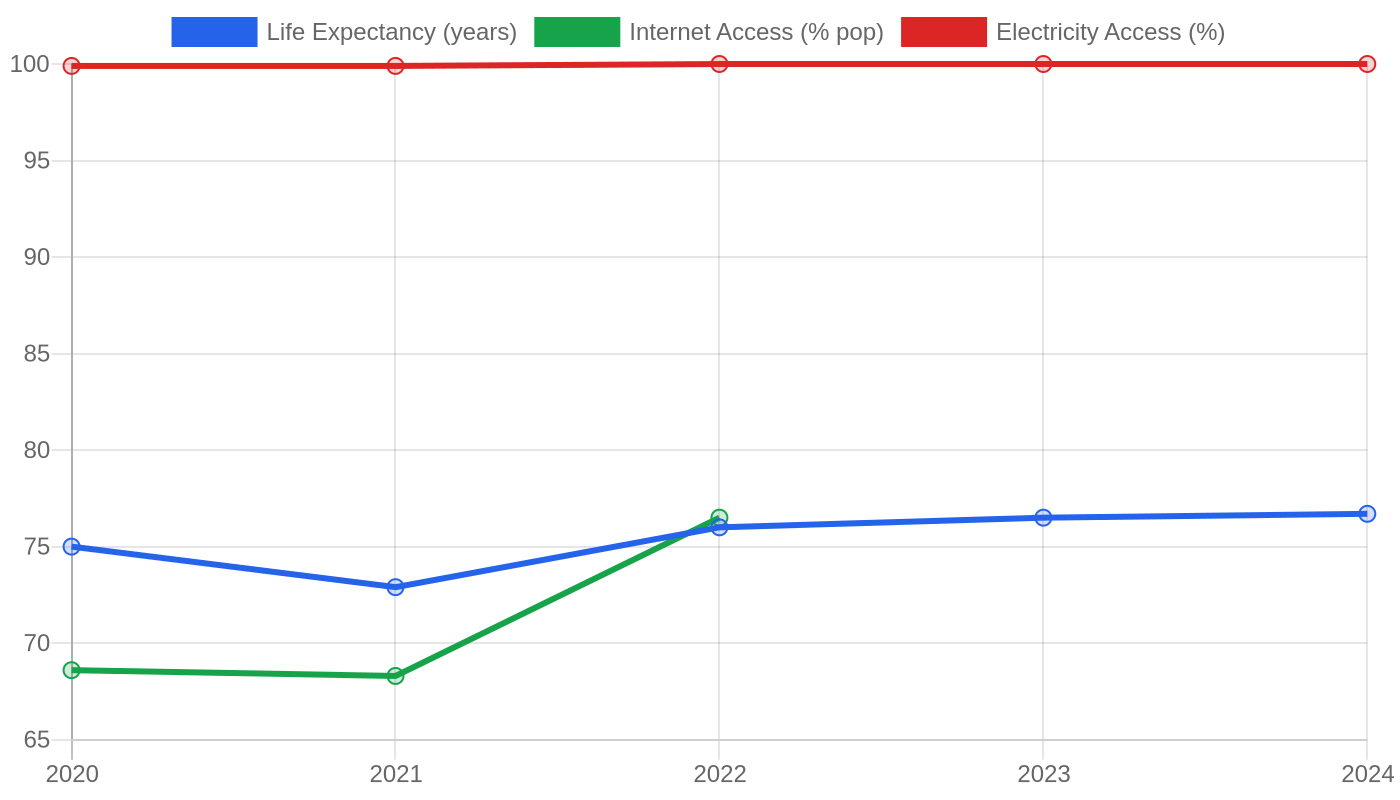
– The absence of recent World Bank economic data makes it difficult to assess current GDP growth, inflation, and unemployment trends, underscoring transparency challenges.
– Investors and analysts should monitor Tunisia closely as a bellwether for democratic resilience in the Middle East and North Africa region.
The Economy: A Banking Behemoth With Few Other Engines
When one examines the roster of Tunisia’s largest publicly traded companies, a striking pattern emerges. Of the top corporations listed on the Bourse de Tunis, nearly all are financial institutions. Amen Bank, Arab Tunisian Bank, Banque de l’Habitat, Banque de Tunisie et des Emirats, Banque de Tunisie, Banque Internationale Arabe de Tunisie, Banque Nationale Agricole, and Banque Zitouna dominate the landscape. The only non-financial firm among the top tier is Adwya, a health care company.
This concentration tells a story of an economy that has struggled to diversify beyond banking and into manufacturing, technology, or export-oriented industries.
The World Bank, which typically provides comprehensive economic data for member countries, has not released recent figures for Tunisia’s GDP growth, inflation, or unemployment. This data gap is itself a significant indicator. For a country that was once held up as the sole success story of the Arab Spring, the absence of timely economic statistics raises questions about governance transparency and the capacity of state institutions to monitor economic performance.
Without concrete numbers on GDP per capita or GNI per capita, analysts must rely on qualitative assessments of Tunisia’s economic health.
What is clear is that Tunisia’s economy faces structural headwinds. The dominance of the banking sector suggests that credit flows are heavily intermediated through traditional lenders, potentially crowding out smaller enterprises and startups. The lack of major industrial or technology firms among the top companies indicates that Tunisia has not yet developed the kind of export-oriented manufacturing base that has driven growth in other emerging economies.
The health care sector, represented by Adwya, offers a glimmer of diversification, but one company does not constitute a transformation.
The Cost of Living: Squeezed Between Inflation and Stagnation
Without specific cost-of-living indices from the World Bank, painting a precise picture of daily expenses in Tunisia requires inference from the broader economic context. The country’s heavy reliance on imported food and energy makes it vulnerable to global price shocks, a vulnerability that has been acutely felt across North Africa in recent years. Tunisian households, like their regional counterparts, face the challenge of rising prices for basic goods against a backdrop of limited wage growth.
Housing costs in Tunis, the capital, have historically been more affordable than in other Mediterranean capitals, but the gap has been narrowing. The banking sector’s dominance means that mortgage financing is available through institutions like Banque de l’Habitat, which specializes in housing loans. However, the affordability of homeownership depends heavily on employment stability and income levels—two variables that remain opaque in the absence of current unemployment data.
For many Tunisians, particularly young people, the rental market offers the only viable path to housing, but rents have been climbing in urban areas.
Investment & Business Climate: Banking on the Banks
For investors considering Tunisia, the landscape is defined by the financial sector’s overwhelming presence. The Bourse de Tunis, the country’s stock exchange, is itself listed among the top companies, a reflection of the market’s relatively small size and the government’s efforts to deepen capital markets.
Foreign investors looking for exposure to Tunisia will find themselves largely investing in banks, which means their returns are tied to the health of the domestic credit market and the broader economy.
The political environment adds another layer of complexity. Tunisia’s constitutional framework, adopted in 2014, was designed to provide legal certainty for businesses and investors. The constitution guarantees rights for women and establishes a civil law court system, both of which are positive signals for corporate governance and labor market participation. However, the democratic backsliding that began in 2021 has introduced political risk that was previously absent.
When a country’s political system undergoes rapid and unpredictable change, businesses face uncertainty about regulatory stability, contract enforcement, and the rule of law.
Sectors beyond banking deserve attention, even if they are underrepresented among the top companies. Health care, represented by Adwya, has growth potential as Tunisia’s population ages and demand for medical services increases. Agriculture, tourism, and renewable energy are also areas where Tunisia has natural advantages, though none have yet produced a company large enough to break into the top ranks of publicly traded firms.
Safety, Politics & Quality of Life: Democracy Under Pressure
The political landscape in Tunisia has undergone a dramatic transformation. The country is constitutionally a presidential republic, with a president serving as head of state and a prime minister as head of government, supported by a bicameral parliament and a civil law court system. The 2014 constitution, adopted in the wake of the Arab Spring, was celebrated for its progressive provisions, including explicit guarantees for women’s rights.
For a time, Tunisia was the only democracy in North Africa, a beacon of hope in a region dominated by authoritarian regimes.
That changed after 2021. The data provided notes that Tunisia experienced “democratic backsliding,” a phrase that encompasses the president’s consolidation of power, the suspension of parliament, and the rewriting of the political rules. The constitution states that the president’s religion “shall be Islam,” a clause that has taken on new significance as political leaders have invoked religious and nationalist themes to justify their actions.
The shift from democracy to a more centralized system has implications for every aspect of Tunisian life, from the freedom of the press to the independence of the judiciary.
Crime and safety indices are not available from the World Bank data, but Tunisia has historically been considered one of the safer countries in North Africa for both residents and visitors. The quality of life, however, is inextricably linked to the political and economic trajectory. When democratic institutions are weakened and economic data goes unreported, citizens and observers alike are left to wonder whether the gains of the Arab Spring are being preserved or eroded.
What’s Happening Now: The Post-Democracy Pivot
Tunisia is currently navigating a period of profound uncertainty. The democratic backsliding that began in 2021 has not been reversed, and the country’s political system remains in flux. The president has moved to centralize authority, marginalizing the parliament and the prime minister’s office that were central to the 2014 constitutional order. This has created a governance vacuum in some areas while concentrating power in others.
Economically, the absence of current data from the World Bank suggests that the government may be struggling to maintain basic statistical reporting, a worrying sign for any country seeking foreign investment. The banking sector, which dominates the stock exchange, is likely feeling the effects of political instability, as lending decisions become more cautious and credit growth slows.
The health care company Adwya and other non-financial firms face similar headwinds, operating in an environment where policy predictability has diminished.
For the Tunisian people, the immediate concerns are practical: jobs, prices, and public services. Without reliable data on unemployment and inflation, it is impossible to say with certainty whether conditions are improving or worsening. What is clear is that the political system that was supposed to deliver economic progress and democratic accountability is no longer functioning as it was designed.
The question now is whether Tunisia can find a new equilibrium, or whether the democratic experiment that inspired the region will continue to unravel.
The Bottom Line
Tunisia remains one of the most important countries to watch in North Africa, not because of its economic size, but because of its symbolic weight. It was the only democracy to emerge from the Arab Spring, and its trajectory will serve as a case study for whether democratic transitions can survive economic hardship and political pressure. Investors should approach with caution, recognizing that the banking sector’s dominance offers limited diversification and that political risk has increased significantly.
For policymakers and analysts, Tunisia is a reminder that democracy is not a destination but a continuous process, one that requires constant attention and reinforcement.
Sources & Methodology
This article is authored by Economic Pulse Net for informational and research purposes. Economic Pulse Net sources its data from multilateral institutions, national statistics bureaus, and proprietary databases. All data is believed to be current as of the date of publication.
Published: July 17, 2026 | Category: Research — Tunisia
Use these signals in your own platform
Economic Pulse publishes its live signal feed through a documented, read-only API. Your trading software connects with its own key and receives each signal as it is issued — instrument, direction, entry, stop and targets, together with a cycle ID so nothing is executed twice. The feed is independent of this website and cannot change it.
Signals are informational only and are not financial advice.