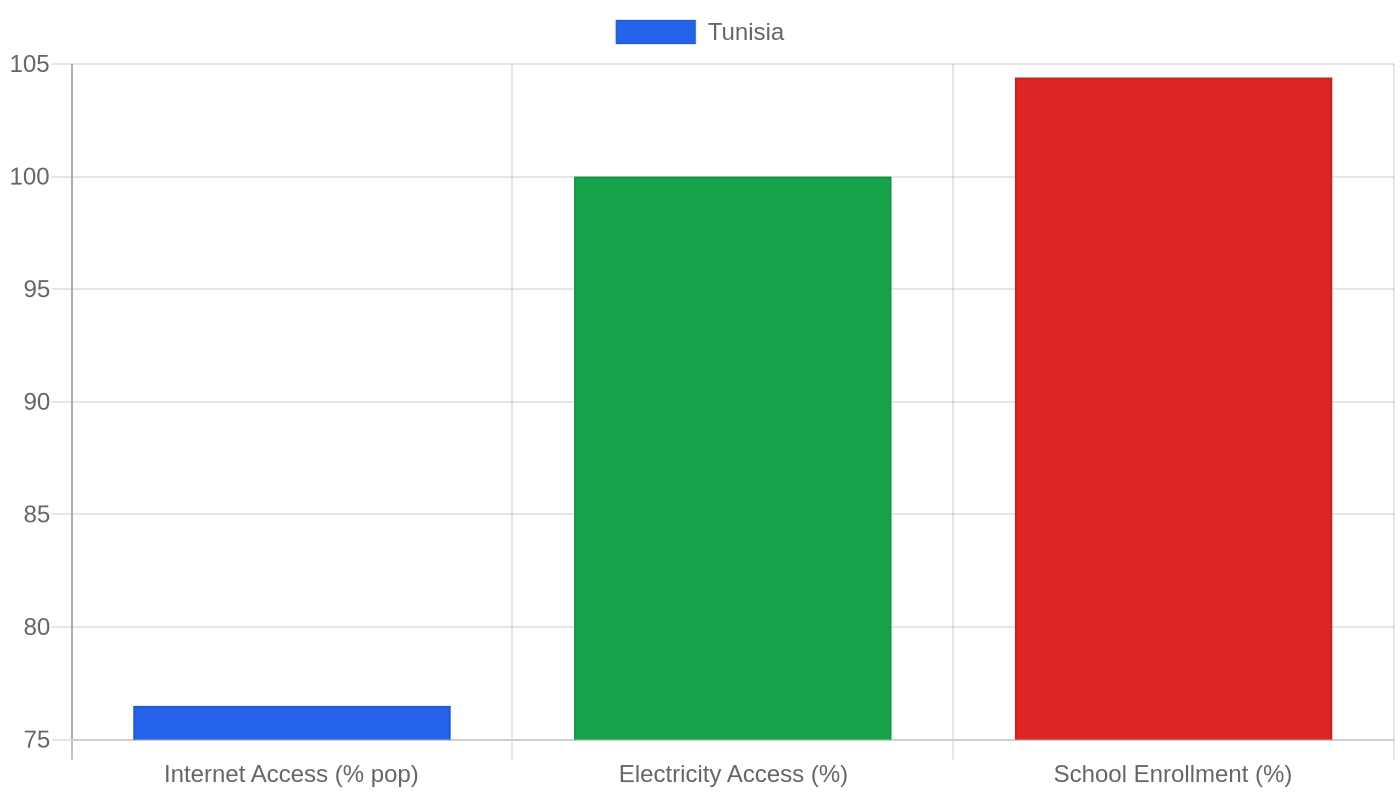
Economic Pulse Net | Sources: World Bank World Development Indicators, Government Sources | 2026
Key Takeaways
– Tunisia remains the only democracy to emerge from the Arab Spring, but democratic backsliding since 2021 has raised serious concerns about the country’s political trajectory and institutional stability.
– The economy is dominated by a financial sector that accounts for the vast majority of the country’s top publicly traded companies, suggesting limited diversification beyond banking and healthcare.
– Without recent World Bank data on GDP growth, inflation, or unemployment, analysts are operating with significant information gaps that obscure the true state of Tunisia’s economic health.
– The political landscape shifted dramatically after 2021, when what was once North Africa’s sole democracy began a period of democratic backsliding, creating uncertainty for investors and citizens alike.
– Tunisia’s constitution, adopted in 2014, enshrines women’s rights and Islamic identity for the presidency, reflecting the delicate balance between secularism and religious tradition that continues to shape national debates.
The Missing Numbers — Tunisia’s Economic Fog
The World Bank’s latest data on Tunisia presents a troubling paradox: the numbers simply are not there. With no recent figures available for GDP growth, inflation, unemployment, or GDP per capita, the country enters 2025 as something of an economic ghost — a nation whose statistical profile has gone dark at a moment when transparency matters most. This absence of data is itself a data point.
When a country stops reporting key economic indicators, or when international institutions cannot update their figures, it often signals deeper institutional stress. For Tunisia, a nation that once prided itself on being the democratic exception in North Africa, the lack of current economic metrics raises uncomfortable questions about governance capacity and data integrity.
The industries that do drive the Tunisian economy remain largely opaque in the available data. Without clear sectoral breakdowns from the World Bank, observers must rely on the corporate landscape to infer where the economic gravity lies. What is clear is that Tunisia’s financial sector dominates the formal economy, with banks and financial institutions representing the overwhelming majority of the country’s top publicly listed companies.
This concentration carries risks: when an economy depends heavily on banking, it becomes vulnerable to credit cycles, non-performing loan crises, and the health of the broader regional economy. The absence of inflation data is particularly concerning for Tunisian households, who have faced rising costs for basic goods without official figures to track the erosion of their purchasing power.
Unemployment, historically a flashpoint in Tunisia — it was a key driver of the 2011 uprising — remains unquantified in the latest World Bank records, leaving policymakers and citizens alike navigating blind.
Housing the Tunisian Dream — Cost of Living in an Uncertain Economy
The cost of living in Tunisia, while not captured in the available data with specific numbers, can be understood through the lens of what is known about the country’s economic structure and regional position. Tunisia sits between Europe and Sub-Saharan Africa, and its cost of living has historically been lower than European averages but higher than many of its African peers.
Housing costs in Tunis, the capital, have been driven by urban migration and a constrained housing supply, though the available data does not provide specific rent or purchase price figures. For Tunisian families, the gap between incomes and housing costs has been a persistent source of social tension, particularly for young people seeking to establish independent households.
The rental market in Tunisia’s major cities has traditionally favored landlords, with demand outstripping supply in desirable neighborhoods. Homeownership, long considered a marker of middle-class stability, has become increasingly difficult for first-time buyers, especially as the financial sector — dominated by the very banks listed among the country’s top companies — has tightened lending standards in an uncertain economic environment.
Daily expenses for food, transportation, and utilities consume a significant portion of household budgets, though without current inflation data from the World Bank, it is impossible to quantify how much those costs have risen. What can be said is that Tunisia’s cost of living pressures are a microcosm of the country’s broader challenges: a formal economy that struggles to provide affordable basics while an informal sector absorbs those who cannot find formal employment.
Banking on Tunis — The Financial Sector’s Dominance and Its Discontents
The list of Tunisia’s top companies reads like a roll call of the nation’s financial establishment. Amen Bank, Arab Tunisian Bank, Banque de l’Habitat, Banque de Tunisie et des Emirats, Banque de Tunisie, Banque Internationale Arabe de Tunisie, Banque Nationale Agricole, Banque Zitouna, and the Bourse de Tunis itself — these institutions dominate the corporate landscape. Only one non-financial company appears among the top ten: Adwya, a healthcare firm.
This concentration tells a story about Tunisia’s economic structure. The banking sector is deep, established, and politically connected, but it also crowds out other industries that might drive more diversified growth.
For investors considering Tunisia, the financial sector offers both opportunity and risk. The banks are well-capitalized by regional standards and benefit from a relatively sophisticated regulatory environment, but they are also exposed to the sovereign debt of a government that has faced recurring fiscal pressures. The Bourse de Tunis, the country’s stock exchange, provides a platform for investment, but its narrow base of listed companies limits diversification options.
Sectors beyond banking — manufacturing, tourism, agriculture, and technology — remain underrepresented in the formal capital markets, suggesting that Tunisia has not yet fully leveraged its entrepreneurial potential. The business climate, while improved after the 2011 revolution compared to the Ben Ali era, continues to face challenges related to bureaucracy, corruption perceptions, and the uncertainty created by the political shifts since 2021.
Democracy Under Pressure — Safety, Politics, and the Quality of Tunisian Life
Tunisia’s political landscape has undergone a profound transformation. The Constitution of Tunisia, adopted on 26 January 2014, was hailed as a landmark document that guaranteed rights for women and established a presidential republic with a bicameral parliament and a civil law court system. For years, Tunisia was celebrated as the only democracy in North Africa, a beacon of hope in a region dominated by monarchies and military regimes.
That changed after 2021, when the country experienced what analysts describe as democratic backsliding — a gradual erosion of the institutions and norms that had made Tunisian democracy distinctive.
The crime and safety indices for Tunisia are not available in the current data, but the country has historically been considered one of the safer nations in North Africa, with lower rates of violent crime than some of its neighbors. The quality of life in Tunisia reflects its dual identity: a Mediterranean nation with European-influenced urban centers and a more conservative interior.
Tunisians enjoy a relatively high level of education and healthcare access compared to regional peers, but economic frustration has been a persistent undercurrent. The political uncertainty since 2021 has added a layer of anxiety to daily life, as citizens wonder whether the democratic gains of the post-2011 period will be preserved or further eroded.
The Democratic Reckoning — Tunisia’s Current Moment
Right now, Tunisia is living through a period of profound uncertainty. The democratic backsliding that began in 2021 has not been reversed, and the country’s political trajectory remains unclear. The presidency, which according to the 2014 constitution must be held by a Muslim, has accumulated greater power at the expense of the parliament and the prime minister’s office.
This concentration of authority has alarmed civil society organizations, international partners, and many Tunisians who remember the authoritarian era that preceded the Arab Spring.
The economic situation on the ground is tense. Without current inflation data from the World Bank, it is difficult to quantify, but anecdotal evidence from Tunisian media and international organizations suggests that purchasing power has declined. The financial sector, dominated by the banks that top the corporate list, faces pressure from non-performing loans and a government that has struggled to secure international financing on favorable terms.
The Bourse de Tunis, while still operational, reflects the broader uncertainty with reduced trading volumes and cautious investor sentiment. Tunisia’s young population, which played such a pivotal role in the 2011 uprising, faces limited economic opportunities, and the political system’s ability to address their grievances is in question.
The Bottom Line
Tunisia remains a country of enormous potential and profound risk. For investors and analysts watching North Africa, Tunisia offers a case study in the fragility of democratic transitions and the economic costs of political uncertainty. The dominance of the financial sector, the absence of current economic data, and the political backsliding since 2021 create a complex picture that demands careful monitoring.
Those who believe in the resilience of Tunisia’s civil society and its democratic aspirations will watch closely for signs of renewal; those focused on risk will note the warning signs. Either way, Tunisia is a story that is far from over.
Sources & Methodology
This article is authored by Economic Pulse Net for informational and research purposes. Economic Pulse Net sources its data from multilateral institutions, national statistics bureaus, and proprietary databases. All data is believed to be current as of the date of publication.
Published: July 17, 2026 | Category: Research — Tunisia
Use these signals in your own platform
Economic Pulse publishes its live signal feed through a documented, read-only API. Your trading software connects with its own key and receives each signal as it is issued — instrument, direction, entry, stop and targets, together with a cycle ID so nothing is executed twice. The feed is independent of this website and cannot change it.
Signals are informational only and are not financial advice.