Economic Pulse Net | Sources: World Bank World Development Indicators, Government Sources | 2026
Key Takeaways
– Togo’s economy is anchored by a powerful financial services sector, headlined by Ecobank and Atlantic Bank Group, positioning Lomé as a regional banking hub.
– The country’s political system features a president indirectly elected for a four-year double term, with executive power shared between the head of state and a president of the Council of Ministers.
– Aviation is a surprising pillar of the Togolese corporate landscape, with four major airlines—including ASKY Airlines and Africa West Airlines—operating within its borders.
– Regional utilities cooperation, exemplified by the Communauté Électrique du Bénin, highlights Togo’s cross-border approach to infrastructure and energy challenges.
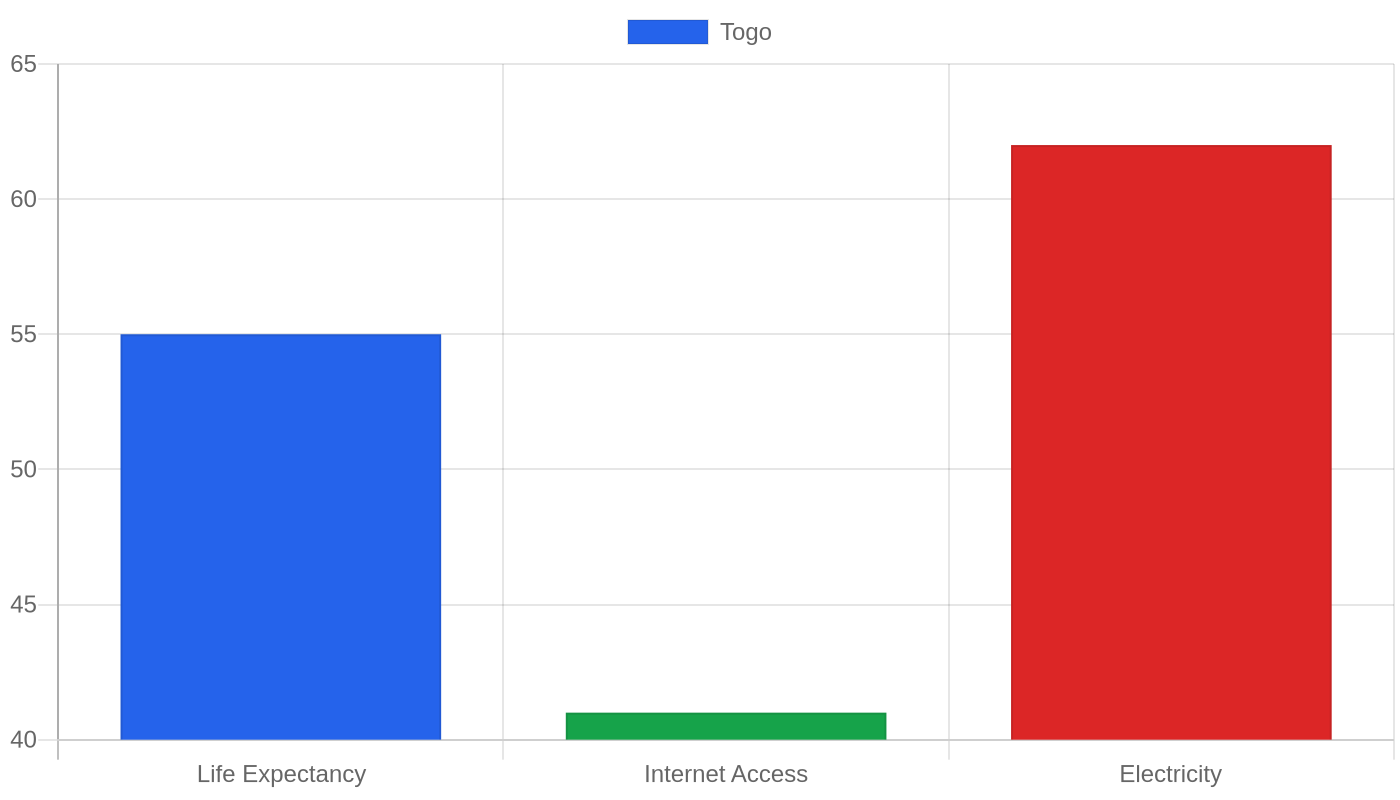
– While comprehensive World Bank economic indicators for Togo are currently incomplete, the existing corporate and political data paints a picture of a nation actively building regional economic bridges.
The Engine Room — Banking on Regional Ambition
Togo’s economic story cannot be told in isolation. While the World Bank’s latest GDP growth, inflation, and employment figures for Togo remain unrecorded in the current dataset, the country’s corporate architecture reveals a nation that has positioned itself as a financial intermediary for the West African region. The presence of Ecobank—one of the most recognizable banking names across the continent—is not incidental.
Ecobank’s headquarters in Lomé has transformed the Togolese capital into a serious player in cross-border finance, moving money and facilitating trade across multiple francophone and anglophone markets.
Alongside Ecobank, Atlantic Bank Group adds another layer of financial depth. The concentration of two major banking groups in a single small country suggests that Togo’s economic model is less about industrial production and more about financial services, logistics, and acting as a gateway for regional commerce. This is a country that monetizes its geography.
The Port of Lomé, while not explicitly mentioned in the data, is the logical beneficiary of this banking infrastructure—the physical counterpart to the financial flows that Ecobank and Atlantic Bank Group manage.
The absence of hard macroeconomic numbers from the World Bank is notable, but it does not diminish the structural reality: Togo’s economy is service-oriented, with financial services at its core. For investors, this means looking beyond traditional manufacturing metrics and understanding that Togo’s value proposition lies in its role as a regional intermediary.
When inflation or GDP figures do become available, they will likely reflect the health of the broader West African Economic and Monetary Union rather than purely domestic dynamics.
Housing and Daily Life — The Cost of Living in a Services Economy
Without specific housing cost data from the World Bank, any analysis of Togo’s cost of living must be framed through the lens of its economic structure. In a services-driven economy like Togo’s, urban centers—particularly Lomé—tend to develop a two-tier housing market: one serving the banking and aviation professionals who work for the major corporations headquartered there, and another serving the broader population engaged in informal trade and small-scale commerce.
The financial sector’s dominance suggests that Lomé’s prime real estate market is shaped by expatriate banking executives and regional business travelers. This creates a rental market in the city’s better neighborhoods that is likely priced at a premium compared to the national average, though exact figures are not available in the current data.
For the average Togolese citizen, housing costs are more likely driven by land tenure systems, family compounds, and the gradual urbanization that characterizes most West African capitals.
What can be inferred from the corporate data is that Togo’s economy supports a professional class—airline staff, bankers, utility administrators—whose purchasing power and consumption patterns differ significantly from those in the informal sector. This bifurcation is typical of African economies transitioning toward services, and Togo appears to be following that trajectory.
Without precise CPI data, the most honest assessment is that Togo’s cost of living reflects its dual reality: a modernizing urban core connected to regional trade networks, and a broader population whose daily expenses are shaped by local markets, transportation, and food prices that remain largely unmeasured in global datasets.
Business and Investment — Aviation, Utilities, and the Corporate Landscape
Togo’s corporate roster is unexpectedly dominated by aviation. Africa West Airlines, Air Horizon, Air Togo, and ASKY Airlines all call Togo home. This concentration of carriers in a country with a relatively small domestic market signals a deliberate strategy of using Lomé as a regional aviation hub. ASKY Airlines, in particular, has historically been positioned as a pan-African carrier, connecting West and Central African cities through its Lomé base.
For investors, this is a clear signal: Togo is betting on connectivity, both financial and physical.
The presence of the Communauté Électrique du Bénin—a binational utility shared with neighboring Benin—demonstrates that Togo understands the necessity of cross-border infrastructure. Energy is the single most binding constraint on African industrialization, and Togo’s decision to pool resources with Benin is a pragmatic acknowledgment that small economies cannot build viable power systems alone.
This utility cooperation is a model that other West African states could emulate, and it gives Togo a degree of energy security that purely national approaches might not provide.
La Poste du Togo represents the industrial and logistical backbone of the country, managing postal services and, increasingly, financial inclusion through post office banking. In many African economies, postal networks serve as de facto financial infrastructure for rural populations, and Togo’s integration of its postal service into the broader economic fabric is a quiet but significant development.
For businesses looking to enter the Togolese market, the key sectors are clear: financial services, aviation logistics, energy cooperation, and postal-financial integration.
Governance and Security — The Political Architecture of Stability
Togo’s political system is distinctive. The president is indirectly elected—meaning the population does not directly vote for the head of state—and serves a double term of four years, effectively a maximum of eight years in office. The president also serves as commander-in-chief of the armed forces, holds the right to initiate legislation, and can dissolve parliament. This concentration of constitutional authority places significant power in the executive branch.
Executive power, however, is formally exercised by the council of ministers, led by a president of the Council of Ministers—a position formerly known as the prime minister. This arrangement creates a dual-executive structure where the president sets the strategic direction, but the day-to-day governance falls to the council and its leader. The president appoints the president of the Council of Ministers, which means the head of government serves at the pleasure of the head of state.
This is a system designed for continuity and centralized control, with limited checks on executive authority.
For citizens and investors, this political structure offers a degree of predictability—policy direction is unlikely to shift dramatically without presidential support. However, it also raises questions about political succession, institutional independence, and the space for opposition voices.
The absence of crime and safety index data from the World Bank makes it difficult to assess public security objectively, but Togo has generally been viewed as a relatively stable country in a region that has experienced significant volatility. The political architecture suggests a government that prioritizes order and continuity.
Current Affairs — Regional Integration in Real Time
The most significant development in Togo’s current economic landscape is the continued operation and expansion of its regional connectivity infrastructure. ASKY Airlines, with its Lomé hub, remains a critical piece of West African air travel, linking cities that have limited direct connections. The airline’s ongoing operations signal that Togo is actively fulfilling its role as a regional transit point, despite the well-documented financial challenges facing African carriers.
Ecobank’s continued presence in Lomé is another live indicator of Togo’s economic trajectory. As one of Africa’s largest banking groups, Ecobank’s commitment to its Togolese headquarters has implications for everything from foreign exchange availability to regional trade finance.
The bank’s operations in Lomé effectively make Togo a clearinghouse for commercial activity across multiple African markets, a role that is likely to become more important as continental free trade initiatives gain momentum.
The Communauté Électrique du Bénin’s ongoing operations represent a live experiment in regional energy cooperation. As West African countries grapple with electricity generation deficits, the Togo-Benin utility arrangement provides a working example of how small states can achieve economies of scale through partnership. This is not theoretical—it is operational infrastructure delivering power to two countries from shared generation and distribution assets.
For policymakers across the region, the Togo-Benin model is a case study in pragmatic energy diplomacy.
The Bottom Line
Togo is not a country that makes headlines with dramatic economic numbers; it is a country that makes progress through quiet, structural positioning. For investors and businesses focused on West African integration, Togo offers something increasingly rare: a stable, services-oriented hub with established banking infrastructure, a functioning aviation sector, and cross-border utility cooperation. The country’s political system provides continuity, even if it raises questions about democratic depth.
Watch Togo not for its domestic market size, but for its role as the connective tissue of West African commerce—a role that Ecobank, ASKY Airlines, and the Communauté Électrique du Bénin are actively building every day.
Sources & Methodology
This article is authored by Economic Pulse Net for informational and research purposes. Economic Pulse Net sources its data from multilateral institutions, national statistics bureaus, and proprietary databases. All data is believed to be current as of the date of publication.
Published: August 01, 2026 | Category: Research — Togo
Use these signals in your own platform
Economic Pulse publishes its live signal feed through a documented, read-only API. Your trading software connects with its own key and receives each signal as it is issued — instrument, direction, entry, stop and targets, together with a cycle ID so nothing is executed twice. The feed is independent of this website and cannot change it.
Signals are informational only and are not financial advice.