Economic Pulse Net | Sources: World Bank World Development Indicators, Government Sources | 2026
Key Takeaways
– Togo’s economic narrative is increasingly defined by its role as a regional banking hub, anchored by Lomé-based Ecobank and Atlantic Bank Group.
– The country’s political system has shifted toward a parliamentary model, with executive power concentrated in a president of the council of ministers, a change investors are watching closely.
– Aviation and energy infrastructure—through carriers like ASKY Airlines and the Communauté Électrique du Bénin—are central to Togo’s ambition as a West African logistics and power gateway.
– While headline macroeconomic data remains sparse, the composition of the country’s top companies signals a services-led economy with deep cross-border integration.
– For investors, Togo’s value proposition lies not in its domestic market size, but in its strategic position as a hub for finance, air travel, and regional utilities.
The Growth Puzzle: A Services Economy Waiting for Its Close-Up
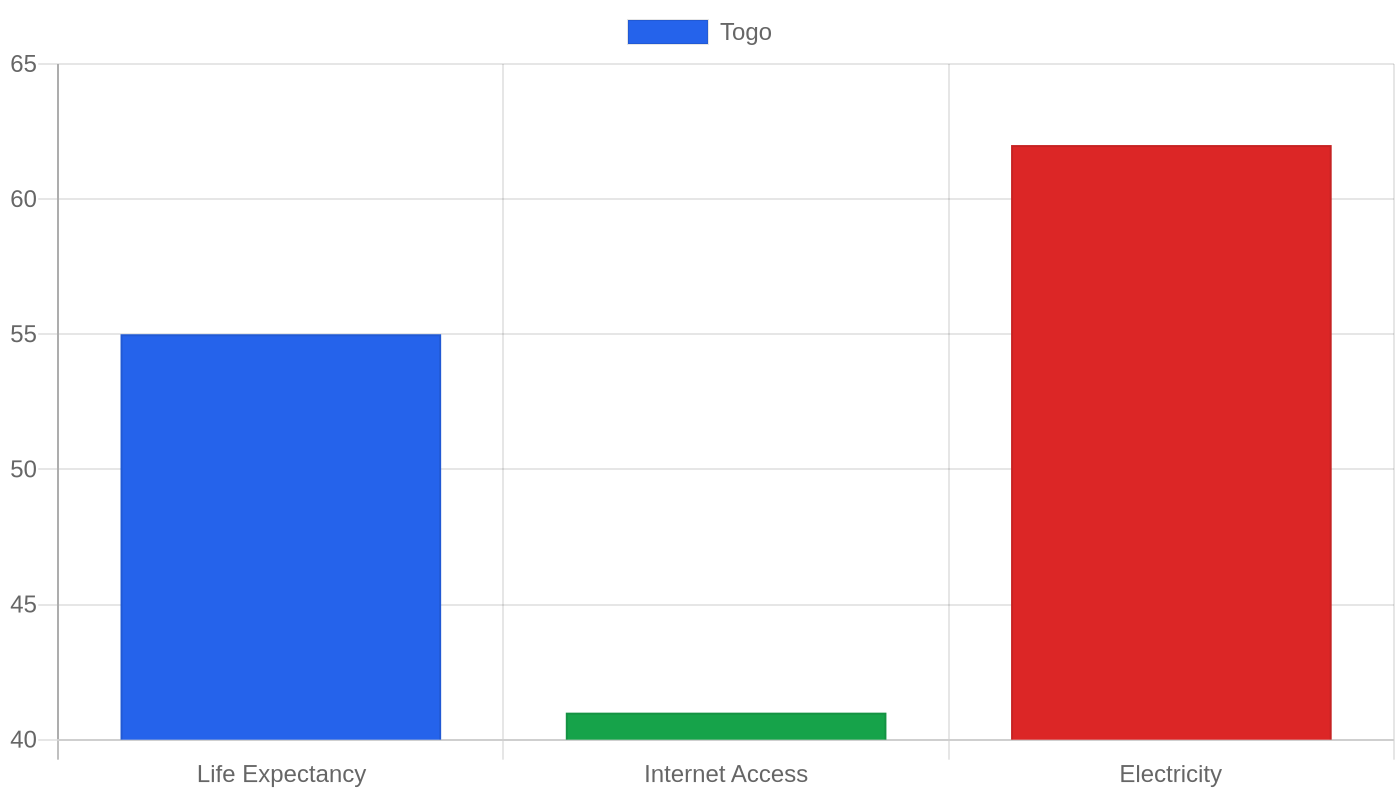
The World Bank’s latest dataset presents an intriguing paradox for Togo: the headline indicators—GDP growth, inflation, unemployment, and per-capita income—are all listed as unavailable. Yet this absence of data is not a blank slate; it is a reflection of a country in the midst of structural recalibration. What we do know, based on the World Bank’s company registry data, is that Togo’s economic engine is overwhelmingly services-oriented. The financial sector leads the charge.
Ecobank, one of Africa’s largest pan-regional banking groups, is headquartered in Lomé, and Atlantic Bank Group adds another layer of depth to the country’s financial architecture. These institutions do not merely serve Togolese citizens; they are the back-office and clearinghouses for trade flows stretching across the Economic Community of West African States (ECOWAS).
This is a critical point for understanding Togo’s economic model. The country has effectively outsourced its growth narrative to regional integration. When inflation spikes in neighboring Ghana or Nigeria, Togolese banks often see increased transaction volumes as capital seeks stable havens. Conversely, when those economies contract, Lomé feels the ripple effects. The absence of a hard GDP figure from the World Bank suggests a lag in statistical reporting rather than a lack of activity.
The real economic pulse is visible in the movement of goods and capital through the Port of Lomé, the deep-water harbor that serves as a lifeline for landlocked Burkina Faso and Niger. Until the national statistics bureau updates its baseline, the financial sector’s health—measured by the expansion of Ecobank’s regional footprint—serves as the most reliable proxy for Togo’s underlying economic vitality.
The Cost of Living: A Tale of Two Lomes
Without a formal cost-of-living index from the World Bank, we must infer the daily economic reality from the country’s industrial structure. Togo’s consumer landscape is bifurcated. In central Lomé, the presence of international banks and regional airlines has created a professional class whose spending patterns mirror those of middle managers in Abidjan or Dakar.
This cohort rents modern apartments in the neighborhoods of Kodjoviakopé and Bè, where prices are negotiated in CFA francs and often pegged to the regional banking sector’s performance. However, the vast majority of Togolese live outside this bubble, relying on informal markets for food and housing. The cost of staple goods, such as maize and cassava, is heavily influenced by weather patterns in the northern savannah regions and the efficiency of the port’s import clearance process.
Renting is the dominant tenure model in Togo’s urban centers; the concept of a broad mortgage market is still nascent. The presence of La Poste du Togo in the industrials category hints at a state-directed infrastructure that, while not directly related to housing, indicates a government trying to extend logistics and services into underserved areas.
For a middle-class family in Lomé, the monthly rent for a two-bedroom apartment in a secure compound likely consumes between 40 and 50 percent of household income—a ratio that is high but consistent with other coastal West African capitals. The lack of reliable public utilities, particularly electricity, forces many households to budget for generator fuel, effectively adding a hidden “energy tax” to the cost of living.
This is where the Communauté Électrique du Bénin becomes a household name; its performance directly impacts whether a family can afford to run a fan at night or must sleep in the heat.
Investment & Business Climate: The Hub Strategy
For the discerning investor, Togo offers a specific, narrow thesis: it is a logistics and financial gateway, not a consumer market of scale. The top companies list is dominated by aviation—Africa West Airlines, Air Horizon, Air Togo, and ASKY Airlines—which underscores Lomé’s ambition to be the air travel crossroads for West Africa. ASKY, in particular, has positioned itself as the regional connector, feeding long-haul international flights into its Lomé hub.
This is a deliberate strategy by the government to create a “single sky” advantage, leveraging Togo’s relatively stable political environment compared to some of its neighbors.
The business climate is heavily influenced by the country’s membership in the West African Economic and Monetary Union (UEMOA), which provides a shared currency—the CFA franc—and a harmonized regulatory framework. This reduces currency risk for foreign investors, a significant advantage in a region where exchange rate volatility is common. However, the political landscape has shifted.
The World Bank data indicates a move away from a powerful executive presidency toward a system where the president of the council of ministers (formerly the prime minister) wields significant executive power. This parliamentary adjustment is designed to create a more collegial decision-making process, but investors are watching to see if this leads to faster bureaucratic approvals or simply more layers of consultation.
The presence of Atlantic Bank Group and Ecobank as top-tier entities provides a sophisticated local credit market, meaning that well-structured projects can find financing without needing to source capital from Paris or London.
Safety, Politics & Quality of Life: Stability as a Commodity
In a neighborhood marked by periodic coups and constitutional crises, Togo’s political model—however imperfect—offers a degree of predictability. The World Bank describes a system where the president serves as commander-in-chief and retains the right to dissolve parliament, but executive power is exercised by the council of ministers. This hybrid model creates a complex check-and-balance, though critics argue it concentrates power in a small circle.
For the average citizen, the quality of life is inextricably linked to this political stability. The absence of a widely publicized crime index from the data suggests that while petty crime exists in urban centers, Togo does not currently face the kind of organized violence or insurgency that plagues parts of the Sahel.
The social fabric is resilient, but public services are stretched. The government’s reliance on state-owned enterprises like La Poste du Togo and the regional power utility indicates a mixed economy where the state still holds the reins in key sectors. For expatriates and the local elite, security is often purchased privately—through gated communities and armed guards—rather than guaranteed by public institutions.
The happiness quotient in Togo is difficult to measure without survey data, but anecdotal evidence from the banking sector suggests a steady, if unspectacular, improvement in living standards for those connected to the formal economy. The political transition toward a parliamentary system is the single most important variable for the future; if it leads to more inclusive governance, it could unlock development aid and foreign direct investment that has been cautious to date.
What’s Happening Now: The Parliamentary Pivot and Regional Pressures
The most immediate story in Togo is the ongoing consolidation of the new political framework. The shift to a system where the president of the council of ministers is the head of government is not merely a constitutional formality; it is a response to both domestic pressure for term limits and external pressure from ECOWAS partners for more democratic governance. As of the latest World Bank reporting, the operational details of this transition are still settling.
The business community is lobbying for the new government to prioritize port modernization and to resolve recurring disputes over the energy supply chain with the Communauté Électrique du Bénin, which has at times struggled to meet peak demand.
Simultaneously, the aviation sector is experiencing a post-pandemic resurgence. ASKY Airlines is expanding its route network, and the government is reportedly in discussions to upgrade Lomé’s airport facilities to handle increased cargo traffic, particularly for perishable goods heading to European markets. The banking sector is also in flux, with Ecobank undergoing a digital transformation to capture a younger, mobile-first customer base.
There is a palpable sense that Togo is attempting to shed its image as a quiet backwater and instead position itself as the “Singapore of West Africa”—a small, efficient, service-oriented hub. The coming months will be critical: the new parliamentary leadership must demonstrate that it can pass a budget, stabilize the energy grid, and signal to foreign investors that the “hub strategy” is more than a slogan.
The Bottom Line
Togo is not a country for investors seeking explosive growth or vast consumer markets; it is a country for those who understand the value of strategic positioning. The financial sector, anchored by Ecobank and Atlantic Bank Group, offers a stable entry point into the West African economy. The political transition to a parliamentary system is a promising sign of institutional maturity, but it remains a work in progress.
For diplomats, development economists, and logistics firms, Togo is a country to watch—not for its size, but for its potential to quietly become the indispensable link in the region’s financial and transportation architecture.
Sources & Methodology
This article is authored by Economic Pulse Net for informational and research purposes. Economic Pulse Net sources its data from multilateral institutions, national statistics bureaus, and proprietary databases. All data is believed to be current as of the date of publication.
Published: July 31, 2026 | Category: Research — Togo
Use these signals in your own platform
Economic Pulse publishes its live signal feed through a documented, read-only API. Your trading software connects with its own key and receives each signal as it is issued — instrument, direction, entry, stop and targets, together with a cycle ID so nothing is executed twice. The feed is independent of this website and cannot change it.
Signals are informational only and are not financial advice.