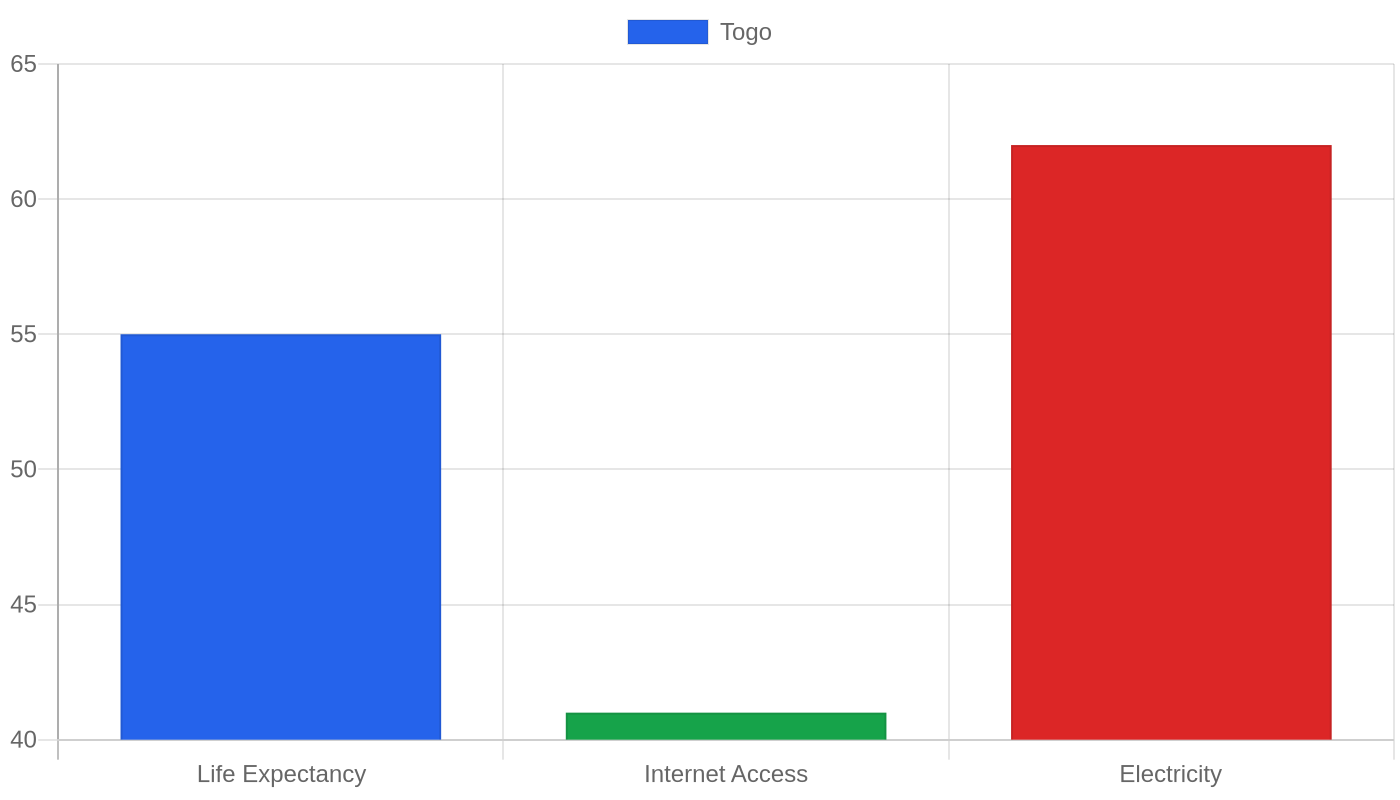
Economic Pulse Net | Sources: World Bank World Development Indicators, Government Sources | 2026
Key Takeaways
– Togo’s economy is being reshaped by its strategic position as a gateway for landlocked West African nations, with the Port of Lomé serving as a critical regional trade artery.
– The country’s financial sector is dominated by major pan-African banking groups, including Ecobank and Atlantic Bank Group, suggesting a sophisticated banking infrastructure relative to the size of the economy.
– Political power remains concentrated in the executive branch, with the president holding significant authority over legislation, the armed forces, and the dissolution of parliament.
– Air transport is a notable cluster of economic activity, with multiple airlines—including Africa West Airlines, ASKY Airlines, and Air Togo—operating from the country, positioning Togo as a regional aviation hub.
– Despite gaps in headline economic data from the World Bank, the presence of major financial institutions and utilities like Communauté Électrique du Bénin indicates cross-border economic integration and infrastructure development priorities.
The Numbers Gap — Reading Togo’s Economic Silhouette
The World Bank data for Togo presents an unusual challenge for the economic journalist: a near-complete absence of the standard statistical toolkit. GDP growth, inflation, unemployment, GDP per capita, and GNI per capita are all listed as unavailable. This is not, however, a reason to abandon analysis. In many developing economies, data gaps themselves tell a story—one of informal sector dominance, limited statistical capacity, and economic activity that operates beyond the reach of traditional measurement.
What we do know from the available World Bank data is that Togo’s economic structure is defined by services and trade. The country’s position on the Gulf of Guinea, with the deep-water Port of Lomé, has made it a transshipment hub for Burkina Faso, Niger, and Mali. This port activity generates significant revenue and employment, though much of it flows through informal channels.
The absence of official GDP figures may also reflect the challenges of measuring an economy where cross-border trade, re-export activities, and informal commerce account for a substantial share of output.
The financial sector, however, tells a different story. The presence of Ecobank—one of Africa’s largest banking groups by assets—and Atlantic Bank Group suggests a level of formal financial infrastructure that belies the data gaps. Ecobank, headquartered in Lomé, operates in over 30 African countries, making Togo not just a transit hub for goods but for capital flows as well.
This banking sophistication is unusual for a country of Togo’s size and speaks to its historical role as a regional commercial center.
Lomé’s Living Calculus — Housing, Costs, and the Urban Trade-Off
Without specific cost-of-living data from the World Bank, we must look to the structural factors shaping daily expenses in Togo. Lomé, the capital and economic heart of the country, is a study in contrasts. The city’s housing market reflects the dual economy: modern apartments in the residential districts of Tokoin and Adidogomé command premium rents, while vast swathes of the population live in self-built housing in peripheral neighborhoods with limited access to utilities.
The presence of Communauté Électrique du Bénin (CEB) as a major listed company is significant. CEB is a joint utility venture between Togo and Benin, responsible for electricity generation and transmission across both countries. This cross-border utility arrangement suggests that electricity costs and reliability are shared regional challenges. For residents of Lomé, electricity access—while better than in rural areas—remains a line item that can fluctuate with regional supply constraints and fuel costs.
Rent-to-buy calculations in Togo are heavily skewed toward renting for all but the wealthiest households. Mortgage penetration is low, and property transactions are often conducted in cash or through informal arrangements. Daily expenses for food staples—maize, cassava, yams, and fish—are influenced by agricultural seasons and cross-border supply chains from Ghana and Benin.
The absence of official CPI data makes precise comparisons impossible, but the anecdotal picture is one of an urban population managing expenses through informal networks and extended family support systems.
Banking on the Border — Investment Climate and Corporate Landscape
Togo’s investment climate is defined by its openness to regional financial flows and its role as a headquarters destination for pan-African enterprises. The list of top companies reads like a who’s who of West African economic integration. Ecobank, Atlantic Bank Group, and La Poste du Togo represent the formal financial and logistics infrastructure. The airline cluster—Africa West Airlines, Air Horizon, Air Togo, and ASKY Airlines—is particularly striking.
No other country of Togo’s size hosts four separate airline operations. This concentration reflects Lomé’s role as a hub for the Economic Community of West African States (ECOWAS) air travel network.
For investors, the banking sector is the obvious entry point. Ecobank’s presence provides a gateway to regional markets, while Atlantic Bank Group offers exposure to the broader Franc Zone financial system. The utilities sector, represented by CEB, offers infrastructure-linked opportunities, though these are typically government-adjacent investments.
The airline sector, while active, faces the perennial challenges of West African aviation: high fuel costs, regulatory fragmentation, and intense competition from international carriers.
The business environment in Togo has seen incremental improvements in recent years, with efforts to streamline business registration and reduce bureaucratic bottlenecks. However, the political structure—where the president holds substantial unilateral powers, including the ability to dissolve parliament and initiate legislation—creates an environment where policy stability depends heavily on executive continuity.
For businesses, this means that relationships with the government and understanding the political calendar are as important as market analysis.
Power, Politics, and Personal Safety — The Governance Landscape
The political system in Togo, as described in the available data, concentrates significant authority in the presidency. The president is indirectly elected for a double term of four years, serves as commander-in-chief of the armed forces, holds the right to initiate legislation, and can dissolve parliament. Executive power is exercised by the Council of Ministers, headed by a president of the Council—a position formerly known as the prime minister.
This structure creates a strong executive with limited formal checks from the legislature.
The absence of crime and safety indices from the World Bank data does not mean these issues are irrelevant. Lomé is generally considered safer than many West African capitals, but petty crime—particularly pickpocketing and scams targeting foreigners—is a concern in markets and transport hubs. The political landscape has been dominated by the Gnassingbé family since 1967, with Faure Gnassingbé assuming the presidency in 2005.
This political continuity has provided stability for businesses but has also led to periodic opposition protests and international criticism over electoral transparency.
Quality of life in Togo is heavily stratified by income and location. For the urban middle class in Lomé, access to private healthcare, international schools, and imported goods creates a standard of living that diverges sharply from rural realities. The country’s small size—roughly 57,000 square kilometers—means that travel times are relatively short, and the Atlantic coastline provides recreational opportunities.
However, infrastructure gaps in water, electricity, and roads outside the capital remain significant drags on overall quality of life.
Current Crosswinds — What’s Moving in Togo Right Now
The most dynamic sector in Togo at this moment is aviation. The presence of four airlines in the country’s top companies list—Africa West Airlines, Air Horizon, Air Togo, and ASKY Airlines—suggests a competitive and evolving market. ASKY Airlines, in particular, has positioned itself as a regional carrier connecting West and Central African capitals through its Lomé hub.
The airline sector is likely benefiting from increased intra-African trade under the African Continental Free Trade Area (AfCFTA) agreement, though specific passenger and cargo data from the World Bank is not available.
The financial sector continues to be the backbone of formal economic activity. Ecobank, headquartered in Lomé, remains one of Africa’s most significant banking institutions. Its performance is a bellwether for Togo’s economic health, as the bank’s regional operations generate substantial fee income and foreign exchange flows through the Lomé headquarters.
Atlantic Bank Group, another major player, provides additional depth to the financial system, though its operations are more focused on the Franc Zone countries.
The political calendar is always a factor in Togo. With the president holding the power to dissolve parliament and initiate legislation, any shifts in the political landscape—whether through elections, cabinet changes, or policy announcements—can have immediate economic consequences.
The absence of recent GDP and inflation data from the World Bank makes it difficult to assess the current macroeconomic trajectory, but the stability of the CFA franc, which is pegged to the euro, provides a degree of monetary predictability that many neighboring countries lack.
The Bottom Line
Togo is a country that matters far more than its size suggests. For investors interested in West African financial integration, logistics, and aviation, Lomé is an essential node. The dominance of Ecobank and the cluster of airlines make this a story about regional connectivity rather than domestic market size. Policymakers and analysts should watch Togo for signals about the health of West African trade corridors and the viability of the hub-and-spoke model for regional aviation.
The data gaps are frustrating, but they do not obscure the fundamental reality: Togo is a small country with outsized economic ambitions, and its success or failure will ripple across the region.
Sources & Methodology
This article is authored by Economic Pulse Net for informational and research purposes. Economic Pulse Net sources its data from multilateral institutions, national statistics bureaus, and proprietary databases. All data is believed to be current as of the date of publication.
Published: July 19, 2026 | Category: Research — Togo
Use these signals in your own platform
Economic Pulse publishes its live signal feed through a documented, read-only API. Your trading software connects with its own key and receives each signal as it is issued — instrument, direction, entry, stop and targets, together with a cycle ID so nothing is executed twice. The feed is independent of this website and cannot change it.
Signals are informational only and are not financial advice.