Economic Pulse Net | Sources: World Bank World Development Indicators, Government Sources | 2026
Key Takeaways
– Tanzania remains Africa’s longest-serving ruling party state, with the Chama Cha Mapinduzi (CCM) in power since independence in 1961 — a political stability that cuts both ways for investors and reformers.
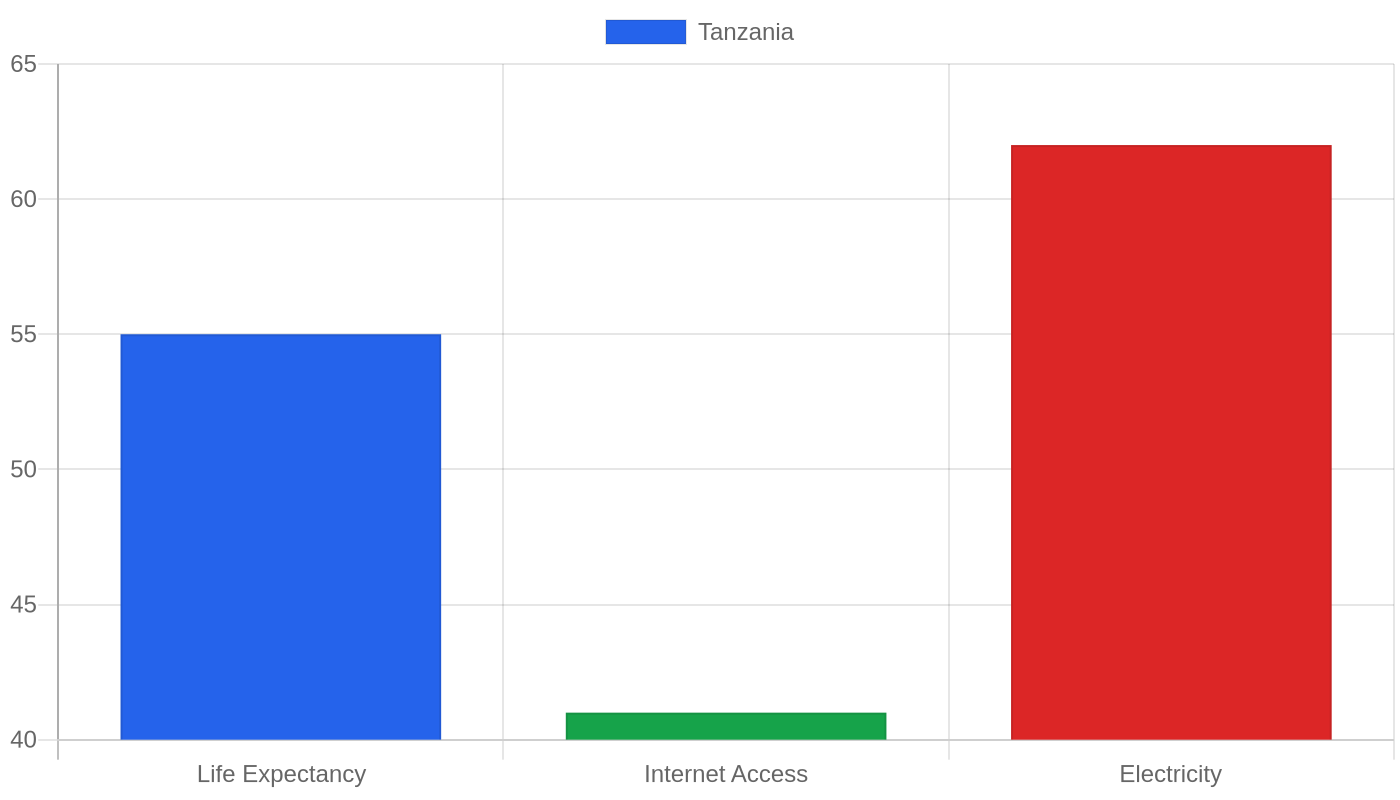
– The economic picture is defined by what’s absent from the data — with the World Bank’s latest figures showing no confirmed GDP growth, inflation, or unemployment readings, analysts are watching a country in a statistical fog.
– The corporate landscape is a mix of state-backed aviation, private telecommunications, and regional industrial heavyweights, including Dangote Industries Tanzania and the Bakhresa Group, pointing to a diversified but concentrated business ecosystem.
– Dar es Salaam Stock Exchange and the Bank of Tanzania anchor the financial sector, suggesting a formal economy that is maturing even as informal markets dominate daily life.
– Political liberalisation came late — only in 1992 did the constitution allow opposition parties — and the CCM’s grip remains the single most important factor shaping the business environment.
The Numbers Gap — What We Don’t Know Matters
Here’s the uncomfortable truth about Tanzania’s economy in 2026: the World Bank’s key indicators are blank. No GDP growth figure. No inflation reading. No unemployment rate. No GDP per capita, no GNI per capita, no population count. For a country that has positioned itself as East Africa’s quiet giant, this statistical silence is itself a story.
What we do know is structural. Tanzania’s main industries — while not enumerated in the available data — are widely understood to span agriculture, mining, and a growing services sector. The companies registered in the country tell their own tale: Air Tanzania, the national carrier, sits alongside private operators like Air Excel, Auric Air, and Coastal Aviation, suggesting a robust domestic aviation market serving both tourism and business travel.
Airtel Tanzania represents one of Africa’s largest telecom networks, while Bakhresa Group — a conglomerate with interests in flour milling, logistics, and beverages — demonstrates that local capital has scaled beyond borders. Dangote Industries Tanzania, part of the pan-African industrial empire, anchors the manufacturing side.
The absence of hard numbers from the World Bank means economists are working with proxies. When inflation data is missing, analysts look at fuel prices, food costs, and currency stability. When GDP is unmeasured, they watch port activity in Dar es Salaam, tourist arrivals to Zanzibar, and gold export volumes. Tanzania’s economy is real, it is moving, but the official scoreboard is dark.
Cost of Living — The Price of Everyday Survival
Without official CPI data from the World Bank, the cost of living in Tanzania must be read through the lens of its corporate structure and regional context. Dar es Salaam, the commercial capital, is a city where formal and informal economies collide.
The presence of major telecommunications and banking firms suggests a growing middle class with disposable income — but for the majority, daily life is shaped by small-scale trade, transport costs, and food prices that fluctuate with weather and global commodity markets.
Housing in Tanzania’s major cities has been under pressure for years, driven by urban migration and limited formal construction. The rental market dominates; homeownership remains out of reach for most, particularly in Dar es Salaam where demand from expatriates and the growing professional class has pushed prices upward. Compared to neighbours like Kenya or Uganda, Tanzania has historically offered slightly lower living costs, but the gap is narrowing as the economy urbanises.
What the data does not tell us — inflation rates, wage growth, purchasing power — is precisely what Tanzanians feel every day. When the World Bank’s figures are absent, the lived experience of price volatility becomes the only reliable indicator.
Investment & Business Climate — Giants and Gatekeepers
The list of Tanzania’s top companies reads like a who’s who of East African commerce. Bakhresa Group is the kind of homegrown success story that policymakers love to cite — a conglomerate that started small and now spans multiple sectors. Dangote Industries Tanzania brings the weight of Africa’s richest man into the local market, signalling confidence in the country’s industrial potential.
The Dar es Salaam Stock Exchange provides a formal channel for capital raising, while the Bank of Tanzania oversees a financial system that has modernised significantly over the past decade.
For investors, the appeal is clear: a large population, strategic location, and natural resources. The challenges are equally evident. A one-party dominant state means policy continuity, but also raises questions about transparency, contract enforcement, and the rule of law. The telecommunications sector, anchored by Airtel, shows that foreign investment can thrive. The aviation industry, with both state-owned Air Tanzania and private carriers, demonstrates a mixed model where government and market coexist.
Sectors to watch include aviation, given the number of registered carriers, and financial services, with the stock exchange and central bank both active. The conglomerate model — exemplified by Bakhresa — suggests that diversified local capital remains the most resilient form of business in Tanzania.
Safety, Politics & Quality of Life — Stability as a Double-Edged Sword
Tanzania’s political landscape is remarkable by any measure. The CCM has held power since independence in 1961, making it the longest-serving ruling party in Africa. From the country’s formation until 1992, it was the only legally permitted party. The constitutional amendment of 1 July 1992 opened the door to multiparty politics, but the CCM has never lost an election since.
This political continuity has delivered a certain kind of stability. Tanzania has avoided the civil wars, coups, and ethnic conflicts that have plagued many of its neighbours. The crime and safety indices are not available in the current data, but the country’s reputation as a peaceful, welcoming nation — a major draw for tourism — is well established. Zanzibar’s beaches and the Serengeti’s plains depend on this perception of safety.
Yet the quality of life in Tanzania is a study in contrasts. The political stability has not translated into rapid economic transformation. The absence of GDP per capita data makes it difficult to measure progress, but the reality on the ground is that Tanzania remains one of the poorer countries in the region, despite its potential.
What’s Happening Now — The Quiet Transformation
Right now, Tanzania is in a period of careful recalibration. The World Bank’s missing data points suggest either a transition in statistical reporting or a reluctance to publish figures that might not flatter the ruling party’s narrative. Either way, the information vacuum creates space for speculation.
The corporate landscape is evolving. Air Tanzania’s presence alongside private carriers indicates a government that wants to be in the aviation business while tolerating competition. The Bakhresa Group’s expansion into new sectors suggests that local capital is confident in the country’s medium-term prospects.
Dangote’s continued investment in Tanzania, despite the challenging business environment across Africa, is a vote of confidence from one of the continent’s most sophisticated industrialists.
The Dar es Salaam Stock Exchange remains a work in progress. Listing requirements are being refined, and there is hope that more companies will go public, deepening the capital markets. The Bank of Tanzania has been working on financial inclusion, though progress is difficult to measure without reliable data.
Politically, the CCM shows no signs of loosening its grip. The party that has ruled since 1961 faces an opposition that is fragmented and often harassed. For international observers, the question is whether Tanzania can achieve the economic transformation it needs within a political system that prizes continuity over change.
The Bottom Line
Tanzania is a country to watch for patient investors and Africa-focused analysts. The political stability is real, the corporate landscape is diversifying, and the strategic position on the Indian Ocean gives it natural advantages. But the missing data is a warning sign. In a world where economic management is judged by numbers, Tanzania’s blank scorecard is itself a statement. For those who believe in the country’s potential, the opportunity is to get in early.
For those who require transparency, the silence speaks volumes.
Sources & Methodology
This article is authored by Economic Pulse Net for informational and research purposes. Economic Pulse Net sources its data from multilateral institutions, national statistics bureaus, and proprietary databases. All data is believed to be current as of the date of publication.
Published: August 05, 2026 | Category: Research — Tanzania
Use these signals in your own platform
Economic Pulse publishes its live signal feed through a documented, read-only API. Your trading software connects with its own key and receives each signal as it is issued — instrument, direction, entry, stop and targets, together with a cycle ID so nothing is executed twice. The feed is independent of this website and cannot change it.
Signals are informational only and are not financial advice.