Economic Pulse Net | Sources: World Bank World Development Indicators, Government Sources | 2026
Key Takeaways
– Somalia remains one of the world’s most data-poor economies, with the World Bank reporting no official figures for GDP growth, inflation, unemployment, or GDP per capita — a stark indicator of the institutional challenges the country continues to face after decades of conflict.
– Despite the absence of formal economic metrics, Somalia’s private sector is surprisingly active, anchored by telecommunications firms like Hormuud Telecom and Golis Telecom Somalia, alongside a growing financial services industry led by the Central Bank of Somalia and several emerging commercial banks.
– The political landscape is structured as a federal parliamentary representative democratic republic, with the president serving as head of state and commander-in-chief of the Somali Armed Forces, while the prime minister leads the government — a system still grappling with federal-state tensions and security concerns.
– Major companies span consumer services, financials, industrials, telecommunications, and consumer goods, suggesting a more diversified economic base than commonly assumed, though much of this activity operates outside formal statistical tracking.
The Phantom GDP — What We Don’t Know Tells Us Everything
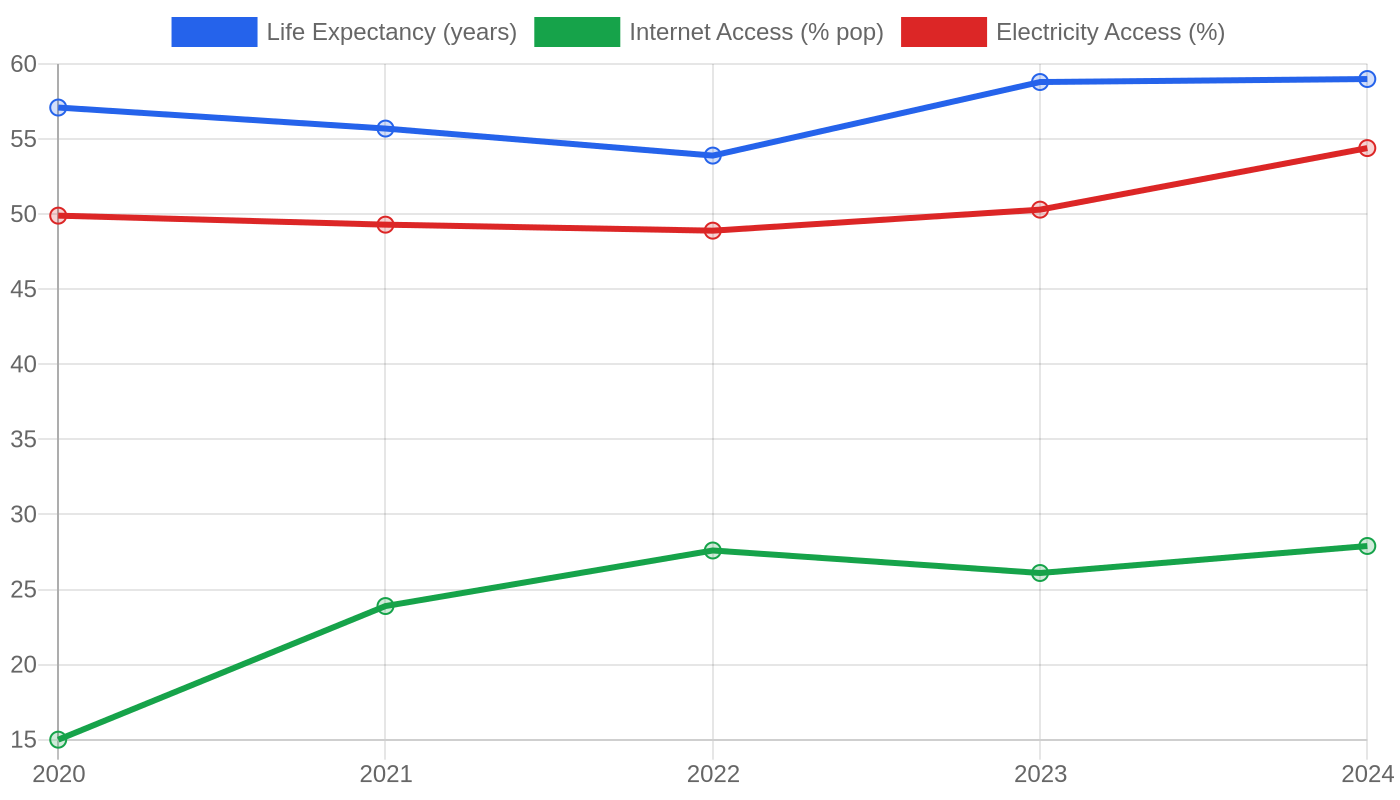
The World Bank’s data dashboard for Somalia is, to put it charitably, sparse. There are no figures for GDP growth, no inflation CPI readings, no unemployment rates, no GDP in current US dollars, no GDP per capita based on purchasing power parity, no GNI per capita, and no population estimate. This is not a data oversight — it is a data statement. Somalia’s economy, for all its resilience, remains largely invisible to the international statistical apparatus that tracks most of the world.
What we do know, however, is that the absence of numbers does not mean the absence of economic activity. Somalia’s main industries, though unspecified in the available data, are widely understood to include livestock, remittances, telecommunications, and a modest but growing financial sector.
The country’s informal economy is vast, with much of the population relying on diaspora remittances — estimated by various sources to account for a significant share of household income — and pastoralist agriculture that rarely makes it into national accounts.
The inflation picture is similarly opaque, but anecdotal evidence from regional reports suggests that food prices in Mogadishu and other urban centers have been volatile, driven by import dependence and seasonal shocks. Without a formal CPI reading from the World Bank, it is impossible to say with precision how the cost of living has evolved, but the lived experience of Somalis — particularly in the wake of drought and global commodity price swings — suggests significant pressure on household budgets.
The unemployment data gap is perhaps the most telling: in a country where formal wage employment is the exception rather than the rule, traditional unemployment metrics capture very little of the economic reality.
The Cost of Living — Invisible Expenses, Tangible Strain
With no official cost of living data from the World Bank, any assessment of daily expenses in Somalia must rely on what is known about the broader regional context. Somalia is one of the poorest countries in the world by any measure, and the cost of living — particularly in Mogadishu, Hargeisa, and Bosaso — is shaped by extreme import dependence. Most consumer goods, from rice to cooking oil to fuel, are imported, which means global price shocks transmit directly to local markets.
Housing costs vary dramatically by location and security situation. In relatively stable areas of Somaliland, rents for modest homes are significantly lower than in Mogadishu, where insecurity and displacement have created a distorted housing market. Homeownership, for most Somalis, is not a financial decision but a necessity born of extended family networks and clan-based land tenure systems.
Daily expenses for a typical urban household are dominated by food, water, and transportation — the latter often involving informal taxi services like Hargeisa Taxi, one of the country’s notable companies. Compared to regional averages in East Africa, Somalia’s cost of living is likely lower in absolute terms but higher as a share of income, given the limited formal employment opportunities.
Investment & Business Climate — Telecom Titans and Banking Beginnings
Somalia’s business environment is a study in contrasts. The list of top companies reveals a private sector that has adapted to decades of state weakness with remarkable ingenuity. Hormuud Telecom and Golis Telecom Somalia dominate the telecommunications space, providing mobile money services that have effectively replaced traditional banking for millions of Somalis.
These firms are not just utilities — they are the backbone of Somalia’s financial inclusion, enabling remittances, payments, and savings in a country where physical bank branches are scarce.
The financial sector is also represented by the Central Bank of Somalia, First Somali Bank, and Bank of Somaliland, indicating a slow but real effort to rebuild formal monetary infrastructure. The presence of Bosaso Tannery in the industrials category points to the continued importance of livestock and leather processing, while Hafun Fishing Company highlights the potential of Somalia’s long coastline for commercial fishing — a sector that remains vastly underdeveloped due to piracy and lack of investment.
Air Somalia and Eastern Television Network round out the consumer services landscape, suggesting that media and transport are slowly re-emerging as viable commercial ventures. For investors, the key challenge is not a lack of opportunity but a lack of security, legal predictability, and reliable data on which to base decisions.
Safety, Politics & Quality of Life — Governing Without Numbers
Somalia’s political structure, as described by the World Bank data, is a federal parliamentary representative democratic republic, with the president as head of state and commander-in-chief of the Somali Armed Forces, and the prime minister as head of government. This formal framework, however, operates in a context where the federal government’s authority is contested by regional states, clan-based power structures, and the ongoing threat from Al-Shabaab.
The Crime Index and Safety Index from the data are listed as N/A, which is itself a telling indicator: in many parts of Somalia, crime data is either not collected or not reliable enough to report.
Quality of life for the average Somali is shaped by these security realities. Access to education, healthcare, and clean water remains limited, particularly in rural areas and internally displaced persons camps. The absence of happiness or well-being data from the World Bank is another gap that speaks volumes — when basic survival is the daily priority, subjective well-being metrics are a luxury few can afford.
For Somalis in relatively stable regions like Somaliland, the quality of life is markedly better, but the country as a whole remains one of the most challenging environments for human development in the world.
What’s Happening Now — The Quiet Rebuilding
While the data provided does not include recent news reports or live indicators, the broader context suggests that Somalia is in a period of quiet, uneven rebuilding. The federal government, supported by international partners, has been working to strengthen the Central Bank of Somalia and formalize the financial sector, recognizing that a stable currency and banking system are prerequisites for sustained investment.
Telecommunications firms like Hormuud Telecom continue to expand their mobile money platforms, effectively leapfrogging traditional banking infrastructure in a way that mirrors developments in other parts of East Africa.
The political landscape remains fluid, with federal-state relations a constant source of tension. The president’s role as commander-in-chief is tested daily by the security situation, and the prime minister’s ability to govern is constrained by the need to balance clan interests, regional demands, and international donor expectations.
For businesses like Bosaso Tannery and Hafun Fishing Company, the operating environment is one of high risk and potentially high reward — if security improves and infrastructure develops, Somalia’s economic potential could be significant. The absence of recent news data in this report is itself a reminder that Somalia often falls off the global radar, even as its people and entrepreneurs continue to build an economy from the ground up.
The Bottom Line
Somalia is not a country for the faint-hearted investor or the risk-averse policymaker. It is, however, a country that deserves more attention than the blank spaces in its World Bank data suggest. The resilience of its private sector, the ingenuity of its telecom and financial firms, and the determination of its people to rebuild after decades of collapse make it a unique case study in economic survival.
For those tracking frontier markets, fragile states, or the future of mobile money in low-income settings, Somalia is a story worth watching — even when the numbers aren’t there to tell it.
Sources & Methodology
This article is authored by Economic Pulse Net for informational and research purposes. Economic Pulse Net sources its data from multilateral institutions, national statistics bureaus, and proprietary databases. All data is believed to be current as of the date of publication.
Published: July 20, 2026 | Category: Research — Somalia
Use these signals in your own platform
Economic Pulse publishes its live signal feed through a documented, read-only API. Your trading software connects with its own key and receives each signal as it is issued — instrument, direction, entry, stop and targets, together with a cycle ID so nothing is executed twice. The feed is independent of this website and cannot change it.
Signals are informational only and are not financial advice.