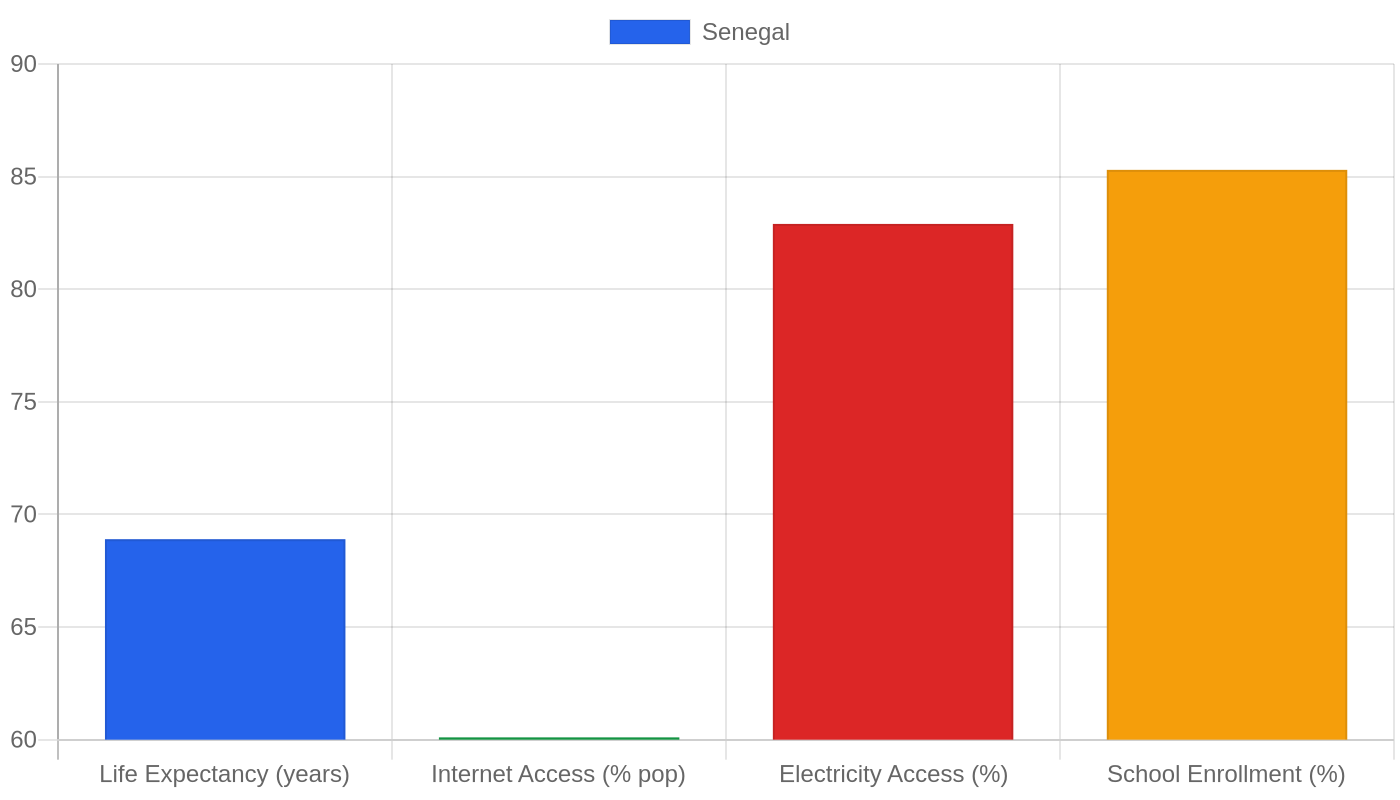
Economic Pulse Net | Sources: World Bank World Development Indicators, Government Sources | 2026
Key Takeaways
– Political Stability as Currency: Senegal remains one of West Africa’s most politically stable nations, with a republican system that has seen peaceful transfers of power since independence, a rare commodity in the region.
– Aviation and Infrastructure at the Forefront: The nation’s corporate landscape is dominated by aviation and transport, signaling a strategic bet on connectivity and regional trade.
– A State-Led Economic Model: From electricity generation (Senelec) to postal services (La Poste) and rail (Dakar–Niger Railway), state-owned enterprises remain the backbone of the economy.
– Telecommunications as a Growth Pillar: With Sonatel and Ikatel anchoring the sector, telecom is emerging as a critical driver of modernization and foreign investment.
– Leadership with a Literary Legacy: Senegal’s founding president, Léopold Sédar Senghor, set a unique cultural tone for governance, being the first African elected to the Académie française.
The Economic Engine: Aviation, Energy, and the Search for Data
The World Bank’s latest data snapshot for Senegal presents a curious paradox: headline figures for GDP growth, inflation, and unemployment are currently unavailable, leaving analysts to paint the picture through the country’s corporate structure and policy direction. What emerges is a nation doubling down on its role as a regional hub.
The dominance of aviation companies—Air Sénégal International, Atlantis Airlines, Groupement Aérien Sénégalais, and Senegal Airlines—suggests a deliberate strategy to position Dakar as a gateway to West Africa. This is not accidental; a country that prioritizes air travel infrastructure is betting on business mobility, tourism, and export-oriented services rather than relying solely on commodity extraction.
The energy sector, anchored by Senelec (the national electricity utility), is arguably the most critical piece of the puzzle. For any developing economy, reliable power is the difference between industrial takeoff and stagnation. Senelec’s prominence in the corporate rankings indicates that the state is still the primary guarantor of energy access, a double-edged sword: it ensures control over a vital resource but also exposes the government to fiscal strain when fuel prices fluctuate globally.
Similarly, the Dakar–Niger Railway represents a historic commitment to overland trade, connecting Senegal’s port to the landlocked economies of the Sahel. This railway is not just a piece of nostalgia; it is a commercial artery that could reduce logistics costs for regional commerce, though its modernization has been a perennial challenge.
The absence of hard inflation or GDP numbers from the World Bank means we must read the tea leaves. A nation with this corporate profile is likely experiencing moderate growth, driven by services and infrastructure spending, but it faces the classic West African headwinds: exposure to global commodity prices, weather-dependent agriculture, and a youthful population hungry for employment.
Unemployment data being unavailable is itself a story—it suggests either data collection gaps or a labor market that is largely informal, where traditional metrics fail to capture the hustle economy of Dakar’s streets. The bottom line is that Senegal is structurally sound but statistically opaque, a combination that demands cautious optimism from economists and investors alike.
The Cost of Living: Dakar’s Double-Edged Sword
Without specific price indices from the World Bank, we must look at the broader picture of what it means to live in Senegal’s urban centers. Dakar, as a coastal capital with a growing service sector, is notoriously more expensive than the rest of the country—a pattern seen across West Africa where capital cities act as economic magnets, inflating housing and food costs for the middle class.
The presence of a robust aviation sector suggests a steady flow of expatriates, business travelers, and regional diplomats, all of whom drive demand for premium housing in neighborhoods like Almadies or Ngor. This creates a bifurcated market: luxury apartments for the elite and international workers, versus crowded suburban settlements where most residents rely on informal transport and open-air markets for daily needs.
Renting is the dominant tenure in Dakar, as it is in most of the region, given that mortgage penetration remains low and land ownership is often tangled in customary law and bureaucratic delays. For a young professional, a significant portion of income likely goes to rent and utilities, especially electricity from Senelec, which, while state-controlled, still requires households to budget for it carefully.
The cost of daily staples—rice, fish, millet, and onions—is subject to seasonal swings and import prices, meaning that inflation, even if unmeasured, is a lived reality for the average Senegalese family. Compared to regional neighbors, Senegal’s cost of living is moderate but rising, particularly as Dakar cements its status as a diplomatic and business hub.
The lack of hard data makes it difficult to quantify, but the structural indicators point to a city where the middle class feels the squeeze, even as the economy nominally grows.
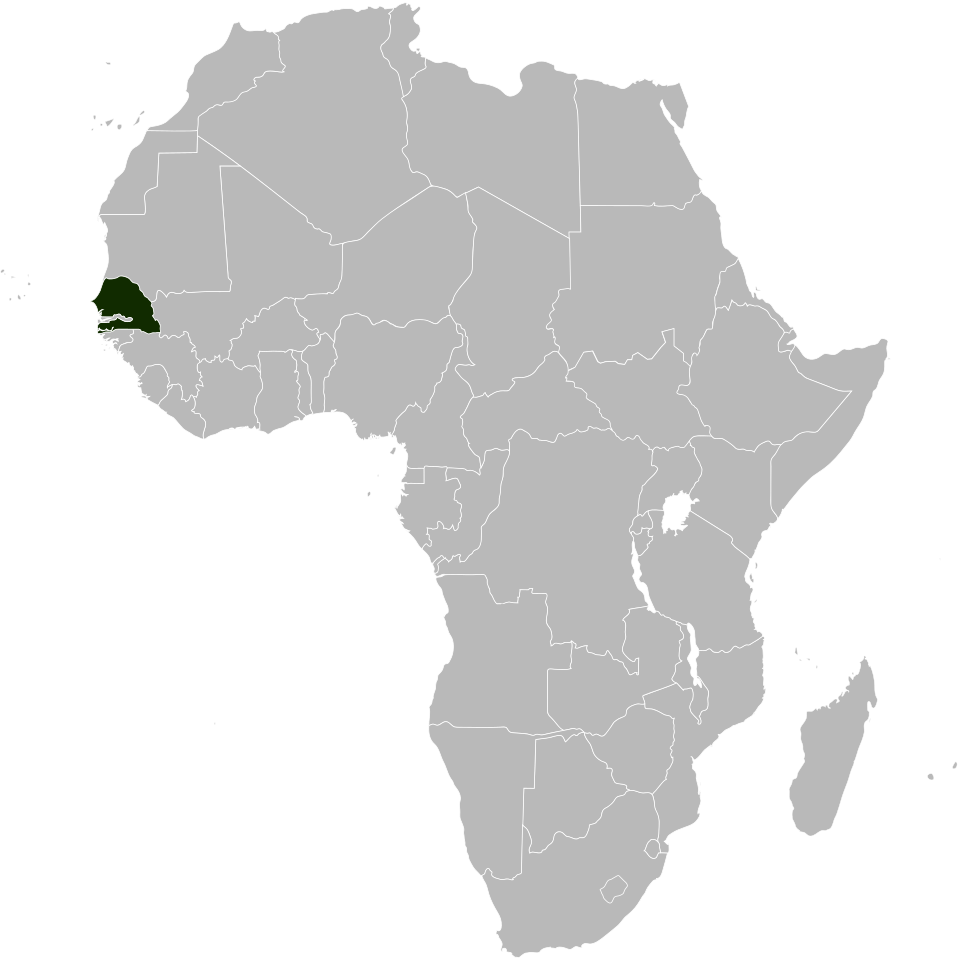
Investment & Business Climate: A State-Backed Bet on Connectivity
For investors, Senegal presents a landscape where the state is both a partner and a competitor. The corporate top ten reveals a heavy tilt toward consumer services and utilities, with minimal representation from manufacturing or tech startups—yet this is changing. Sonatel, the telecommunications giant, is the crown jewel, offering a lucrative entry point for those looking to profit from the digital economy.
Ikatel, another telecom player, signals that the sector is competitive enough to support multiple operators, a healthy sign for service quality. The challenge for foreign direct investment is navigating a system where state-owned enterprises like Senelec and La Poste dominate strategic sectors, meaning that private players often need government partnerships to scale.
The aviation cluster is the most intriguing investment story. With four major airlines operating under the Senegalese flag or with significant local ties, there is clear political will to make Dakar’s Léopold Sédar Senghor International Airport—or its newer replacement, Blaise Diagne International Airport—a regional crossroads. This is a bet on the future of pan-African trade and tourism, particularly as other West African hubs face insecurity.
However, the airline industry is notoriously capital-intensive and prone to failure, as the history of African carriers shows. Investors should watch whether these companies are profitable or sustained by state subsidies, as the latter would indicate a strategic rather than commercial rationale. The business climate is improving, but it rewards those with patience and local knowledge, not those seeking quick exits.
Safety, Politics & Quality of Life: The Legacy of Senghor’s Republic
Senegal’s political landscape is a testament to the power of institutional memory. The country’s first president, Léopold Sédar Senghor, was a poet and writer—the first African elected to the Académie française—which set a cultural precedent for governance that values intellectualism and diplomacy. His successor, Abdou Diouf, went on to serve as the Organisation’s general secretary, further cementing Senegal’s reputation as a nation of statesmen rather than strongmen.
This lineage matters for quality of life: it has fostered a political culture where elections, though periodically changing in term length (seven years, then five, then seven, then five again as of 2016), are conducted with a degree of civility that is uncommon in the region.
In terms of safety, the absence of a crime index from the provided data is notable, but Senegal’s reputation as a stable, low-conflict nation is well-earned. Compared to its Sahelian neighbors, Senegal has largely avoided jihadist insurgencies and military coups, making it a refuge for international organizations and a safe base for regional operations.
The quality of life, however, is a mixed bag: the cultural richness, music scene, and coastal beauty are world-class, but infrastructure gaps in power and transport can test residents’ patience. The political system, with its five-year presidential terms, ensures regular accountability, though the dominance of state-linked companies means that economic power and political power often overlap.
For the average citizen, the trade-off is clear: stability and freedom of expression in exchange for an economy that has yet to fully deliver on its promise of widespread prosperity.
What’s Happening Now: The Dakar Crossroads
Right now, Senegal is at a strategic inflection point, driven by its corporate heavyweights and regional positioning. The continued operation of four aviation companies suggests that the government is aggressively pursuing an “open skies” policy, aiming to capture transit traffic that might otherwise go to larger hubs. This is happening against a backdrop of regional volatility, where Senegal’s relative safety makes it an increasingly attractive destination for headquarters and logistics bases.
The telecommunications sector, led by Sonatel, is likely expanding its mobile money and data services, a critical driver of financial inclusion in a country where traditional banking penetration is low. Meanwhile, Senelec is presumably grappling with the dual challenge of expanding grid access to rural areas while transitioning to renewable energy sources, a pressure point for international climate finance.
Politically, the shift to five-year presidential terms (as of 2016) indicates a government that is trying to balance stability with responsiveness, though it also reflects the compromises inherent in coalition politics. The legacy of Senghor and Diouf looms large, and the current leadership must navigate the expectations of a youthful population that is more connected, more educated, and less willing to wait for the fruits of development.
The absence of recent inflation data is frustrating, but the structural story is clear: Senegal is betting on connectivity—by air, by rail, and by data cable—to leapfrog its way into the middle-income bracket. The question is whether the state-led model can move fast enough to satisfy a generation that measures progress in gigabytes per second, not in five-year plans.
The Bottom Line
Senegal is a country to watch for anyone interested in West Africa’s future, not because it is flashy, but because it is foundational. If the aviation and telecom bets pay off, Senegal could become the Singapore of West Africa—a small, stable, service-oriented hub that punches above its weight. For investors, the opportunity lies in partnering with state entities rather than competing against them.
For policymakers, Senegal offers a case study in how political stability can be maintained across decades, even as economic data remains frustratingly opaque. The bottom line: this is a nation with the right instincts and the wrong numbers—but in the world of emerging markets, instincts often count for more.
Sources & Methodology
This article is authored by Economic Pulse Net for informational and research purposes. Economic Pulse Net sources its data from multilateral institutions, national statistics bureaus, and proprietary databases. All data is believed to be current as of the date of publication.
Published: August 10, 2026 | Category: Research — Senegal
Use these signals in your own platform
Economic Pulse publishes its live signal feed through a documented, read-only API. Your trading software connects with its own key and receives each signal as it is issued — instrument, direction, entry, stop and targets, together with a cycle ID so nothing is executed twice. The feed is independent of this website and cannot change it.
Signals are informational only and are not financial advice.