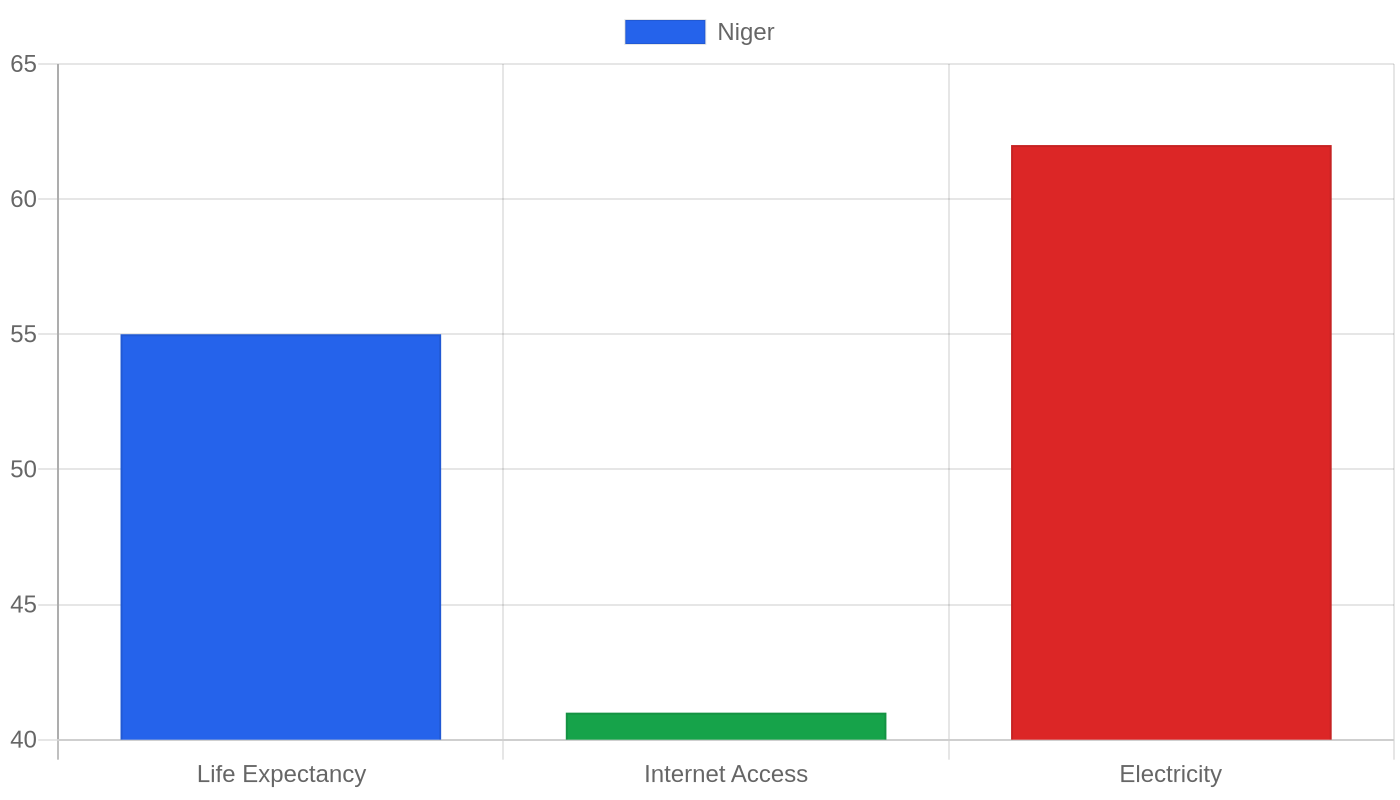
Economic Pulse Net | Sources: World Bank World Development Indicators, Government Sources | 2026
Key Takeaways
* Political Transition: The July 2023 coup d’état has fundamentally altered Niger’s governance structure, dissolving the constitution and placing the government under the leadership of Omar Tiani, creating a new era of political uncertainty.
Data Scarcity: Official macroeconomic indicators, including GDP growth, inflation, and unemployment rates, are currently unavailable from the World Bank, reflecting the disruption in data collection and reporting during the transition period.
State-Led Economy: The business landscape is dominated by state-owned or state-influenced entities, particularly in utilities, telecommunications, and basic materials, with key players like NIGELEC, SONIDEP, and COMINAK.
Infrastructure Focus: The presence of companies in transport, energy, and telecommunications highlights the critical infrastructure challenges and opportunities within the country.
Stability Concerns: With crime and safety indices also unavailable, the primary risk for external observers and investors remains the political transition and its impact on national stability.
The Shadow of Missing Metrics
In the current economic landscape of Niger, the most striking feature is the absence of reliable, up-to-date macroeconomic data. According to the World Bank, key indicators such as GDP growth, inflation (CPI), unemployment, and total GDP value are all listed as “N/A.” This data vacuum is not merely a statistical oversight; it is a direct reflection of the profound political and administrative disruption following the July 2023 coup d’état.
For an emerging economy, the inability to track inflation and employment is a significant warning sign, as it hampers the ability of policymakers to implement targeted economic interventions and makes it difficult for international partners to assess the true health of the nation. The lack of a reported GDP per capita or GNI per capita further obscures the standard of living and economic productivity, leaving analysts to rely on qualitative assessments rather than quantitative metrics.
This period of data opacity suggests that the formal economic reporting mechanisms have been strained or suspended, a common occurrence during abrupt political transitions where institutional continuity is broken. Consequently, any economic analysis of Niger must currently be framed within the context of institutional fragility rather than traditional market performance.
The Cost of Living in a Data Vacuum
With official cost of living indices and specific housing or daily expense data unavailable, assessing the standard of living in Niger requires a focus on the structural components of the economy rather than specific price points.
The dominance of state-owned enterprises in essential services, such as NIGELEC in utilities and Niger Poste in industrials, suggests that basic service delivery remains a central pillar of daily life, though potentially subject to the inefficiencies or subsidies often associated with state monopolies.
While specific rent-versus-buy comparisons or regional average costs cannot be cited due to the lack of provided data, the presence of major consumer service providers like Arik Niger and Dounia TV indicates a functioning, albeit state-influenced, market for basic consumer needs. The economic reality for the average citizen is likely defined by the stability of these state-provided services rather than market-driven price fluctuations.
In the absence of precise CPI data, the cost of living is best understood through the lens of access to these fundamental utilities and services, which remain the backbone of the national economy.
State Power and the Business Landscape
The corporate sector in Niger is heavily characterized by state-owned or state-controlled entities, reflecting a government-centric approach to economic management. Key players include NIGELEC, the national utility provider, and SONIDEP, which operates in the oil and gas sector, highlighting the importance of energy resources to the nation’s industrial base.
In the basic materials sector, COMINAK and SOMAIR stand out as major entities, likely playing significant roles in mining and raw material extraction, which are vital for export revenue. The consumer services sector is also dominated by state-linked brands, including Arik Niger, Dounia TV, and the Office of Radio and Television of Niger, indicating that media and telecommunications are viewed as strategic national assets.
Additionally, Sociéte Nigerienne de Transports de Voyageurs points to the critical infrastructure role of state-managed transport networks. This structure suggests that private enterprise operates within a framework heavily shaped by state priorities, where access to markets and resources is often mediated through these large, established institutions rather than through open, competitive market forces.
Safety, Politics, and the New Order
The political landscape of Niger has undergone a radical transformation since the July 2023 coup d’état, which resulted in the dissolution of the constitution and the removal of the previous executive structure. The government is now led by Omar Tiani, marking a shift from the semi-presidential system established by the 2010 constitution to a new, undefined political reality.
With the constitution dissolved, the legal framework governing executive power and civil liberties is in a state of flux, creating an environment where political stability is the primary concern for both citizens and external observers. Crime and safety indices are currently unavailable, which prevents a quantitative assessment of the security situation, but the political upheaval itself is a significant factor in public safety and social cohesion.
The transition from a constitutional framework to a de facto military-led administration introduces inherent risks, as the rule of law and institutional checks and balances are temporarily suspended or redefined. This political uncertainty casts a long shadow over all other aspects of quality of life, including economic confidence and social stability.
Current Affairs: The Aftermath of the Coup
The most pressing issue in Niger today is the consolidation of power following the July 2023 coup d’état. The dissolution of the constitution and the appointment of Omar Tiani as the leader of the government represent a break with the democratic norms established in the 2010 referendum, setting the stage for a prolonged period of political transition.
This shift has immediate implications for international relations, as the country navigates its new geopolitical alignment while managing domestic expectations for stability and economic improvement. The lack of recent economic data from sources like the World Bank underscores the disruption to normal governance and statistical reporting, suggesting that the administration is still in the process of re-establishing functional institutional processes.
As the government seeks to legitimize its rule, the focus is likely shifting from immediate political crisis management to the practical challenges of rebuilding economic confidence and restoring basic services. The business environment is adapting to this new reality, with state-owned enterprises likely playing a more central role in maintaining essential services during this transition period.
The Bottom Line
Niger is a country in the midst of a profound political and institutional transition, where the absence of reliable economic data is as significant as the political changes themselves. Investors and observers should watch this country closely not for its current market performance, but for its potential to stabilize and re-establish functional economic institutions.
The dominance of state-owned enterprises in key sectors like energy, mining, and telecommunications suggests that any future economic recovery will be heavily influenced by the efficiency and transparency of these state entities. Ultimately, the outlook for Niger depends on the government’s ability to navigate the post-coup landscape, restore constitutional order, and rebuild the data infrastructure necessary for transparent economic management.
Sources & Methodology
This article is authored by Economic Pulse Net for informational and research purposes. Economic Pulse Net sources its data from multilateral institutions, national statistics bureaus, and proprietary databases. All data is believed to be current as of the date of publication.
Published: September 08, 2026 | Category: Research — Niger
Use these signals in your own platform
Economic Pulse publishes its live signal feed through a documented, read-only API. Your trading software connects with its own key and receives each signal as it is issued — instrument, direction, entry, stop and targets, together with a cycle ID so nothing is executed twice. The feed is independent of this website and cannot change it.
Signals are informational only and are not financial advice.