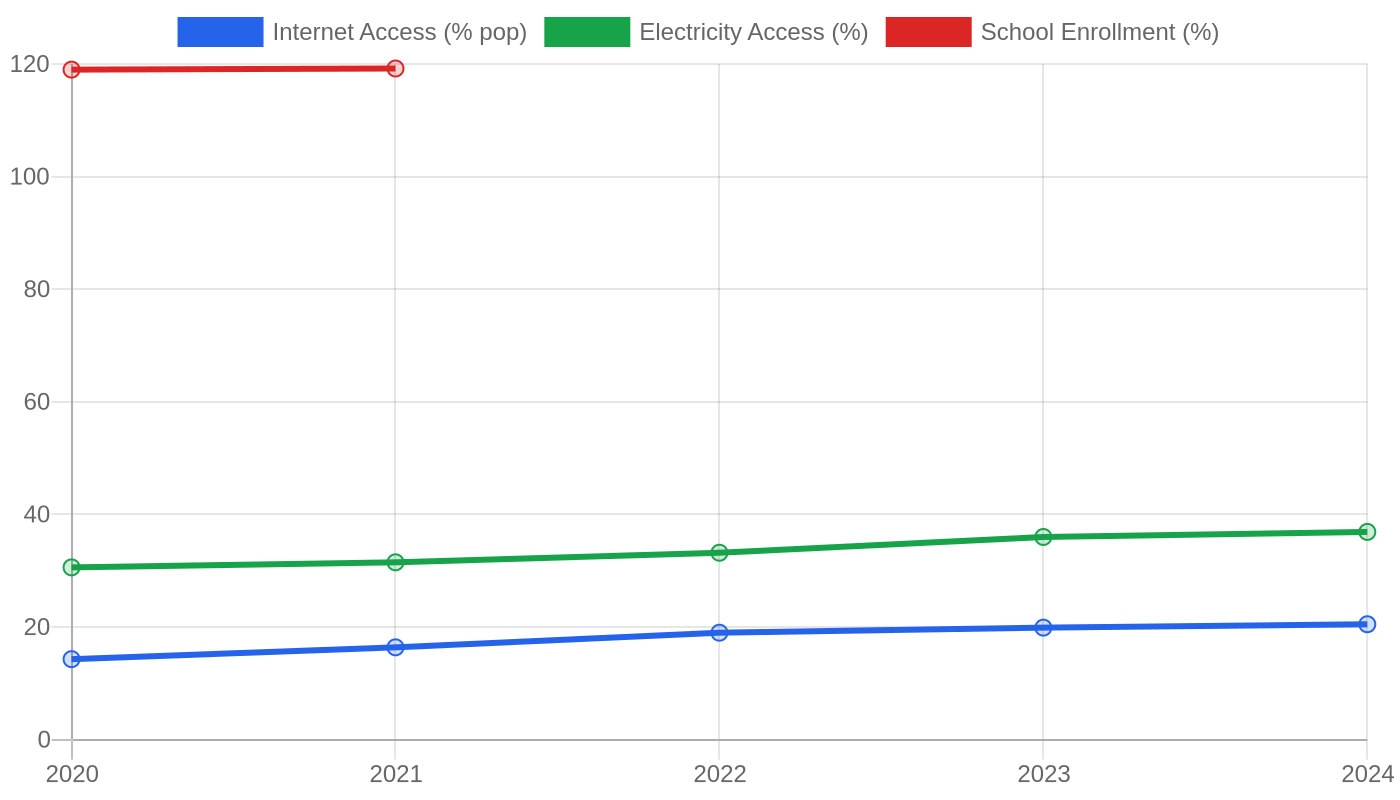
Economic Pulse Net | Sources: World Bank World Development Indicators, Government Sources | 2026
Key Takeaways
– Mozambique’s economy is defined by its vast untapped natural gas reserves, yet chronic infrastructure gaps and political instability continue to stall a long-promised transformation.
– The country’s top companies are dominated by state-linked utilities, transport, and banking — a reflection of an economy still heavily dependent on public sector coordination.
– Mozambique’s political system concentrates significant power in the presidency, with the head of state serving as both head of government and commander-in-chief, shaping the business environment.
– Despite being one of Africa’s most resource-rich nations, the absence of recent World Bank data on GDP, inflation, and employment underscores the challenge of tracking an economy operating in a data vacuum.
– For investors, Mozambique remains a high-risk, high-reward proposition — the gas wealth is real, but so are the governance and security hurdles.
The Numbers Gap — What We Don’t Know Tells Its Own Story
The World Bank, the international body that tracks the economic pulse of nearly every nation on earth, currently reports no recent figures for Mozambique’s GDP growth, inflation rate, or unemployment level. That data vacuum is itself a story.
It speaks to an economy where formal statistical collection struggles to keep pace with the realities on the ground — a sprawling informal sector, provincial economies that operate almost independently from the capital Maputo, and a state apparatus that has historically lacked the resources to conduct comprehensive national surveys.
What we do know is that Mozambique sits on some of the largest natural gas deposits discovered in Africa in the last decade. The World Bank has long flagged this resource wealth as a potential game-changer for a country where the majority of the population still depends on subsistence agriculture. But transforming gas reserves into broad-based prosperity requires more than drilling rigs. It demands ports, pipelines, power grids, and a workforce with technical skills — all of which remain underdeveloped.
The main industries that do register in the formal economy are telling. Mozambique Ports and Railways, the Beira Railroad Corporation, and Electricidade de Moçambique are among the top companies by recognition. These are not Silicon Valley startups or financial tech disruptors. They are the bones of an industrial economy — transport corridors, energy utilities, logistics.
This suggests an economy still in a foundational phase, where the primary task is building the physical infrastructure to move goods and power from where they are produced to where they are needed.
The Cost of Living — A Tale of Two Mozambiques
For the average Mozambican, daily expenses are shaped by geography as much as income. In Maputo, the capital and economic hub, prices for basic goods — rice, cooking oil, soap, fuel — track regional averages for Southern Africa, driven by the city’s port connectivity and concentration of formal employment. But outside the capital, in the rural provinces of Nampula or Zambezia, the cost of living is a different calculation entirely.
There, goods are more expensive because transport links are poor, and incomes are lower because the cash economy is thinner.
Housing tells a similar story. In Maputo’s better neighborhoods, rents for a modest apartment can consume a large share of a formal-sector salary. Buying property remains out of reach for most, as mortgage financing is limited and land tenure systems can be opaque. The concept of “rent versus buy” is largely irrelevant for the majority of Mozambicans, who build their own homes using traditional materials or rent informally from extended family networks.
The World Bank has noted in past reports that housing affordability in Mozambique is less a question of market prices and more a question of access to secure land titles and basic services like running water and electricity.
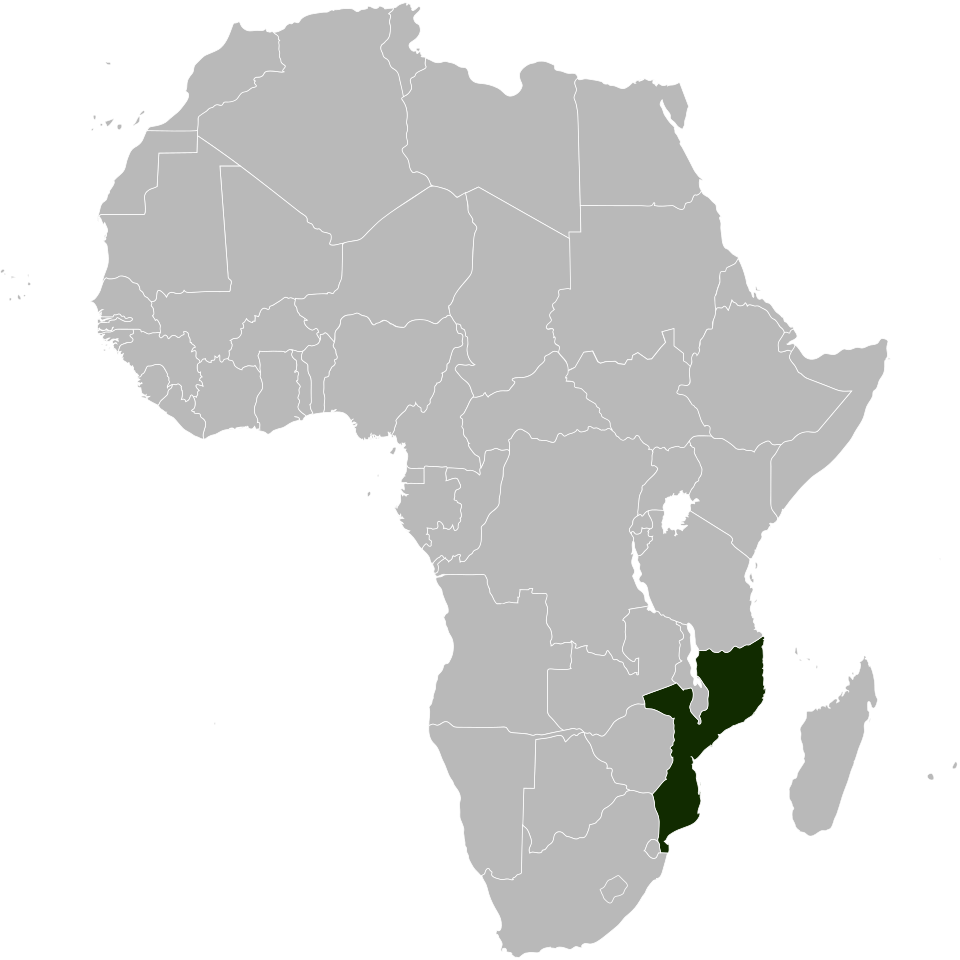
Investment & Business Climate — The State as Gatekeeper
The list of Mozambique’s most prominent companies reads like a directory of state capitalism. The Bank of Mozambique is the central bank. Banco Nacional de Investimento is the state development bank. Electricidade de Moçambique controls the power grid. Mozambique Ports and Railways and the Beira Railroad Corporation manage the country’s critical transport corridors. Correios de Moçambique runs the postal service.
Even in aviation, the major carriers — LAM Mozambique Airlines, Kaya Airlines, Air Corridor, and Moçambique Expresso — are either state-owned or heavily state-influenced.
For a foreign investor, this concentration means that doing business in Mozambique often means doing business with the government. The sectors to watch are those where the state is actively seeking private capital: natural gas extraction, transport logistics, and energy generation. The country’s offshore gas fields in the Rovuma Basin have attracted some of the world’s biggest energy companies, but progress has been repeatedly delayed by security concerns and political uncertainty.
The business environment remains challenging — bureaucratic red tape, corruption perceptions, and the difficulty of enforcing contracts are well-documented hurdles that the World Bank has flagged in its Ease of Doing Business surveys.
Safety, Politics & Quality of Life — Power at the Top
The political landscape of Mozambique is defined by a constitution that concentrates extraordinary authority in a single office. The President of the Republic functions as head of state, head of government, and commander-in-chief of the armed forces. They are directly elected for a five-year term, and they appoint the prime minister, who chairs the cabinet and coordinates government functions.
This structure creates a system where policy direction, security strategy, and economic management all flow from the presidency.
That concentration of power has implications for safety and stability. In recent years, Mozambique has faced a significant insurgency in the northern province of Cabo Delgado — the very region where the gas fields are located. The security situation there has disrupted investment timelines and displaced hundreds of thousands of people.
The national statistics bureau and international humanitarian organizations have documented the human cost, even if comprehensive crime and safety indices are currently unavailable. For ordinary Mozambicans, quality of life varies enormously by region — relatively stable and connected in the south, more precarious and isolated in the north.
What’s Happening Now — The Gas Clock Is Ticking
The most pressing story in Mozambique today is the race to bring the Rovuma Basin gas projects online. After years of delays caused by the insurgency and the global energy price shock, there are signs of renewed momentum. Government officials have been signaling that security conditions in Cabo Delgado have improved enough to resume full-scale construction.
International energy companies are watching closely — Mozambique’s gas could supply European markets seeking alternatives to Russian supply, giving the country a strategic importance it has never had before.
At the same time, the political calendar is moving. With presidential elections on the horizon, the current government is under pressure to show progress on economic development and security. The prime minister’s office has been coordinating efforts to attract foreign investment while managing the fiscal challenges of a state that depends heavily on foreign aid and commodity revenues. The Bank of Mozambique has been navigating currency pressures and inflation imported from global markets.
For a country that has been promised a gas-fueled transformation for over a decade, the window of opportunity is narrowing. The world’s appetite for new fossil fuel projects is not infinite, and Mozambique must demonstrate that it can deliver.
The Bottom Line
Mozambique is a country of vast potential and persistent friction. For investors with long time horizons and high risk tolerance, the gas sector offers a rare frontier opportunity. For development economists and aid organizations, the challenge remains how to ensure that resource wealth translates into better lives for a population still waiting for the dividends of extraction.
Anyone watching Africa’s energy future should have Mozambique on their radar — but they should also understand that in this country, the gap between promise and delivery has historically been wide.
Sources & Methodology
This article is authored by Economic Pulse Net for informational and research purposes. Economic Pulse Net sources its data from multilateral institutions, national statistics bureaus, and proprietary databases. All data is believed to be current as of the date of publication.
Published: July 16, 2026 | Category: Research — Mozambique
Use these signals in your own platform
Economic Pulse publishes its live signal feed through a documented, read-only API. Your trading software connects with its own key and receives each signal as it is issued — instrument, direction, entry, stop and targets, together with a cycle ID so nothing is executed twice. The feed is independent of this website and cannot change it.
Signals are informational only and are not financial advice.