Economic Pulse Net | Sources: World Bank World Development Indicators, Government Sources | 2026
For decades, Mozambique has been a story of paradoxes: a country blessed with vast natural gas reserves yet grappling with profound poverty; a nation that emerged from a brutal civil war only to face a simmering Islamist insurgency in its northern provinces. As the global economy pivots toward energy security and critical minerals, this Indian Ocean nation finds itself thrust into the geopolitical spotlight.
The question for investors, policymakers, and citizens alike is whether Mozambique can finally translate its immense resource wealth into broad-based prosperity—or whether the old patterns of fragility will continue to hold the country back. This is a nation whose trajectory matters far beyond its borders, and the decisions made in Maputo over the next several years will reverberate across southern Africa.
Key Takeaways
– Energy Superpower in Waiting: Mozambique sits on some of the most significant natural gas discoveries in Africa, positioning it as a potential major global liquefied natural gas exporter, yet the full realization of this potential remains stalled by security concerns and financing hurdles.
– Infrastructure as the Backbone: The country’s economic identity is deeply tied to its transport corridors, with the Mozambique Ports and Railways and the Beira Railroad Corporation serving as critical arteries for both domestic commerce and landlocked neighbors.
– A State-Led Economy: From the central bank to the national investment bank and the electricity utility, state-owned enterprises dominate the economic landscape, creating both opportunities for coordinated development and risks of inefficiency.
– Political Stability is the Watchword: The constitutional framework concentrates significant power in the presidency, and the political climate remains a key variable for any economic forecast.
– A Nation in Transition: With a young population and strategic geographic position, Mozambique’s long-term potential is undeniable, but near-term challenges around safety, governance, and economic diversification remain pressing.
Macro-Economic Terrain: Waiting for the Data to Catch Up
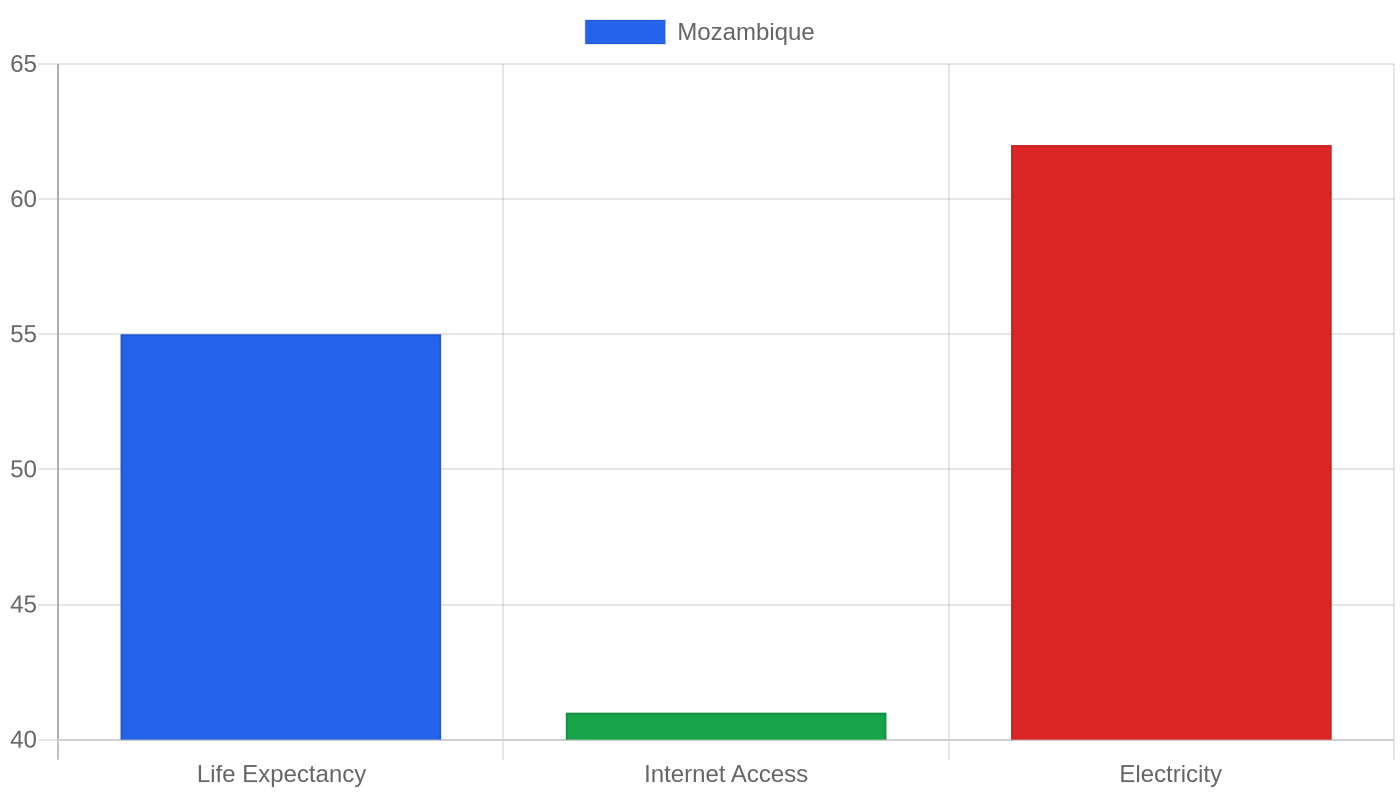
When examining Mozambique through the lens of the World Bank’s latest data, a journalist encounters an unusual challenge: the headline indicators—GDP growth, inflation, unemployment, and even GDP per capita—are currently listed as unavailable. This absence of hard numbers is itself a story. It speaks to a country whose statistical infrastructure is still developing, and where the informal economy likely plays a far larger role than official tallies can capture.
However, the lack of fresh data points does not mean the economy is static. On the contrary, Mozambique is in a state of profound flux, driven by the massive natural gas projects in the Rovuma Basin, which have attracted tens of billions in foreign direct investment over the past decade.
While the World Bank’s latest figures are pending, the structural picture is clear: this is an economy transitioning from a reliance on mega-projects and aluminum exports to one that hopes to be powered by liquefied natural gas.
The inflationary and employment picture is equally opaque in the official statistics, but the underlying realities are well understood. Mozambique has historically experienced double-digit inflation during food and fuel price shocks, and the unemployment rate, while officially moderate, masks a vast underemployment problem where most citizens work in subsistence agriculture or the informal sector.
The GDP composition is shifting, but the country remains heavily dependent on capital-intensive extractive industries that generate significant export revenue but relatively few jobs. The services sector, including the consumer-facing companies like LAM Mozambique Airlines and Kaya Airlines, is growing but from a low base. The key economic narrative is one of duality: a modern, export-oriented enclave economy operating alongside a traditional, low-productivity domestic sphere.
Until the World Bank and other institutions release updated figures, analysts must rely on these qualitative assessments to understand the true state of the Mozambican economy.
The High Cost of Living: Navigating Daily Life in a Resource-Rich Nation
For the average Mozambican household, the cost of living is a daily negotiation with scarcity. While comprehensive cost-of-living indices are not currently available from the provided data, the structural factors driving prices are evident from the country’s economic profile. As a net importer of many food staples, refined fuels, and manufactured goods, Mozambique is highly susceptible to global commodity price swings.
When international prices rise, they are passed directly to consumers in Maputo, Beira, and Nampula, often with a significant markup due to logistical bottlenecks. The reliance on the transport corridors managed by entities like Mozambique Ports and Railways means that internal distribution costs are high, making goods more expensive in inland areas than at the coast.
Housing in the capital, Maputo, presents a stark contrast: luxury apartments catering to expatriate gas workers and a growing middle class command premium prices, while the majority of the population lives in informal settlements where access to clean water and reliable electricity—provided by Electricidade de Moçambique—remains inconsistent.
Comparing Mozambique to its regional peers is difficult without precise index numbers, but the general pattern is one of high structural costs relative to income levels. The GNI per capita figure, currently unavailable, would likely paint a picture of a low-income country where a significant portion of household expenditure goes toward food.
For those in formal employment, the presence of major employers like Banco Nacional de Investimento and the Bank of Mozambique offers some stability, but the public sector wage bill is often stretched. The daily reality for many is a reliance on informal markets and cross-border trade. The cost of living is not just an economic statistic; it is a political pressure point. When transport costs rise, or when the maize meal price spikes, it can quickly translate into social unrest.
Understanding the cost of living in Mozambique is therefore essential to understanding its political economy.
Investment and Business Climate: The Giants and the Gatekeepers
The corporate landscape of Mozambique is dominated by a mix of state-owned behemoths and consumer-facing service providers, a structure that defines the investment climate. At the heart of the formal economy are the financial institutions—the Bank of Mozambique, which serves as the central bank, and Banco Nacional de Investimento, the national development bank. These entities are not just market participants; they are the gatekeepers of capital and the architects of monetary policy.
For any foreign investor, understanding the priorities of these institutions is as important as understanding the geology of a gas field or the yield of a cashew crop. Alongside the banks, the industrial sector is anchored by the transport and logistics giants: Mozambique Ports and Railways and the Beira Railroad Corporation. These are the strategic assets that connect Mozambique’s mineral wealth to global markets and provide a vital service to landlocked neighbors like Zimbabwe, Zambia, and Malawi.
Investment in these corridors is seen as a regional public good, and their efficiency is a key indicator of the broader business climate.
The utilities sector, led by Electricidade de Moçambique, is another critical piece of the puzzle. Power generation and distribution are foundational to any industrial policy, and the country’s potential to become a regional energy hub extends beyond gas to include significant hydroelectric capacity. For investors, the opportunities are vast but come with caveats. The presence of state-owned enterprises means that the line between commercial interest and public policy is often blurred.
Deals are frequently negotiated at the highest political levels, and success depends on navigating a complex web of relationships. The consumer services sector, including airlines like LAM Mozambique Airlines, Moçambique Expresso, and Air Corridor, as well as the postal service Correios de Moçambique, indicates a growing domestic market, but these companies often struggle with operational challenges and competition from informal transport providers.
The business climate is one of high potential and high friction—a place where fortunes can be made in logistics and energy, but where patience and local knowledge are non-negotiable prerequisites.
Safety, Politics, and the Quality of Life: The Human Dimension
The political and security environment in Mozambique is the lens through which all other economic data must be viewed. The constitutional framework, as outlined in the country’s founding document, concentrates significant authority in the President of the Republic, who serves as head of state, head of government, and commander-in-chief of the armed forces.
This centralization of power provides for decisive governance, but it also means that the political temperature is heavily influenced by the personality and policies of the executive. The prime minister, appointed by the president, plays a coordinating role within the cabinet, but ultimate authority rests with the presidency. This structure has provided stability since the end of the civil war, but it also creates a winner-take-all dynamic that can heighten political tensions, particularly around election cycles.
Regarding safety and quality of life, the provided data does not include a specific crime index or safety index, which is a significant gap in our understanding. However, the broader regional context and the presence of a persistent insurgency in the northern province of Cabo Delgado—the very region housing the massive gas projects—paints a concerning picture. The security situation has forced a reevaluation of risk for both international investors and local communities.
For the average citizen, quality of life is more directly impacted by access to public services than by headline political debates. The efficiency of Correios de Moçambique, the reliability of the national airline, and the reach of the electrical grid are the tangible metrics that define daily existence.
The political landscape, with its emphasis on national unity under a strong presidency, is designed to foster a sense of cohesion, but the economic disparities between the resource-rich north and the more developed south remain a persistent challenge to that unity.
Current Affairs: The Pulse of a Nation in Flux
Right now, Mozambique is navigating a delicate moment. The most significant story remains the trajectory of the liquefied natural gas megaprojects. After years of delays caused by the security situation in Cabo Delgado, there is renewed, albeit cautious, optimism about a restart of major construction. The government has made security a top priority, but the situation on the ground remains tense. This is not just a corporate story; it is a national saga that will determine the country’s fiscal future.
If the projects proceed, Mozambique could see a transformation in its public finances, allowing for investment in health, education, and infrastructure. If they stall again, the country will continue to rely on the more modest revenues from existing industries and the goodwill of international donors.
Simultaneously, there is a quiet but steady push to diversify the economy beyond gas. The government is keenly aware of the “resource curse” risk and is promoting sectors like agriculture, tourism, and manufacturing. The performance of state-owned enterprises like Electricidade de Moçambique and the transport companies is under increased scrutiny, with pressure to improve efficiency and governance.
The central bank, the Bank of Mozambique, is tasked with maintaining currency stability in a volatile global environment, a challenging job given the country’s import dependence. The political calendar also looms large, with the next general elections set to test the resilience of the country’s democratic institutions. The world is watching to see if Mozambique can finally deliver on its promise, turning its vast natural wealth into a higher standard of living for its people.
The next few quarters will be telling.
The Bottom Line
Mozambique is not a country for the faint-hearted investor or the casual observer. It is a land of immense strategic importance and untapped potential, where the decisions made in the boardrooms of Maputo and the corridors of power will shape the future of southern Africa. The country offers a unique proposition: the chance to get in on the ground floor of what could be one of the world’s most significant energy stories.
However, this opportunity comes with a complex risk profile that includes political centralization, security volatility, and a heavy state presence in the economy. For those with a long-term horizon and a high tolerance for complexity, Mozambique represents one of the most compelling frontier market narratives of our time. It is a nation that could easily become a regional powerhouse, or just as easily remain a cautionary tale. The next chapter is being written now.
Sources & Methodology
This article is authored by Economic Pulse Net for informational and research purposes. Economic Pulse Net sources its data from multilateral institutions, national statistics bureaus, and proprietary databases. All data is believed to be current as of the date of publication.
Published: August 07, 2026 | Category: Research — Mozambique
Use these signals in your own platform
Economic Pulse publishes its live signal feed through a documented, read-only API. Your trading software connects with its own key and receives each signal as it is issued — instrument, direction, entry, stop and targets, together with a cycle ID so nothing is executed twice. The feed is independent of this website and cannot change it.
Signals are informational only and are not financial advice.