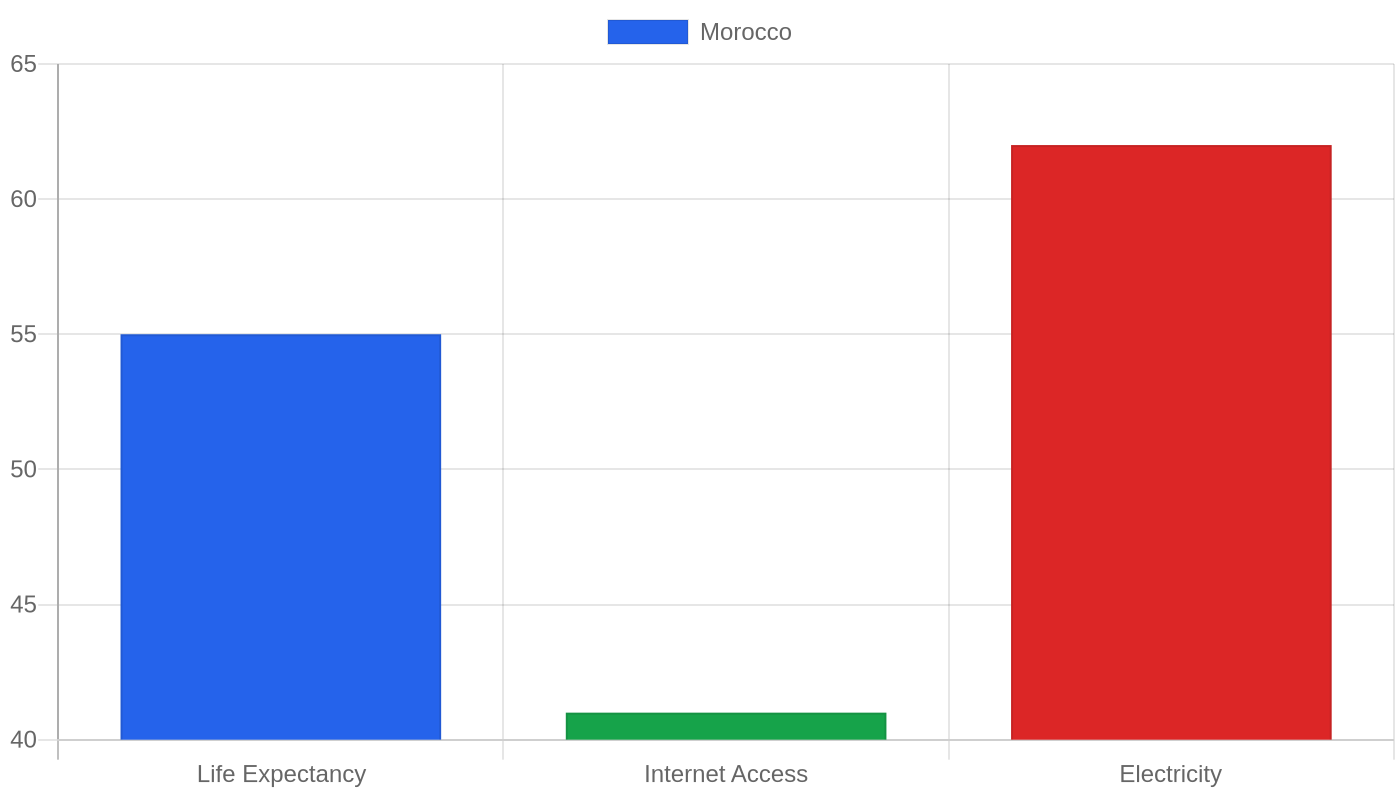
Economic Pulse Net | Sources: World Bank World Development Indicators, Government Sources | 2026
Key Takeaways
– Morocco’s economy is anchored by a powerful cluster of financial and energy conglomerates, with Attijariwafa Bank and Akwa Group dominating the commercial landscape.
– The country’s political system is classified as a “hybrid regime” by The Economist Democracy Index, ranking third in the MENA region but showing signs of democratic backsliding since 2011.
– Consumer services and transportation sectors are expanding, with companies like Air Arabia Maroc and Africa Morocco Link capitalizing on the country’s strategic position as a gateway between Europe and Africa.
– The economy is heavily reliant on a mix of traditional industries and modern financial services, though detailed macroeconomic data remains limited in official reporting channels.
– Morocco’s business environment is characterized by family-owned conglomerates that have diversified across multiple sectors, creating both stability and concentration of economic power.
The Numbers Game: Reading Between the Data Gaps
The World Bank’s latest economic indicators for Morocco present a curious paradox: the headline numbers are conspicuously absent from official reporting channels. GDP growth figures, inflation rates, and unemployment statistics remain unpublished in the most recent data release, leaving analysts to piece together the economic picture from alternative sources and corporate activity.
What we do know is that Morocco’s economic engine is powered by a distinctive corporate structure that sets it apart from many of its regional peers. The presence of Al Mada, a sprawling conglomerate with interests spanning finance, energy, and consumer goods, speaks to an economic model where diversified holding companies play an outsized role in national development.
This isn’t necessarily a weakness — many emerging economies have built resilience through such structures — but it does concentrate economic decision-making in relatively few hands.
The financial sector appears robust, anchored by Attijariwafa Bank, one of Africa’s largest banking groups by market capitalization. The bank’s dominance suggests a sophisticated financial services industry that has managed to expand beyond Morocco’s borders into pan-African markets. Meanwhile, the energy sector shows similar consolidation, with Afriquia and Akwa Group controlling significant portions of the fuel distribution and oil services market.
The transportation and consumer services sectors tell a story of a country positioning itself as a regional hub. Air Arabia Maroc, the low-cost carrier, and Africa Morocco Link, a ferry operator, both point to an economy that is increasingly integrated with European markets and tourism flows. The presence of media companies like 2M TV alongside consumer goods manufacturers like Aïcha and AB Sport indicates a diversified consumer economy that has moved beyond simple agricultural exports.
The Housing Puzzle: Affordability in an Urbanizing Nation
Morocco’s cost of living picture is one that urban professionals and working families experience very differently depending on where they live. The country’s major cities — Casablanca, Rabat, and Marrakech — have seen significant real estate development over the past decade, with new luxury developments and business districts reshaping the urban landscape.
However, the rental market in these cities has become increasingly competitive as internal migration from rural areas continues to push demand upward.
For most Moroccan families, homeownership remains the preferred long-term goal, but the path to purchasing property has become steeper in recent years. The gap between average incomes and property prices in prime urban locations has widened, pushing many younger Moroccans into the rental market for longer periods or toward peripheral neighborhoods where prices are more manageable.
The informal housing sector, while not officially quantified in the available data, remains a significant feature of Morocco’s urban fabric.
What makes Morocco’s housing situation particularly challenging is the combination of limited affordable supply in city centers and the cultural expectation of homeownership as a marker of stability. This dynamic creates pressure on both the rental market and the new-build sector, with developers focusing on higher-margin luxury projects while the demand for mid-range housing goes partially unmet.
The Business Landscape: Conglomerates and Gatekeepers
Morocco’s investment climate is defined by the outsized presence of a handful of family-controlled conglomerates that have grown into regional powerhouses. Al Mada, formerly known as SNI, represents the pinnacle of this model — a holding company with investments spanning banking, telecommunications, energy, and retail that functions almost as a parallel economy within the national framework.
The dominance of these conglomerates presents a double-edged sword for investors. On one hand, they provide stability and deep local knowledge that can facilitate market entry for foreign partners. On the other hand, their market power can create high barriers to entry for smaller players and limit the dynamism that comes from a more fragmented competitive landscape.
The financial sector, led by Attijariwafa Bank, exemplifies this tension — the bank’s scale allows it to finance major projects, but it also means that credit decisions are concentrated in a relatively small number of institutions.
For international investors, the key sectors to watch are energy, where Afriquia and Akwa Group are positioned to benefit from Morocco’s push toward renewable energy; transportation, where Air Arabia Maroc and Africa Morocco Link serve the growing movement of people and goods between Europe and Africa; and consumer goods, where companies like Aïcha and AB Sport are building brands that could expand regionally.
Democracy, Safety, and the Quality of Life Equation
Morocco’s political landscape presents a complex picture that directly influences its economic trajectory. The Economist Democracy Index classifies the country as a “hybrid regime” — a category that sits between full democracy and authoritarian rule. Morocco ranks third in the MENA region and 95th globally in democracy quality, a positioning that reflects the country’s mix of elected institutions and concentrated royal authority.
The index also notes that Morocco has shown democratic backsliding since 2011, the year of the Arab Spring protests that swept the region. This regression matters for economic reasons beyond abstract political ideals. Democratic institutions — independent courts, free press, robust civil society — are the infrastructure upon which sustainable economic development is built. When these institutions weaken, investor confidence can erode, and long-term planning becomes more difficult.
On the safety front, Morocco has generally maintained a reputation as a stable and secure country compared to many of its regional neighbors. This security environment has been crucial for the tourism sector and for attracting foreign direct investment. The crime index data is not currently available in the latest reporting, but the country’s ability to maintain social order during periods of economic stress has been a notable feature of its governance model.
The quality of life in Morocco is a study in contrasts. The country offers a rich cultural heritage, a favorable climate, and a cost of living that remains attractive for many expatriates and retirees from Europe. However, economic opportunities for young Moroccans remain a pressing concern, with many graduates facing limited prospects in the formal economy and choosing to emigrate or work informally.
The Road Ahead: What’s Moving in Morocco Right Now
Morocco is currently navigating a delicate balancing act between its traditional economic structures and the pressures of modernization and globalization. The continued dominance of conglomerates like Al Mada and Akwa Group suggests that the state-business relationship remains central to economic governance, even as the country pursues policies aimed at attracting foreign investment and diversifying its economic base.
The transportation sector is showing particular dynamism, with Air Arabia Maroc expanding its network and Africa Morocco Link strengthening connections across the Strait of Gibraltar. These developments position Morocco as a logistics and transit hub, capitalizing on its unique geographic position at the intersection of Europe, Africa, and the Middle East. The country’s ports and transportation infrastructure are increasingly being developed with an eye toward regional trade integration.
In the energy sector, the presence of major players like Afriquia and Akwa Group indicates that Morocco is serious about maintaining its position in the regional energy market. The country has made significant public commitments to renewable energy development, and while the specific investment figures are not available in the current data, the corporate structure suggests that established players are positioning themselves for this transition.
The political dimension remains the wildcard in Morocco’s economic story. The democratic backsliding noted by The Economist Democracy Index could eventually affect the country’s ability to attract the kind of investment that requires predictable governance and strong institutions. However, Morocco’s third-place ranking in the MENA region also indicates that it remains ahead of many of its neighbors in terms of political openness and institutional quality.
The Bottom Line
Morocco is a country of significant economic potential constrained by structural limitations. Its corporate sector demonstrates real strength, with major players in banking, energy, and consumer goods that could compete across the African continent. The country’s strategic location and relative stability make it an attractive entry point for businesses looking to access both North African and sub-Saharan markets.
However, the concentration of economic power in a small number of conglomerates, combined with the political system’s hybrid nature and democratic backsliding, creates risks that investors and observers should not ignore. For those willing to navigate these complexities, Morocco offers genuine opportunities — but the window for transformative reform may be narrowing.
Sources & Methodology
This article is authored by Economic Pulse Net for informational and research purposes. Economic Pulse Net sources its data from multilateral institutions, national statistics bureaus, and proprietary databases. All data is believed to be current as of the date of publication.
Published: August 02, 2026 | Category: Research — Morocco
Use these signals in your own platform
Economic Pulse publishes its live signal feed through a documented, read-only API. Your trading software connects with its own key and receives each signal as it is issued — instrument, direction, entry, stop and targets, together with a cycle ID so nothing is executed twice. The feed is independent of this website and cannot change it.
Signals are informational only and are not financial advice.