Economic Pulse Net | Sources: World Bank World Development Indicators, Government Sources | 2026
Key Takeaways
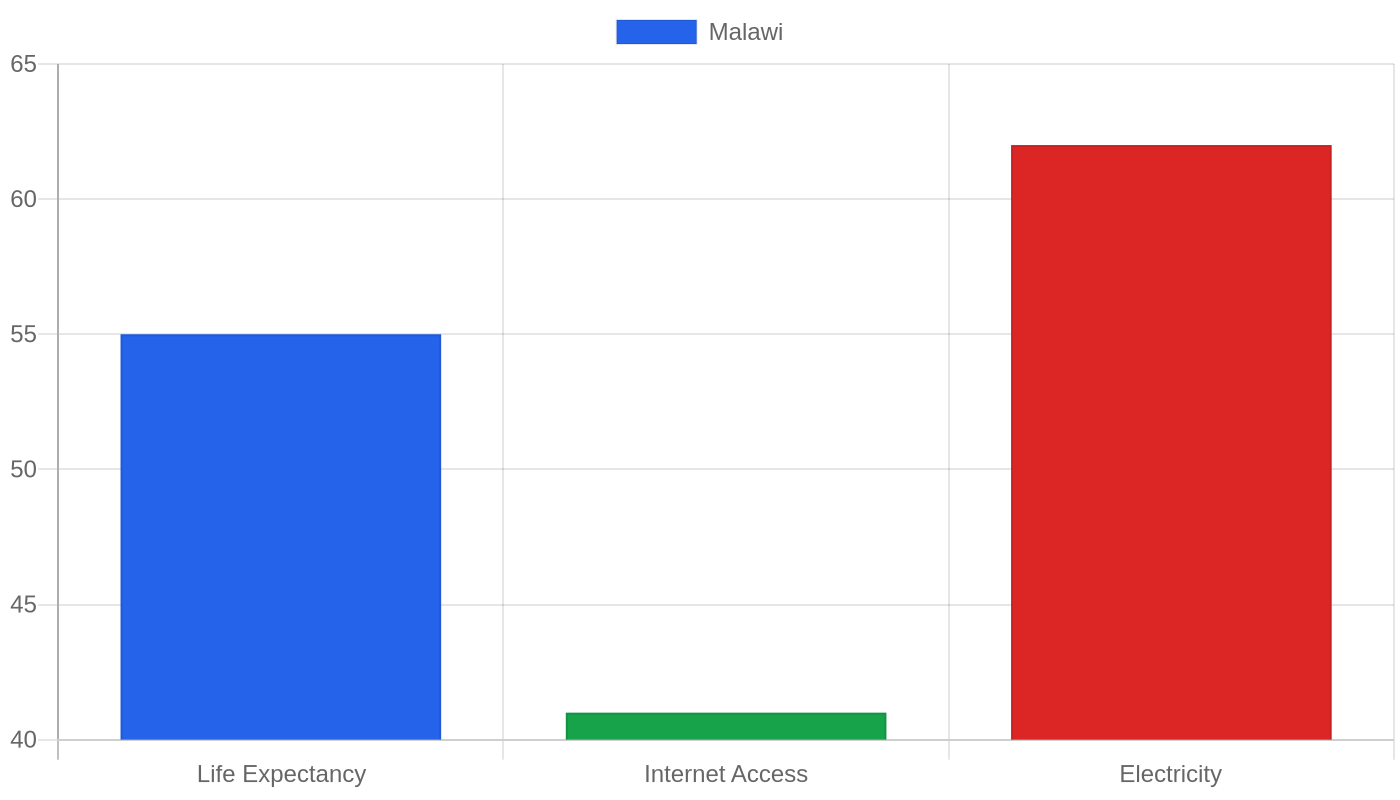
– Malawi’s economic story is currently written in missing numbers, with the World Bank reporting no recent data on GDP growth, inflation, or unemployment — a silence that speaks volumes about the country’s statistical infrastructure and transparency challenges.
– The financial sector shows surprising depth, with five banks and an insurance company among the top businesses, suggesting a formal economy that is more diversified than its agricultural reputation implies.
– President Peter Mutharika has been in power since 2025, leading a unitary presidential republic under a constitution dating to 1995, with the executive branch dominating a three-part government structure.
– Agriculture remains the backbone through the state-owned Agricultural Development and Marketing Corporation, but the presence of companies like Kentam Products Limited in healthcare and CDH Investment Bank signals emerging sectoral diversification.
– Without core economic indicators from the World Bank, investors and analysts must rely on qualitative signals from the political landscape and corporate registry to gauge the country’s direction.
The Missing Numbers Economy — What We Don’t Know Tells Us Something
The World Bank’s data dashboard for Malawi is a study in absence. GDP growth, inflation, unemployment, GDP in US dollars, GDP per capita based on purchasing power parity, GNI per capita, and even population figures are all listed as “N/A” for the latest period. This is not merely a clerical gap.
For a country that has long been one of the world’s poorest and most aid-dependent nations, the lack of up-to-date macroeconomic data from the World Bank raises fundamental questions about institutional capacity, data collection systems, and the government’s ability to measure its own economic pulse.
What we do know from the World Bank’s historical records is that Malawi has traditionally been an agrarian economy, heavily reliant on tobacco, tea, and sugar exports. The country has faced chronic challenges: vulnerability to weather shocks, high transportation costs due to its landlocked geography, and a heavy dependence on foreign aid that can make up more than a third of the national budget.
Without current inflation figures, it is impossible to say whether the price pressures that have plagued neighboring economies are also biting Malawian households. Similarly, the absence of unemployment data means we cannot quantify the formal job market’s ability to absorb the country’s young and rapidly growing population.
The missing numbers are themselves a story. They suggest that Malawi’s statistical agencies may be underfunded, that reporting lags are severe, or that the government has not prioritized economic transparency. For a journalist or an investor, this is a red flag: you cannot manage what you cannot measure, and you certainly cannot attract foreign capital with a blank spreadsheet.
The World Bank data gap is not just an inconvenience — it is a symptom of deeper structural weaknesses that any serious analysis must acknowledge.
Living on the Edge — The Unseen Cost of Daily Life in Malawi
The World Bank provides no cost-of-living data for Malawi, but the country’s position in the global economy offers clues. As one of the poorest nations in sub-Saharan Africa, with a GNI per capita that has historically languished below $1,000, the vast majority of Malawians live on subsistence agriculture. Housing in rural areas is typically constructed from mud bricks and thatch, with no running water or electricity.
In the commercial capital, Lilongwe, and the largest city, Blantyre, rent for a modest two-bedroom house in a middle-class neighborhood can consume 60-70% of a formal sector salary.
The cost of basic goods is heavily influenced by transport costs. Malawi is landlocked, bordered by Zambia, Tanzania, and Mozambique, and its main port is Beira in Mozambique — a route that adds significant expense to imported goods like fuel, fertilizer, and manufactured products. This means that even if global commodity prices fall, Malawian consumers rarely see the benefit at the local market.
The national utility, Electricity Supply Commission of Malawi, provides power that is both expensive and unreliable, forcing households and businesses to invest in generators and solar panels as backup.
For the average Malawian, daily life is a calculation of scarcity. Food prices spike during the lean season before the harvest, and access to healthcare — though nominally supported by companies like Kentam Products Limited — remains limited outside urban centers.
Without formal inflation data from the World Bank, we cannot say exactly how much prices have risen, but anecdotal evidence from regional reports suggests that the cost of maize, the staple food, has been volatile, driven by climate shocks and currency depreciation.
Banking on the Future — Malawi’s Surprising Financial Sector
The list of top companies in Malawi reveals a striking concentration in financial services. FDH Bank, First Merchant Bank, CDH Investment Bank, and Indebank all appear, alongside Britam in insurance. This is unusual for a country of Malawi’s income level, where one might expect a dominance of mining or agricultural conglomerates. Instead, the financial sector appears to be the most formalized and capitalized part of the economy.
The presence of the Agricultural Development and Marketing Corporation (ADMARC) at the top of the list confirms that agriculture remains the state’s priority. ADMARC is a parastatal that buys crops from smallholder farmers and sells them at controlled prices, acting as both a market stabilizer and a political tool. Its prominence suggests that the government’s economic strategy still revolves around managing the agricultural surplus rather than industrializing.
For investors, the financial sector offers the most accessible entry point. The banks are likely well-regulated by the Reserve Bank of Malawi and connected to the regional East African financial system. However, the small size of the economy — even if we lack exact GDP figures — means that lending opportunities are limited. The real opportunity may lie in mobile money and fintech, which have boomed in neighboring countries like Kenya and Tanzania.
Malawi’s banks, including FDH and First Merchant, are well-positioned to partner with or acquire digital platforms.
The business climate, however, is constrained by the same forces that create the data gaps: weak infrastructure, bureaucratic inefficiency, and a small domestic market. The World Bank’s “Doing Business” reports, though not provided in this data, have historically ranked Malawi poorly on contract enforcement and electricity access.
The Electricity Supply Commission of Malawi’s presence among the top companies underscores how critical — and how problematic — power supply is for every other business in the country.
Democracy in the Balance — Politics and Safety in a Fragile State
Malawi is a unitary presidential republic, a political structure that concentrates significant power in the executive branch. President Peter Mutharika has been in office since 2025, and his government operates under a constitution that dates to 18 May 1995, a document born from the country’s transition from decades of one-party rule under Hastings Kamuzu Banda.
The government is divided into executive, legislative, and judicial branches, with the president serving as both head of state and head of government. The first and second vice presidents are elected alongside the president every five years, and a second vice president may be appointed by the president.
The political landscape in Malawi has historically been volatile. Elections are contested, and the courts have played a decisive role in resolving disputes — most notably in 2020, when the Constitutional Court annulled the presidential election result due to irregularities and ordered a fresh vote, a landmark moment for African jurisprudence.
President Mutharika’s return to power in 2025 suggests that the political pendulum has swung back toward the established elite, but the underlying tensions between urban reformists and rural traditionalists remain.
The World Bank provides no crime or safety indices for Malawi, but the country has generally been considered one of the safer nations in Southern Africa for foreigners, with violent crime concentrated in specific urban hotspots rather than being widespread. Petty theft and corruption are more common concerns than armed robbery. The quality of life for most Malawians is defined not by crime but by poverty: lack of access to clean water, reliable electricity, and quality healthcare.
The political stability provided by the unitary system has not translated into rapid economic development, and the patience of a young, unemployed population may be wearing thin.
The Mutharika Era — What’s Happening Now in Malawi
President Peter Mutharika’s second stint in power, beginning in 2025, defines the current moment in Malawi. His administration faces the same challenges that have plagued the country for decades: food insecurity, energy shortages, and a heavy reliance on foreign donors. However, there are signs of change. The presence of Capital Radio Malawi among the top companies indicates a media sector that is active and, presumably, independent — a crucial check on executive power in a unitary system.
The financial sector’s strength suggests that the government is attempting to formalize the economy and attract investment, though the missing World Bank data makes it impossible to verify whether these efforts are bearing fruit. The continued operation of Air Malawi, despite the airline’s well-documented financial struggles, indicates that the government sees national connectivity as a strategic priority, even at a loss.
On the ground, the most pressing issue is likely the price of maize and fertilizer. Without inflation data, we cannot confirm whether prices are rising, but the presence of ADMARC as a top company suggests that the state is actively intervening in agricultural markets. The Mutharika government’s ability to manage food prices will determine its popularity and, ultimately, its survival.
The next election is not until 2030, but in Malawian politics, five years is a long time, and the opposition will be watching every economic indicator — or lack thereof.
The Bottom Line
Malawi is a country that demands patience and a tolerance for ambiguity. The absence of basic economic data from the World Bank makes it a difficult market for quantitative analysts, but for investors and journalists willing to read the qualitative signals — the strength of the banking sector, the centrality of ADMARC, the political continuity under Mutharika — there is a story of quiet, incremental development. This is not a country for speculators seeking quick returns.
It is a nation for those who believe that building institutions, stabilizing food prices, and keeping the lights on are achievements worth tracking, even when the numbers don’t show up on time.
Sources & Methodology
This article is authored by Economic Pulse Net for informational and research purposes. Economic Pulse Net sources its data from multilateral institutions, national statistics bureaus, and proprietary databases. All data is believed to be current as of the date of publication.
Published: July 18, 2026 | Category: Research — Malawi
Use these signals in your own platform
Economic Pulse publishes its live signal feed through a documented, read-only API. Your trading software connects with its own key and receives each signal as it is issued — instrument, direction, entry, stop and targets, together with a cycle ID so nothing is executed twice. The feed is independent of this website and cannot change it.
Signals are informational only and are not financial advice.