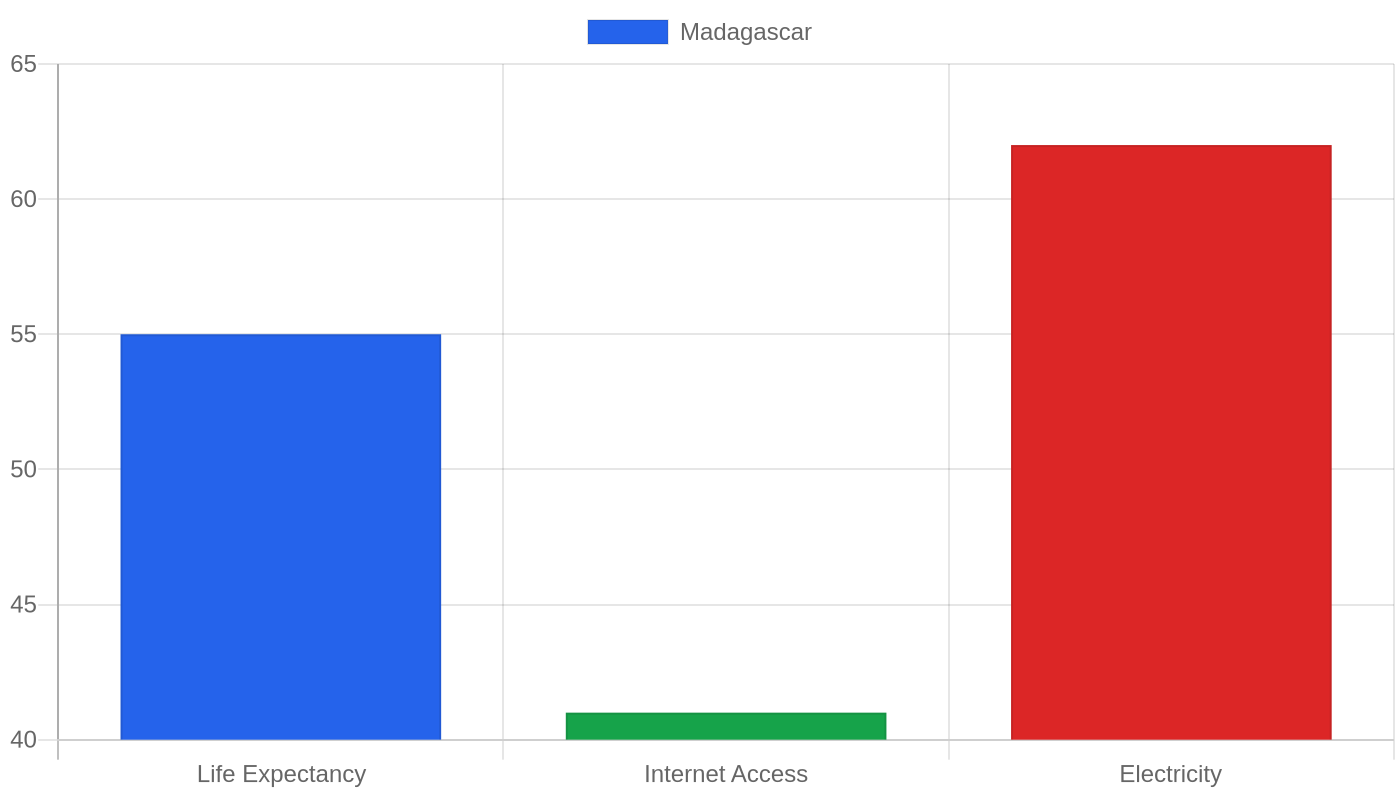
Economic Pulse Net | Sources: World Bank World Development Indicators, Government Sources | 2026
Key Takeaways
– A Political Paradox: Madagascar operates as a semi-presidential, multi-party republic on paper, but the National Assembly and Senate hold very little actual legislative power, creating a governance gap that affects everything from investment to public services.
– A Resource-Rich Economy with Structural Hurdles: With major players like Ambatovy mine and Air Madagascar anchoring the corporate landscape, the economy leans heavily on extractive industries and tourism-adjacent services, yet faces persistent challenges in translating these assets into broad-based prosperity.
– Infrastructure and Utilities as the Silent Bottleneck: The presence of Jirama (utilities) and Madarail (railways) among the top companies underscores how much of Madagascar’s economic future depends on fixing its energy and transport networks.
– A Business Landscape Dominated by a Few Big Names: From Chocolaterie Robert to MCB Madagascar, the corporate sector is concentrated in a handful of sectors, signalling both opportunity for consolidation and vulnerability to external shocks.
– A Nation Waiting for the Data to Catch Up with Reality: With many key economic indicators unavailable, the true picture of Madagascar’s economic health lies in the observable realities of its industries, infrastructure, and political dynamics.
The Numbers Tell a Story — But Only Part of It
The World Bank’s latest data on Madagascar presents an intriguing paradox: the headline indicators — GDP growth, inflation, unemployment, GDP per capita, and GNI per capita — are all listed as unavailable. For the casual observer, this might suggest a statistical black hole. For the seasoned analyst, it tells a different story: a country where formal economic measurement lags behind the lived reality of its people and where the most telling signals come from the sectors that actually move the needle.
What we do know is that Madagascar’s economic backbone is built on a narrow but significant set of pillars. The Ambatovy mine, one of the largest lateritic nickel projects in the world, represents the extractive sector’s outsized role in export earnings and foreign direct investment.
Alongside it, Air Madagascar and Madagascar Flying Services anchor the transportation and tourism-linked service economy, while Madarail keeps the island’s historic rail corridors operational — a critical artery for moving goods from the interior to coastal ports.
The consumer and financial sectors tell a complementary story. Chocolaterie Robert has carved out a premium niche in the global chocolate market, proving that Madagascar can compete on quality and terroir. MCB Madagascar and the Central Bank of Madagascar form the financial backbone, facilitating the credit and liquidity needed for commerce to function.
Yet, the presence of Jirama among the top companies is a double-edged sword: it signals the importance of utilities, but also highlights the chronic energy shortages and infrastructure deficits that have long constrained industrial growth.
The absence of hard numbers from the World Bank should not be read as a lack of economic activity. Rather, it reflects the difficulty of capturing an economy where informality is widespread, subsistence agriculture dominates rural livelihoods, and data collection remains a logistical challenge across a vast, geographically fragmented island. The economy is real, vibrant, and evolving — but its formal measurement is still catching up.
The Cost of Living: The Price of Paradise
For those considering Madagascar, whether as an expatriate professional or an investor scouting opportunities, the cost of living presents a complex picture. The available data does not provide specific housing or rental figures, but the composition of the top companies offers telling clues about the economic pressures facing ordinary households.
The dominance of Jirama in the utilities sector speaks to the daily reality of most Malagasy households: electricity bills that are both expensive relative to income and unreliable in supply. For many, the cost of living is less about rent and more about the hidden costs of daily survival — buying bottled water where piped supply is unreliable, paying for private generators where the grid fails, and absorbing the cost of transport on poorly maintained roads.
The absence of formal housing data suggests a market that is deeply bifurcated. In Antananarivo, the capital, there exists a modern, formal housing market serving the diplomatic, NGO, and business communities, with prices that can rival regional hubs. Yet the vast majority of the population lives in informal settlements or traditional housing, where the concept of “rent” is fluid and often tied to family or community networks.
For the average Malagasy worker, the cost of living is not measured in rent-to-income ratios but in the daily calculus of food, transport, and energy.
Investment and Business Climate: Where the Opportunities Lie
Madagascar’s business climate is a study in contrasts — a country with extraordinary natural assets and a corporate sector that punches above its weight, yet one where the rules of the game remain opaque and the infrastructure is unforgiving.
The top companies list reads like a who’s who of strategic sectors: mining (Ambatovy), aviation (Air Madagascar, Madagascar Flying Services), financial services (MCB Madagascar, Central Bank of Madagascar), utilities (Jirama), transport (Madarail), consumer goods (Karenjy), and even premium food exports (Chocolaterie Robert).
This diversity is a strength — it means the economy is not wholly dependent on any single sector — but it also reveals a concentration of formal economic activity in a relatively small number of large players.
For investors, the sectors to watch are clear. Mining and extractives will continue to dominate foreign exchange earnings, though the global transition to green energy could boost demand for Madagascar’s nickel and cobalt reserves. Agri-processing, exemplified by Chocolaterie Robert, offers a path to higher-value exports. And the financial sector, anchored by MCB and the central bank, is ripe for digital innovation and expansion into underbanked populations.
The challenge lies in the enabling environment. The political structure — a semi-presidential republic where the president holds significant power and the legislature has limited influence — creates a governance environment that can be both efficient and unpredictable. Investors must navigate a landscape where policy can shift with the executive’s priorities, and where the formal protections of a strong legislature are limited.
Safety, Politics, and Quality of Life: Living in the Balance
The available data does not provide crime or safety indices for Madagascar, but the political and institutional context offers a window into the quality of life. The constitutional framework describes a multi-party republic with a popularly elected president, a prime minister, and a cabinet formed on the president’s recommendation. In practice, however, the National Assembly and Senate hold very little power or legislative role, concentrating authority in the executive.
This political centralisation has profound implications for daily life. On one hand, it can enable rapid decision-making and policy implementation when the executive is aligned with development goals. On the other hand, it creates a system where accountability is weak and where citizens have limited institutional avenues to shape policy or challenge decisions.
For the average Malagasy, this translates into a sense of distance from the political process and a reliance on informal networks — family, community, traditional leadership — to navigate daily challenges.
Quality of life in Madagascar is defined by resilience. The island’s famed biodiversity, cultural richness, and natural beauty provide a quality of life that no statistic can capture. Yet the absence of robust public services, reliable utilities, and strong institutions means that this quality of life is hard-won, often requiring significant personal effort and resources to maintain.
What’s Happening Now: A Nation in Motion
Madagascar is not a country at rest. The current moment is defined by a push-and-pull between its considerable potential and its persistent structural challenges. The corporate landscape is evolving, with established players like Air Madagascar and Jirama facing pressure to modernise and adapt to changing market conditions.
The financial sector is quietly transforming. MCB Madagascar and the Central Bank of Madagascar are at the centre of efforts to deepen financial inclusion and modernise the payments system, though progress is incremental. Meanwhile, the extractive sector, led by Ambatovy, continues to be a major source of export revenue and employment, even as global commodity prices fluctuate.
On the political front, the dynamics of the semi-presidential system remain a defining feature. The president’s ability to shape the cabinet and set the policy agenda means that the direction of economic reform — whether toward greater openness, privatisation, or state-led development — depends heavily on the executive’s vision. The weak legislative branch suggests that meaningful checks and balances are limited, which could be a source of both efficiency and concern.
The infrastructure deficit remains the most pressing constraint. Jirama’s struggles with electricity generation and distribution are emblematic of a broader challenge: without reliable power, transport, and communications, Madagascar’s economic potential will remain constrained. Yet there are signs of movement — investments in renewable energy, port modernisation, and road rehabilitation are in various stages of planning and implementation.
The Bottom Line
Madagascar is a country that defies easy categorisation. It is a nation of extraordinary natural wealth and cultural richness, yet one where the formal economy is small and the institutional framework is centralised and weak. For investors, the opportunities lie in mining, agri-processing, and financial services — but only for those willing to navigate a complex and sometimes unpredictable environment.
For policymakers, the challenge is to build the infrastructure and institutions that can unlock the island’s potential. And for the Malagasy people, the daily reality is one of resilience and ingenuity in the face of structural odds. This is a country to watch — not for the faint of heart, but for those who see opportunity where others see obstacles.
Sources & Methodology
This article is authored by Economic Pulse Net for informational and research purposes. Economic Pulse Net sources its data from multilateral institutions, national statistics bureaus, and proprietary databases. All data is believed to be current as of the date of publication.
Published: August 07, 2026 | Category: Research — Madagascar
Use these signals in your own platform
Economic Pulse publishes its live signal feed through a documented, read-only API. Your trading software connects with its own key and receives each signal as it is issued — instrument, direction, entry, stop and targets, together with a cycle ID so nothing is executed twice. The feed is independent of this website and cannot change it.
Signals are informational only and are not financial advice.