Economic Pulse Net | Sources: World Bank World Development Indicators, Government Sources | 2026
Key Takeaways
– Liberia’s economy remains in a transitional phase, with limited publicly available macroeconomic data from the World Bank, underscoring the challenges of data collection and institutional capacity in a post-conflict state.
– The financial sector dominates the corporate landscape, with seven of the ten largest companies in Liberia being banks, indicating a narrow economic base heavily reliant on banking services.
– The country operates a U.S.-style constitutional republic with three co-equal branches of government, providing a familiar political framework for investors despite historical instability.
– Major industries are not explicitly listed in available data, but the prominence of companies like LAMCO in basic materials suggests mining and natural resources remain a key economic pillar.
– Telecommunications and aviation are emerging sectors, with Cable Consortium of Liberia and two airlines among the top companies, pointing to infrastructure development as a growth area.
The Numbers Gap — What Liberia’s Missing Data Tells Us About Its Economy
The World Bank data for Liberia presents a curious challenge: key macroeconomic indicators — GDP growth, inflation, unemployment, GDP in USD, GDP per capita, GNI per capita, and even population — are all listed as not available. At first glance, this might seem like a data failure. But in reality, it is a story in itself.
For a country that emerged from back-to-back civil wars (1989–1997 and 1999–2003) and then faced the devastating Ebola epidemic of 2014–2016, the absence of timely, reliable economic data reflects deeper structural issues. Liberia’s statistical agencies have struggled for decades to rebuild capacity, collect consistent data, and produce the kind of regular economic reports that wealthier nations take for granted.
The lack of inflation data is particularly telling. In many developing economies, inflation is a daily reality that shapes everything from food prices to currency stability. Without it, policymakers are flying blind. Similarly, the absence of unemployment figures means there is no official measure of one of the country’s most pressing social challenges: providing jobs for a young, growing population.
The World Bank’s inability to publish these numbers is not a reflection of negligence but of a system still under construction. Liberia’s economy is, in many ways, an informal one — small-scale agriculture, street trading, and remittances from the diaspora dominate daily life, and these activities are notoriously difficult to capture in formal statistics.
What the data does show is a corporate sector dominated by financial services. Seven of the ten largest companies in Liberia are banks: AccessBank Liberia, Central Bank of Liberia, First International Bank (Liberia), Global Bank Liberia, International Bank, and others. This concentration suggests that the formal economy revolves around banking and credit, likely serving a relatively small urban elite and the international aid community.
The presence of LAMCO in basic materials — a company historically associated with iron ore mining — hints at the resource wealth that has long attracted foreign interest. Liberia sits on significant deposits of iron ore, gold, and diamonds, though extraction has been hampered by infrastructure deficits and governance challenges. The Cable Consortium of Liberia, meanwhile, points to efforts to improve internet connectivity, a vital step for any modern economy.
The Price of Daily Life — Cost of Living in a Data-Scarce Environment
Cost of living data for Liberia is not available in the provided information, but the very absence of this data tells a story about the challenges of measuring economic reality in a country where much of the population lives outside formal markets. In Monrovia, the capital and largest city, daily life is shaped by imported goods — rice, fuel, construction materials — that are subject to global price fluctuations and local supply chain bottlenecks.
Without official inflation figures, residents rely on word of mouth and market gossip to gauge whether prices are rising or falling.
Rent versus buy decisions are largely theoretical for most Liberians. Homeownership is often a matter of family land and informal arrangements rather than mortgage markets. The banking sector, while dominant among top companies, primarily serves businesses and high-net-worth individuals rather than providing widespread consumer credit. For the average Liberian, daily expenses revolve around food, transport, and school fees, with little room for discretionary spending.
Compared to regional averages in West Africa, Liberia’s cost of living is likely lower than in Ghana or Nigeria but higher than in more rural neighbors like Sierra Leone or Guinea, reflecting the premium of operating in a post-conflict capital with limited infrastructure.
Banking on the Future — Investment Climate in a Post-Conflict Economy
Liberia’s investment climate is shaped by its top companies, which are overwhelmingly financial institutions. AccessBank Liberia, First International Bank, Global Bank Liberia, and International Bank form the backbone of the formal economy, providing the credit and payment systems that allow businesses to operate. The Central Bank of Liberia sits at the top, tasked with monetary policy and financial stability in an environment where the U.S. dollar circulates alongside the Liberian dollar.
For investors, this banking concentration is a double-edged sword: it provides a stable platform for transactions but also signals a lack of diversification in the broader economy.
Sectors to watch include telecommunications, represented by Cable Consortium of Liberia, which is critical for connecting the country to global markets. Aviation is another emerging area, with Air Liberia and Liberia Airways among the top companies, suggesting growing demand for air travel and cargo services. The presence of LAMCO in basic materials indicates that mining remains a draw for foreign capital, particularly in iron ore, though the sector has faced boom-and-bust cycles tied to global commodity prices.
The business environment is improving slowly — Liberia has a relatively open foreign investment regime and uses English as its official language — but investors still grapple with weak infrastructure, corruption, and a small domestic market of roughly five million people. The government, modeled on the U.S. system with three co-equal branches, offers legal predictability on paper, but enforcement of contracts and property rights remains uneven.
Democracy in the Making — Safety, Politics, and the Quality of Life
Crime and safety indices for Liberia are listed as not available, which is itself a significant data point. In a country that experienced two devastating civil wars, perceptions of safety are deeply personal and vary widely between Monrovia and rural areas. The political landscape, as described in the data, is a “unitary constitutional republic and representative democracy” with a government modeled on the United States.
The executive branch is headed by a president, the legislature is bicameral, and the judiciary includes a Supreme Court and lower courts. This framework was established by the 1986 Constitution and represents a deliberate effort to create checks and balances after years of authoritarian rule.
In practice, Liberian democracy has been tested repeatedly. The 2017 election marked the first peaceful transfer of power between democratically elected presidents since the end of the civil war, a milestone that boosted confidence in the system. However, the political landscape remains fragile, with low trust in institutions, high levels of corruption, and a justice system that struggles to deliver timely rulings.
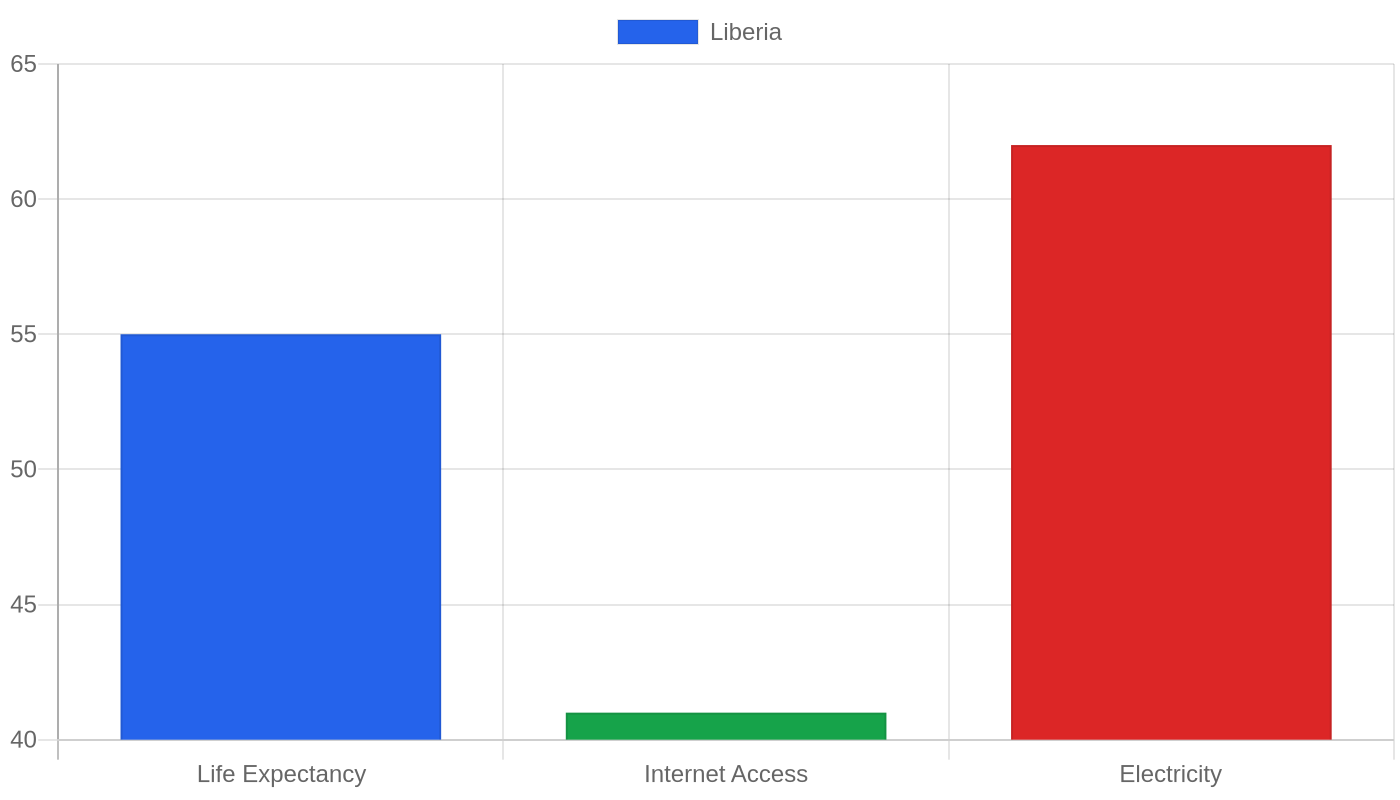
Quality of life is shaped by these realities: access to electricity, clean water, and healthcare is limited, especially outside the capital. The World Bank’s absence of happiness or well-being data means there is no single metric to capture how Liberians feel about their lives, but anecdotal evidence suggests resilience is a defining national trait.
Winds of Change — What’s Happening in Liberia Right Now
The most current data available points to a country in motion, though specific recent news events are not provided in the source material. What can be inferred from the data is that Liberia is at a critical juncture. The dominance of banks among top companies suggests that the financial sector is driving formal economic activity, likely fueled by international aid flows, remittances, and reconstruction spending.
The presence of two airlines — Air Liberia and Liberia Airways — indicates that connectivity is improving, a vital sign for a country that depends on trade and tourism.
The Cable Consortium of Liberia’s position among top companies points to ongoing investments in digital infrastructure, which could unlock new opportunities in services and remote work. LAMCO’s continued relevance in basic materials suggests that mining remains a priority, though the sector faces environmental and governance challenges.
The political framework, with its three co-equal branches, provides a stable foundation for policymaking, but the lack of recent economic data from the World Bank raises questions about the government’s capacity to monitor and respond to economic trends in real time. For now, Liberia appears to be moving forward slowly, building its institutions and infrastructure one step at a time, with the banking sector acting as both the engine and the safety net of the formal economy.
The Bottom Line
Liberia is a country for patient investors and development-focused organizations who understand that rebuilding a post-conflict state takes decades, not years. The dominance of the banking sector offers a stable entry point, while the emerging telecommunications and aviation sectors hint at future growth. The political system, modeled on the U.S. Constitution, provides a familiar framework, but the lack of basic economic data from the World Bank is a red flag that should give any short-term speculator pause.
This is a nation still writing its economic story — and for those willing to read between the lines of missing data, there is a compelling narrative of resilience, reconstruction, and slow but steady progress.
Sources & Methodology
This article is authored by Economic Pulse Net for informational and research purposes. Economic Pulse Net sources its data from multilateral institutions, national statistics bureaus, and proprietary databases. All data is believed to be current as of the date of publication.
Published: July 22, 2026 | Category: Research — Liberia
Use these signals in your own platform
Economic Pulse publishes its live signal feed through a documented, read-only API. Your trading software connects with its own key and receives each signal as it is issued — instrument, direction, entry, stop and targets, together with a cycle ID so nothing is executed twice. The feed is independent of this website and cannot change it.
Signals are informational only and are not financial advice.