Economic Pulse Net | Sources: World Bank World Development Indicators, Government Sources | 2026
Key Takeaways
– Guinea is officially a republic but has functioned as a de facto military autocracy since the 2021 coup d’état, creating significant political uncertainty for investors and citizens alike.
– The country’s economic identity is overwhelmingly defined by its bauxite sector, with the top companies list dominated by mining giants like Alumina Company of Guinea, Compagnie des Bauxites de Guinée, and Halco Mining.
– Despite holding some of the world’s richest bauxite reserves, Guinea faces significant governance challenges that complicate the translation of mineral wealth into broad-based prosperity.
– The airline industry shows surprising diversity for a developing economy, with multiple carriers operating including Air Guinee Express, Air Guinee International, and Eagle Air, suggesting regional connectivity remains a priority.
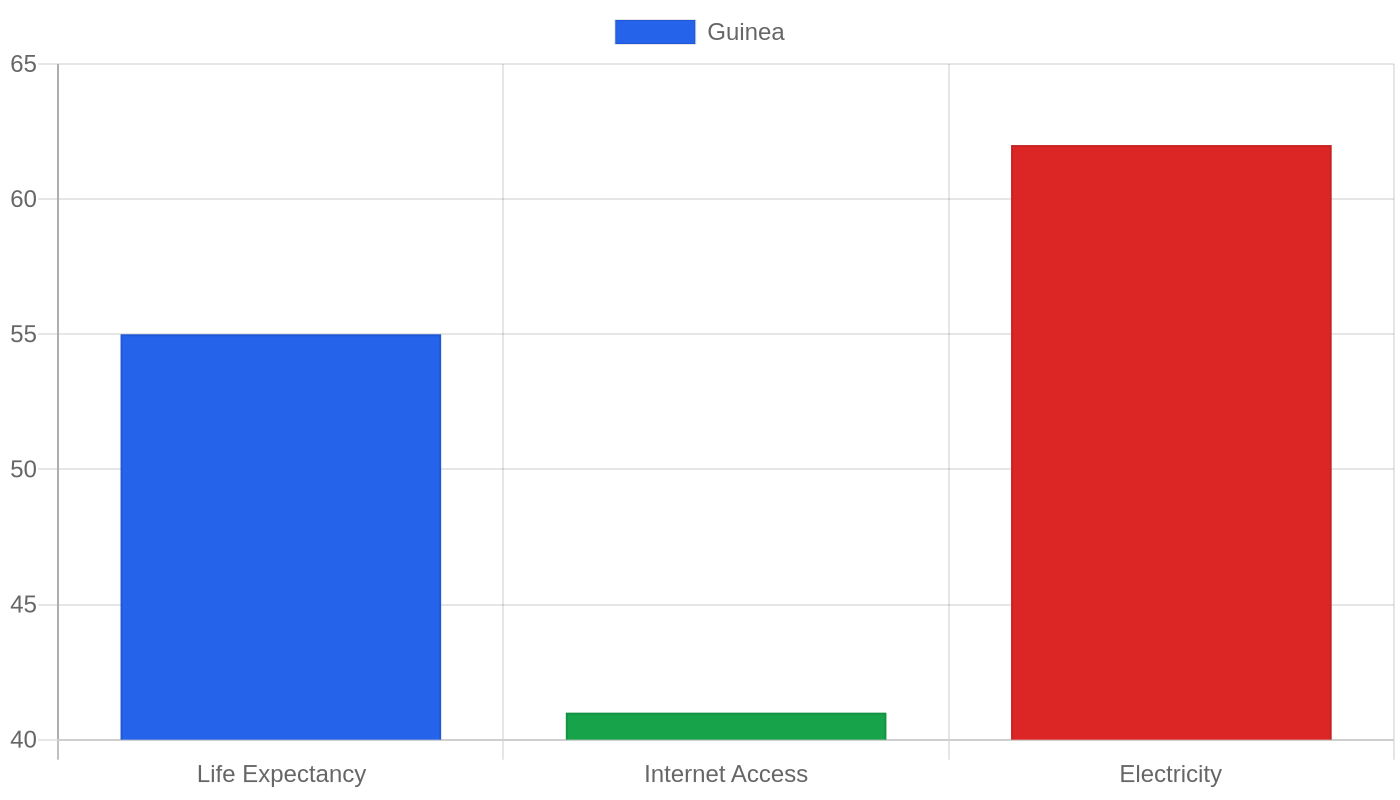
– With key economic indicators unavailable, the most reliable lens for understanding Guinea’s trajectory is its political evolution and the strategic importance of its extractive industries to global aluminium supply chains.
The Bauxite Backbone — What Drives Guinea’s Economy
When economists look at Guinea, they see one word written in red earth: bauxite. The World Bank’s data framework shows the country’s economic profile is anchored in extractive industries, with basic materials companies dominating the corporate landscape. Alumina Company of Guinea, Compagnie des Bauxites de Guinée, and Compagnie des bauxites de Kindia form the industrial core of the nation, while Halco Mining rounds out a sector that has attracted international attention for decades.
These companies are not merely commercial entities; they are the economic engine rooms whose operations determine export revenues, government income, and employment patterns across the country.
The significance of bauxite to Guinea cannot be overstated. Bauxite is the primary ore used to produce aluminium, a metal essential to everything from aircraft manufacturing to beverage cans and electrical transmission lines. For a country with Guinea’s resource endowment, this positions the nation as a critical node in the global aluminium supply chain.
The World Bank’s focus on GDP growth, inflation, and unemployment metrics remains constrained by data limitations, but the composition of the top companies list tells a compelling story about where economic activity concentrates. The dominance of mining firms suggests a dual economy: a capital-intensive extractive sector operating alongside a much larger informal economy that statistics often fail to capture.
The consumer services sector, represented by multiple airlines, indicates that Guinea maintains active regional connections. Air Guinee Express, Air Guinee International, Air Guinée, Eagle Air, and Guinee Air Service all appear on the major companies roster — a remarkable density of carriers for a nation of Guinea’s size. This suggests both the geographic challenges of West African travel and the importance of diaspora connections and trade links to neighbouring countries.
The presence of Office de la poste guinéenne in the industrials category reminds us that traditional state services still operate alongside private enterprise, reflecting the mixed economy that characterises many West African nations.
Living Costs in a Resource Economy — The Price of Daily Life
For ordinary Guineans, the cost of living narrative is shaped by forces that extend far beyond household budgets. When a nation’s economy is heavily oriented toward mineral extraction, domestic price dynamics often diverge from what one might expect.
The mining sector generates foreign currency and employs a relatively small, comparatively well-paid workforce, while the majority of citizens navigate markets where food prices, transportation costs, and housing expenses are influenced by local conditions, import dependencies, and infrastructure limitations.
Housing in Guinea’s urban centres, particularly Conakry, reflects the pressures of urbanisation without the comprehensive data infrastructure to track it precisely. The absence of reliable housing cost indices from the World Bank means that prospective residents and investors must rely on qualitative assessments: accommodation near mining operations commands premiums, while housing in the capital varies dramatically by neighbourhood and proximity to commercial districts.
For most Guineans, homeownership remains an aspirational goal, with rental markets absorbing the majority of urban households.
Daily expenses in Guinea are heavily influenced by the country’s agricultural calendar, import dependencies, and the logistical challenges of moving goods across a country with significant infrastructure gaps. The mining sector’s presence creates localised demand for goods and services that can drive prices in mining towns well above national averages, a pattern familiar across resource-rich African economies.
For the average household, food security and price stability are the most immediate economic concerns, matters that macroeconomic statistics capture imperfectly at best.
Business Climate and Investment — Where the Money Flows
The investment landscape in Guinea is defined by a fundamental tension: extraordinary natural resource wealth coexists with significant political and regulatory uncertainty. The World Bank’s company data reveals that the most prominent corporate entities are either mining operations or airlines, with basic materials companies representing the largest cluster of major businesses.
This concentration signals where both domestic and international investors see opportunity, but it also highlights the narrow base of the formal economy.
For international investors, Guinea’s bauxite sector remains the primary draw. The strategic importance of aluminium to global industry ensures that Guinea’s mineral deposits will continue to attract capital regardless of the domestic political climate. Companies like Halco Mining and Compagnie des Bauxites de Guinée represent decades of international investment and operational experience, suggesting that long-term players have learned to navigate the country’s complexities.
The airline sector, meanwhile, indicates that regional trade and connectivity remain viable business propositions, even in a challenging operating environment.
The business environment for smaller enterprises and new entrants is considerably more challenging. The dominance of extractive industries means that entrepreneurial opportunities often cluster around mining supply chains, transportation, and services to the mining workforce. The political situation since the 2021 coup has added another layer of complexity for investors seeking predictability in regulatory frameworks, contract enforcement, and policy continuity.
For those willing to accept these risks, Guinea offers first-mover advantages in a country whose resource wealth has yet to be fully developed.
Security, Politics, and Daily Life Under Military Rule
The political landscape in Guinea has undergone a dramatic transformation since the 2021 coup d’état. While the country remains a republic de jure, governance has shifted to a de facto military autocracy, fundamentally altering the relationship between citizens and the state.
The World Bank’s political overview describes a system where the president serves as both head of state and head of government, with a unicameral National Assembly intended as the legislative body — but the 2021 coup disrupted these constitutional arrangements, leaving the country in a period of political transition whose endpoint remains unclear.
The judicial branch, headed by the Supreme Court of Guinea, represents the formal structure of legal recourse, but its independence and effectiveness under military rule are matters of significant concern. For ordinary Guineans, the quality of daily life is shaped by this political uncertainty alongside the economic realities of living in a developing country with vast mineral wealth.
The absence of crime and safety indices from the World Bank data makes precise assessments difficult, but the broader West African context, combined with the political situation, suggests that security considerations remain relevant for both citizens and expatriates.
Quality of life in Guinea is a study in contrasts. The country’s resource wealth has not yet translated into the kind of broad-based development indicators that would position it as a regional leader in human development. Infrastructure gaps, service delivery challenges, and the concentration of economic opportunity in specific sectors create a lived reality that differs dramatically between the mining enclaves and the broader population.
The political situation adds a layer of uncertainty to daily life, even as many Guineans go about their routines with the resilience that characterises societies navigating difficult transitions.
The Current Moment — Guinea’s Pivot Point
Guinea stands at a critical juncture in its post-coup trajectory. The political transition that began with the 2021 military takeover has entered a phase where the international community, regional bodies like ECOWAS, and domestic stakeholders are all pressing for clarity about the path back to constitutional governance. The National Assembly’s status remains unresolved, and the promise of elections has yet to produce a concrete timeline that satisfies domestic and international observers.
This political uncertainty carries direct economic consequences, affecting everything from foreign direct investment decisions to the willingness of multilateral institutions to extend financing.
The mining sector continues to operate, and the bauxite exports that generate crucial revenue remain flowing, but the investment climate for new projects faces headwinds. International mining companies are watching the political situation carefully, balancing Guinea’s resource potential against concerns about contract stability and regulatory predictability.
The presence of multiple airlines in the corporate landscape suggests that business travel and regional commerce continue, but sustained economic transformation will require political stability that has remained elusive since the coup.
For the global aluminium industry, Guinea’s importance cannot be overstated. The country’s bauxite reserves represent a strategic asset that will shape global supply chains for decades. This gives Guinea leverage that smaller, less resource-endowed nations lack, but converting that leverage into tangible improvements in governance, infrastructure, and living standards remains the central challenge.
The coming months will be crucial in determining whether Guinea can navigate its political transition without sacrificing the economic momentum that its mineral wealth makes possible.
The Bottom Line
Guinea is a country of extraordinary potential and persistent challenges, where vast bauxite reserves coexist with political instability and underdeveloped institutions. Investors with high risk tolerance and long time horizons may find opportunities in the mining sector and related industries, but they must accept significant uncertainty about the political and regulatory environment.
Development practitioners and regional observers should watch Guinea closely as a test case for whether resource wealth can eventually translate into broader prosperity under difficult political circumstances. For anyone tracking West African economics or global aluminium markets, Guinea is a country that demands attention — even when the data remains frustratingly incomplete.
Sources & Methodology
This article is authored by Economic Pulse Net for informational and research purposes. Economic Pulse Net sources its data from multilateral institutions, national statistics bureaus, and proprietary databases. All data is believed to be current as of the date of publication.
Published: August 10, 2026 | Category: Research — Guinea
Use these signals in your own platform
Economic Pulse publishes its live signal feed through a documented, read-only API. Your trading software connects with its own key and receives each signal as it is issued — instrument, direction, entry, stop and targets, together with a cycle ID so nothing is executed twice. The feed is independent of this website and cannot change it.
Signals are informational only and are not financial advice.