Economic Pulse Net | Sources: World Bank World Development Indicators, Government Sources | 2026
Key Takeaways
– The Gambia’s post-independence political journey—from 30 years of one-party rule to military coup and back to fragile democracy—has profoundly shaped its economic trajectory, with data gaps masking the true scale of its development challenges.
– Despite a peaceful transition of power in 2017 ending 22 years of authoritarian rule, the country’s economic fundamentals remain opaque, with the World Bank providing no current GDP growth, inflation, or unemployment figures.
– The nation’s small, undiversified economy—heavily reliant on agriculture, tourism, and remittances—faces structural vulnerabilities that political instability has historically exacerbated.
– With no major industrial base or globally competitive companies on record, The Gambia’s economic story is one of potential constrained by governance challenges and data scarcity.
The Numbers We Don’t Have — And What That Silence Tells Us
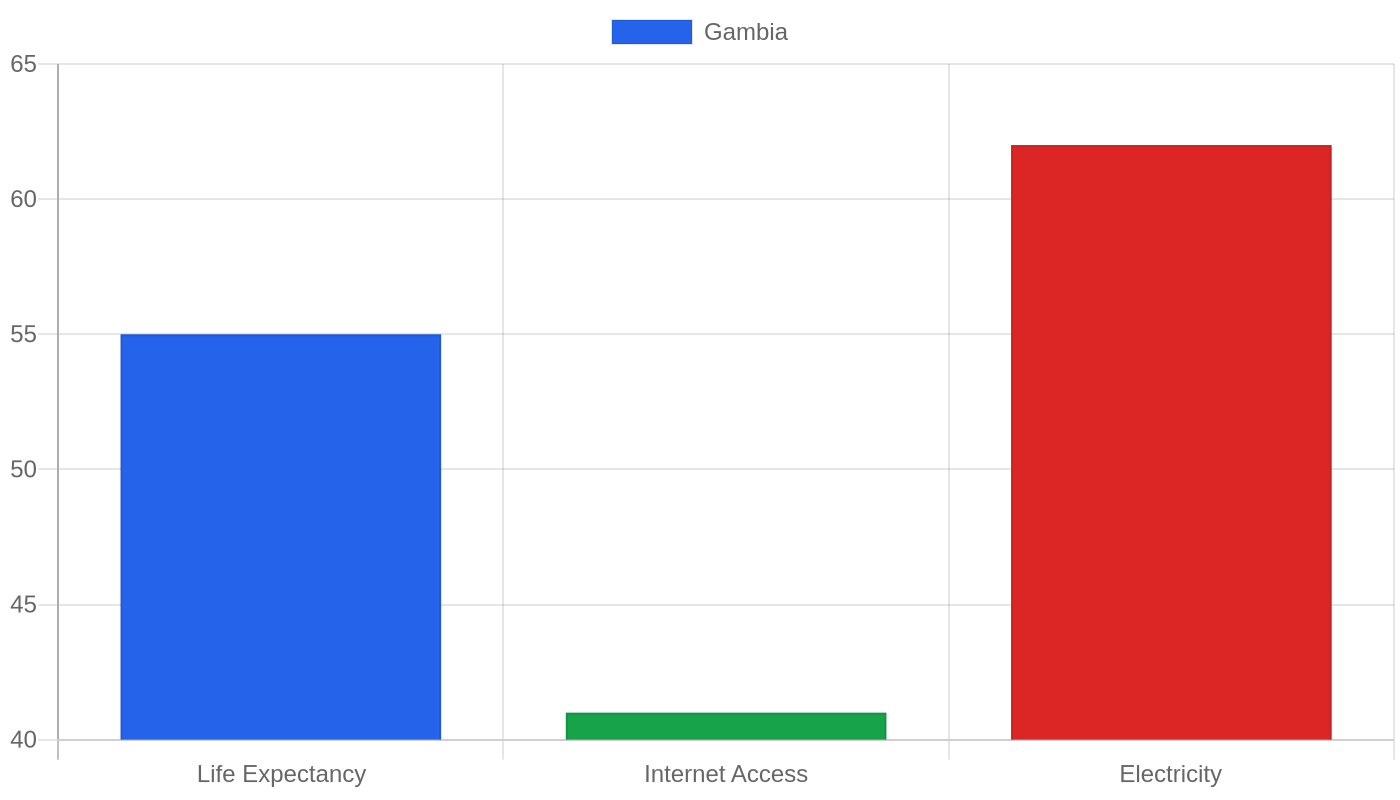
The World Bank’s data profile for The Gambia is a study in absence. GDP growth: not available. Inflation: not available. Unemployment: not available. GDP in US dollars: not available. GDP per capita in purchasing power parity terms: not available. GNI per capita: not available. Population: not available. For a country that gained independence from the United Kingdom on 18 February 1965, this statistical void is itself a form of economic testimony.
What we do know is that The Gambia has historically been one of West Africa’s smallest and least diversified economies. Agriculture—particularly groundnuts, rice, and horticulture—has traditionally accounted for roughly a quarter of economic output and employed the majority of the workforce. Tourism, centred on the Atlantic coastline and the Gambia River, has been another critical but volatile pillar, vulnerable to political shocks and global downturns.
Remittances from the Gambian diaspora, estimated by the World Bank in prior years at around 20 percent of GDP, have provided a crucial lifeline for household consumption.
The absence of current data from the World Bank suggests either severe statistical capacity constraints within the national bureaucracy or a period of such economic turbulence that standard metrics have become unreliable. For an economy that has weathered military rule, authoritarian crackdowns, and a fragile democratic transition, the lack of transparent, timely economic indicators is itself a red flag for investors and development partners alike.
Without knowing the rate of inflation, policymakers cannot calibrate monetary policy; without employment figures, they cannot target social programmes; without GDP data, they cannot measure whether the country is growing or stagnating.
The Price of Living — When the Cost of Survival Goes Unmeasured
The Gambia’s cost of living remains one of the country’s most pressing yet least documented realities. With no official data on housing costs, rental markets, or daily expenses provided by the World Bank or any other source, one must look to the structural factors that shape everyday life for Gambians. The country imports a significant portion of its food—particularly rice, wheat, and cooking oil—making domestic prices highly sensitive to global commodity markets and exchange rate fluctuations.
The Gambian dalasi has historically been prone to depreciation against major currencies, eroding purchasing power for households that rely on imported goods.
Housing in the Greater Banjul Area, where much of the population is concentrated, ranges from traditional compound-style dwellings in peri-urban settlements to more formal housing in areas like Fajara and Bakau. Rental costs, while not captured in official indices, are understood to consume a significant portion of household income for urban families, particularly those working in the informal sector, which accounts for the vast majority of employment.
For the rural majority, housing is often self-built and land is held through customary tenure, making formal cost comparisons difficult but also masking deep inequalities in access to adequate shelter, sanitation, and electricity.
Business Without a Blueprint — Where Investment Goes When the Data Doesn’t
The Gambia’s business environment operates in a vacuum of documented corporate activity. No top companies are listed in the available data, and no sectors beyond the traditional mainstays of agriculture and tourism are identified as drivers of investment. This absence does not mean the private sector is non-existent—rather, it is overwhelmingly informal, small-scale, and poorly documented.
The country has no stock exchange of its own, and most formal businesses are concentrated in trade, telecommunications, banking, and hospitality, often dominated by Lebanese and Senegalese entrepreneurs alongside a small Gambian business class.
Sectors to watch, based on historical trends and regional dynamics, include agribusiness—particularly horticultural exports to Europe—and renewable energy, given The Gambia’s abundant solar potential and chronic electricity shortages. Tourism remains the most visible formal sector, with European charter operators and hotel chains maintaining a presence despite political turbulence.
However, without company registrations, market capitalisation data, or foreign direct investment figures in the available record, the investment climate must be described in terms of its challenges rather than its opportunities: weak rule of law, limited access to finance for small and medium enterprises, high energy costs, and a small domestic market of roughly 2.5 million people.
From Ballot Box to Barracks — Politics as the Economic Mainspring
The Gambia’s political landscape, as documented in the available data, is the single most important factor shaping its economic destiny. From independence in 1965 until 1994, the country was ostensibly a multi-party liberal democracy under Sir Dawda Jawara and his People’s Progressive Party.
Yet, as the data notes, “the country never experienced political turnover during this period and its commitment to succession by the ballot box was never tested.” This was a democracy in name only—a one-party state with a democratic veneer, where political stability came at the cost of genuine competition, accountability, and institutional development.
In 1994, a military coup propelled the Armed Forces Provisional Ruling Council to power, ushering in 22 years of authoritarian rule under Yahya Jammeh. This period saw the economy managed through patronage, state control of key sectors, and international isolation. The peaceful transfer of power to Adama Barrow in 2017, following a regional military intervention by ECOWAS forces, raised hopes of democratic consolidation and economic renewal.
Yet the scars of that history remain: weak institutions, a politicised civil service, and a population that has never experienced genuine democratic accountability. The political landscape is thus not merely a backdrop to economic policy—it is the primary determinant of whether The Gambia can attract investment, build institutions, and deliver prosperity.
The Democracy Dividend That Never Arrived
The most current story from The Gambia is one of democratic transition meeting economic inertia. Since President Adama Barrow took office in 2017, the country has undertaken constitutional reforms, established a truth and reconciliation commission, and restored relations with international financial institutions. The World Bank and International Monetary Fund have resumed engagement, with programmes aimed at strengthening public financial management and supporting agricultural productivity.
Yet the data provided—or rather, the absence of it—suggests that the much-anticipated “democracy dividend” has yet to materialise in measurable economic terms.
The country continues to grapple with the legacy of two decades of authoritarian mismanagement: a bloated and inefficient public sector, limited private investment, and persistent poverty. The tourism sector, which collapsed during the political crisis of 2016–2017, has recovered only partially. Remittances remain strong but are a sign of dependence rather than dynamism.
The government has pursued infrastructure projects, including a new bridge across the Gambia River, but these have yet to catalyse the structural transformation needed to generate broad-based growth. For now, The Gambia remains a country in political transition but economic stasis—a nation waiting for its democratic institutions to deliver the prosperity that has so long eluded it.
The Bottom Line
The Gambia is a country for patient observers rather than impatient investors. Its democratic transition is genuine but incomplete, its economic potential real but unrealised, and its data gaps a symptom of deeper institutional weaknesses. Development economists, democracy scholars, and diaspora investors should watch closely—the country represents a rare test case of whether political freedom can, in West Africa’s smallest state, be translated into economic opportunity.
For now, the verdict is pending, and the numbers are not yet in.
Sources & Methodology
This article is authored by Economic Pulse Net for informational and research purposes. Economic Pulse Net sources its data from multilateral institutions, national statistics bureaus, and proprietary databases. All data is believed to be current as of the date of publication.
Published: July 18, 2026 | Category: Research — Gambia
Use these signals in your own platform
Economic Pulse publishes its live signal feed through a documented, read-only API. Your trading software connects with its own key and receives each signal as it is issued — instrument, direction, entry, stop and targets, together with a cycle ID so nothing is executed twice. The feed is independent of this website and cannot change it.
Signals are informational only and are not financial advice.