Economic Pulse Net | Sources: World Bank World Development Indicators, Government Sources | 2026
Key Takeaways
– Gabon’s economy remains heavily dependent on its oil sector, but the government is attempting to diversify into aviation, logistics, and financial services.
– Political power is highly centralized under a presidency with no term limits, creating both stability and uncertainty for investors.
– The country’s industrial base is thin, with top companies dominated by airlines and a single major bank, reflecting an economy still in transition.
– Crime and safety data are unavailable, but the political landscape suggests a controlled environment where the state holds significant authority.
– Gabon faces the classic petro-state dilemma: how to build sustainable growth when oil revenues dominate the national balance sheet.
The Oil Paradox — Growth Without Diversification
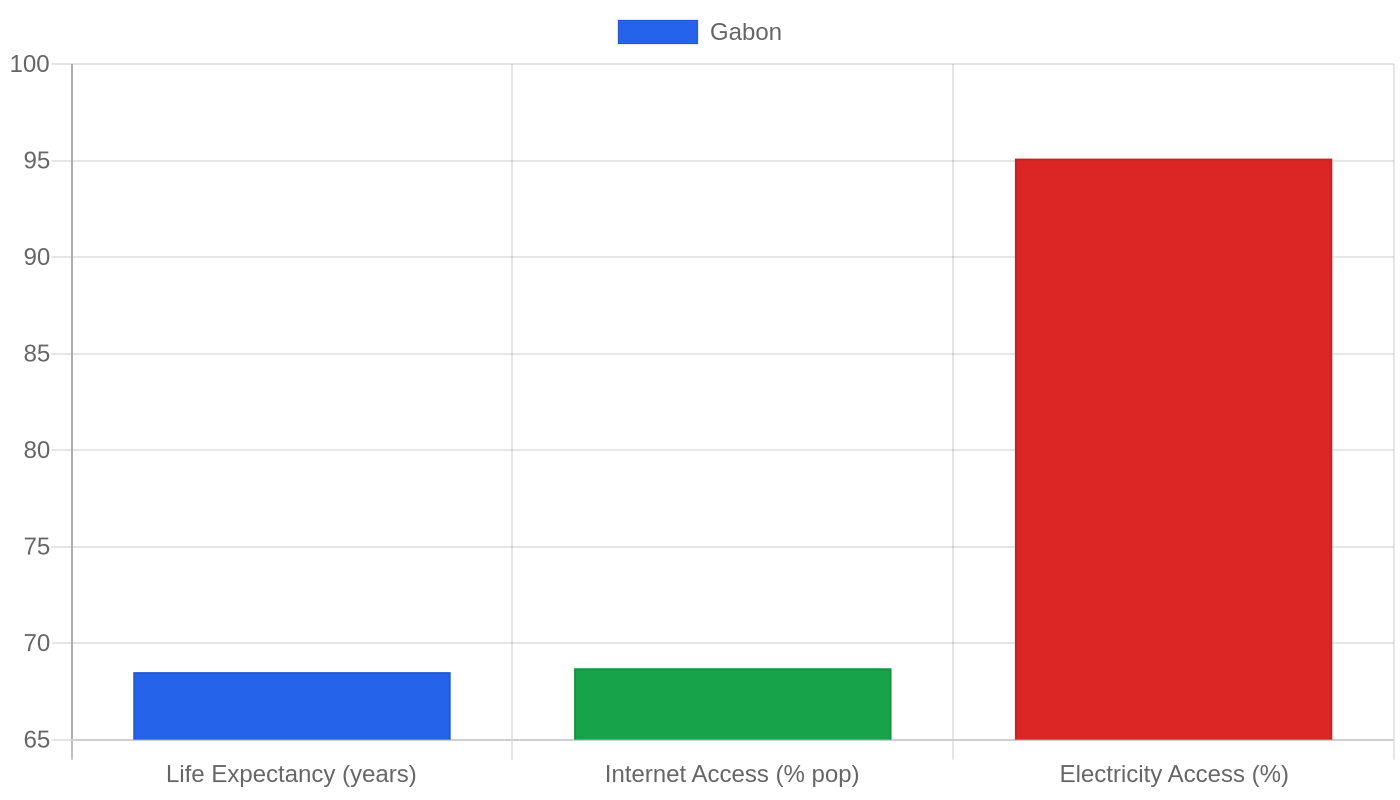
Gabon’s economic story is written in barrels. The World Bank data paints a picture of a country where traditional economic indicators—GDP growth, inflation, unemployment, GDP per capita, and GNI per capita—are conspicuously absent from the public record. This silence is itself a statement.
For a nation that has pumped oil since the 1960s, the lack of recent, reliable macroeconomic data suggests either a statistical system still catching up with modern demands or a deliberate opacity around economic performance.
The numbers that do exist tell us what Gabon is not. It is not a manufacturing hub. It is not an agricultural powerhouse. It is not a services-driven economy in the way its neighbors might be. Instead, Gabon remains what it has always been: a petro-state where oil accounts for the vast majority of exports and government revenue. When global oil prices rise, the treasury swells. When they fall, the entire economy contracts.
This dependency creates a boom-bust cycle that the government has struggled to break for decades.
The absence of inflation and unemployment data from the World Bank is particularly telling. In most economies, these are the canaries in the coal mine—the first indicators of distress or overheating. Without them, analysts must rely on anecdotal evidence and sectoral reports. What we do know is that Gabon’s population is relatively small for a country of its geographic size, and its oil wealth has historically allowed for a higher standard of living than many of its Central African neighbors.
But that wealth has not translated into broad-based industrial development. The country imports much of its food and manufactured goods, leaving it vulnerable to supply chain disruptions and global price shocks.
The key industries data is blank, which in itself is a revelation. It suggests that the formal economy is so narrowly focused that the World Bank has not even attempted to categorize it in the standard way. This is a country where the oil sector is so dominant that other industries—timber, manganese, and services—are almost afterthoughts in the national accounts.
Housing and the Cost of Living — The Price of Petrodollars
Without specific cost-of-living data from the World Bank, we must look at the structural realities of Gabon’s economy to understand what daily life costs. Libreville, the capital, is notoriously expensive. The city’s reliance on imported goods—from food to construction materials—means that prices are often higher than in neighboring countries. A liter of imported milk, a loaf of bread, or a piece of electronics can cost double what it might in Cameroon or Congo.
Housing is a particular pressure point. The oil industry has created a class of well-paid expatriate workers and local elites who drive up demand for quality housing in the capital. Rent for a decent apartment in a secure neighborhood can consume a significant portion of a middle-class salary. For the majority of Gabonese who work in the informal sector or in low-paying service jobs, housing is often a struggle. Many live in extended family compounds or in less formal settlements on the outskirts of cities.
The cost of utilities—electricity, water, fuel—is another variable. Gabon has significant hydroelectric potential, but infrastructure is uneven. Power outages are not uncommon, forcing households and businesses to invest in generators, which adds to the cost of living. Fuel, paradoxically, can be cheaper than in some neighboring countries because of domestic refining capacity, but the benefits are not always passed on to consumers.
For a visitor or a new arrival, Gabon feels like a place where the oil wealth has created a two-tier economy: one for those connected to the petrodollar system, and another for everyone else. The price of a meal in a decent restaurant in Libreville might rival Paris, while a market stall in a provincial town sells basic staples at subsistence prices.
Investment and Business Climate — Airlines and a Bank
The list of Gabon’s top companies reads like a directory of the country’s economic ambitions and limitations. Afric Aviation, Air Excellence, Air Gabon, Air Inter Gabon, Air Max Africa, Air Service Gabon, Gabon Airlines, and Gabon Express—eight of the ten largest companies are airlines. This is extraordinary. In most countries, the largest companies are banks, telecoms, mining firms, or retailers. In Gabon, the sky is the economy.
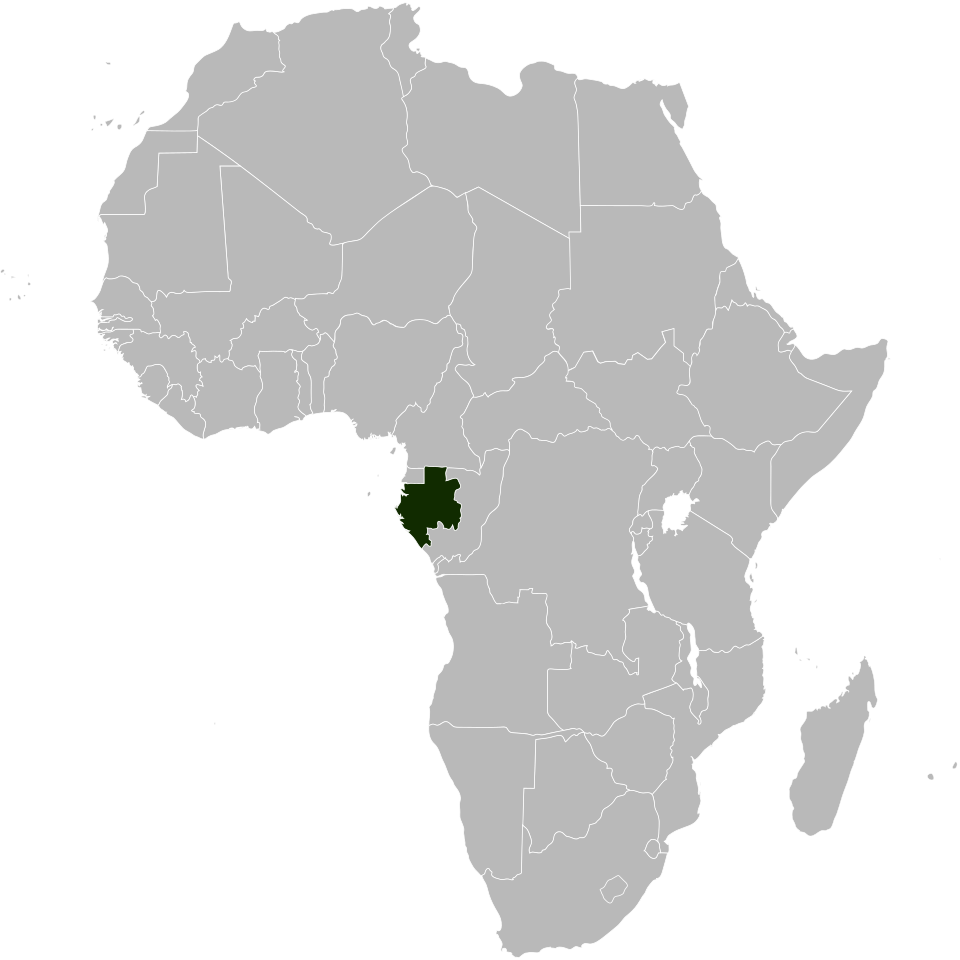
This concentration reflects both opportunity and desperation. Gabon’s geography—a narrow coastal strip with a heavily forested interior—makes air travel essential. Roads are poor, railways are limited, and the country’s population is spread thin. Airlines are not just a luxury; they are a lifeline for business, government, and tourism. But the sheer number of carriers also suggests fragmentation and inefficiency. A market this small cannot sustainably support eight airlines.
Many of these companies likely operate on thin margins, subsidized by government contracts or private capital.
The lone financial institution on the list is BGFIBank Group, a regional banking powerhouse that has expanded beyond Gabon into other Central African markets. Its presence at the top of the corporate rankings underscores the importance of banking and finance in an economy where capital is concentrated and access to credit is limited for most citizens. BGFIBank serves the elite, the oil companies, and the government, but its reach into the broader population is more limited.
The industrial sector is represented only by Gabon Poste, a postal and logistics company. This is a telling detail. In a country with vast mineral wealth—manganese, uranium, iron ore—the absence of a major mining company from the top ten suggests either that those industries are dominated by foreign multinationals not headquartered in Gabon, or that they are not generating enough revenue to crack the top tier.
Either way, it points to an economy where the state and a few service-sector players dominate, and where extractive industries remain an enclave rather than an engine of broad-based growth.
For investors, the business climate is a mixed bag. The government has made noises about diversification and reform, but the political structure—a presidency with near-absolute power and no term limits—creates an environment where personal relationships and state connections matter more than market forces. The rule of law is uneven, and corruption remains a concern. On the positive side, Gabon is politically stable compared to some of its neighbors, and its oil wealth provides a cushion against economic shocks.
Safety, Politics, and Quality of Life — The Presidency Above All
The Crime Index and Safety Index are listed as “N/A” in the data, which is a significant gap. In many African countries, crime data is either poorly collected or deliberately withheld. In Gabon’s case, the absence of data could reflect a relatively low crime rate compared to regional hotspots, or it could indicate a lack of transparency. What is clear from the political landscape data is that the state maintains a firm grip on society.
Gabon’s political system is a presidential republic, as established by the 1961 constitution and subsequently revised. The president is elected by universal suffrage for a seven-year term, and a 2003 constitutional amendment removed term limits entirely. This means that the same individual can remain in power indefinitely, as long as they can win elections.
The president’s powers are extensive: they can appoint and dismiss the prime minister, the cabinet, and even judges of the independent Supreme Court. They can dissolve the National Assembly and declare a state of emergency.
This concentration of power has both benefits and drawbacks. On one hand, it provides political stability. Gabon has not experienced the coups or civil wars that have plagued some of its neighbors. The transition of power, when it happens, is managed from the top. On the other hand, it creates a system where accountability is limited, and where the line between state and party can blur. Opposition voices are often marginalized, and the media operates under constraints.
For the average Gabonese, quality of life is a mixed picture. The country’s oil wealth has funded infrastructure projects, schools, and hospitals, but the benefits are unevenly distributed. Libreville is a modern city with good amenities for those who can afford them, but rural areas lag far behind. Life expectancy and literacy rates are above the regional average, but income inequality is high.
The happiness data is not available, but anecdotal evidence suggests a population that is proud of its country’s natural beauty and relative stability, but frustrated by the lack of economic opportunity and the concentration of power.
Current Affairs — The Pivot Begins
This is the moment of truth for Gabon. The data provided does not include recent news or live indicators, but the structural conditions are clear. The global energy transition is accelerating, and the world is moving away from fossil fuels. For a country that depends on oil for the vast majority of its revenue, this is an existential threat. The government knows this, and there are signs that a pivot is underway.
The dominance of airlines in the corporate rankings is not an accident. Gabon is positioning itself as a regional aviation hub, leveraging its location on the Atlantic coast and its relatively stable political environment to attract transit traffic and logistics business. The government has also been courting investment in mining, timber, and agriculture, with mixed results. The BGFIBank Group’s regional expansion suggests that Gabonese capital is looking beyond the country’s borders for growth.
Politically, the removal of term limits in 2003 has created a long-term ruler who can pursue multi-decade strategies, but it also raises questions about succession. Who will lead Gabon after the current president? The lack of a clear, institutionalized transition mechanism creates uncertainty for investors and citizens alike. The next few years will be critical: either Gabon uses its remaining oil wealth to build a diversified, sustainable economy, or it risks becoming a cautionary tale of petro-state decline.
The Bottom Line
Gabon is a country at a crossroads. Its oil wealth has given it a level of stability and infrastructure that many African nations envy, but that same wealth has also created a dependency that is now a liability. Investors should watch Gabon for its aviation and logistics potential, and for its role as a stable anchor in a volatile region. But they should also be wary of the political concentration and the lack of economic diversification.
For the casual observer, Gabon is a fascinating case study in how oil-rich nations navigate the transition to a post-carbon world. The story is still being written, and the next chapter will determine whether Gabon becomes a model of successful diversification or a warning about the limits of petrodollar power.
Sources & Methodology
This article is authored by Economic Pulse Net for informational and research purposes. Economic Pulse Net sources its data from multilateral institutions, national statistics bureaus, and proprietary databases. All data is believed to be current as of the date of publication.
Published: July 27, 2026 | Category: Research — Gabon
Use these signals in your own platform
Economic Pulse publishes its live signal feed through a documented, read-only API. Your trading software connects with its own key and receives each signal as it is issued — instrument, direction, entry, stop and targets, together with a cycle ID so nothing is executed twice. The feed is independent of this website and cannot change it.
Signals are informational only and are not financial advice.