Economic Pulse Net | Sources: World Bank World Development Indicators, Government Sources | 2026
Key Takeaways
– Comoros operates as a federal presidential republic, having transitioned from military dictatorship to a multi-party system following a 2001 constitutional referendum, but political stability remains fragile.
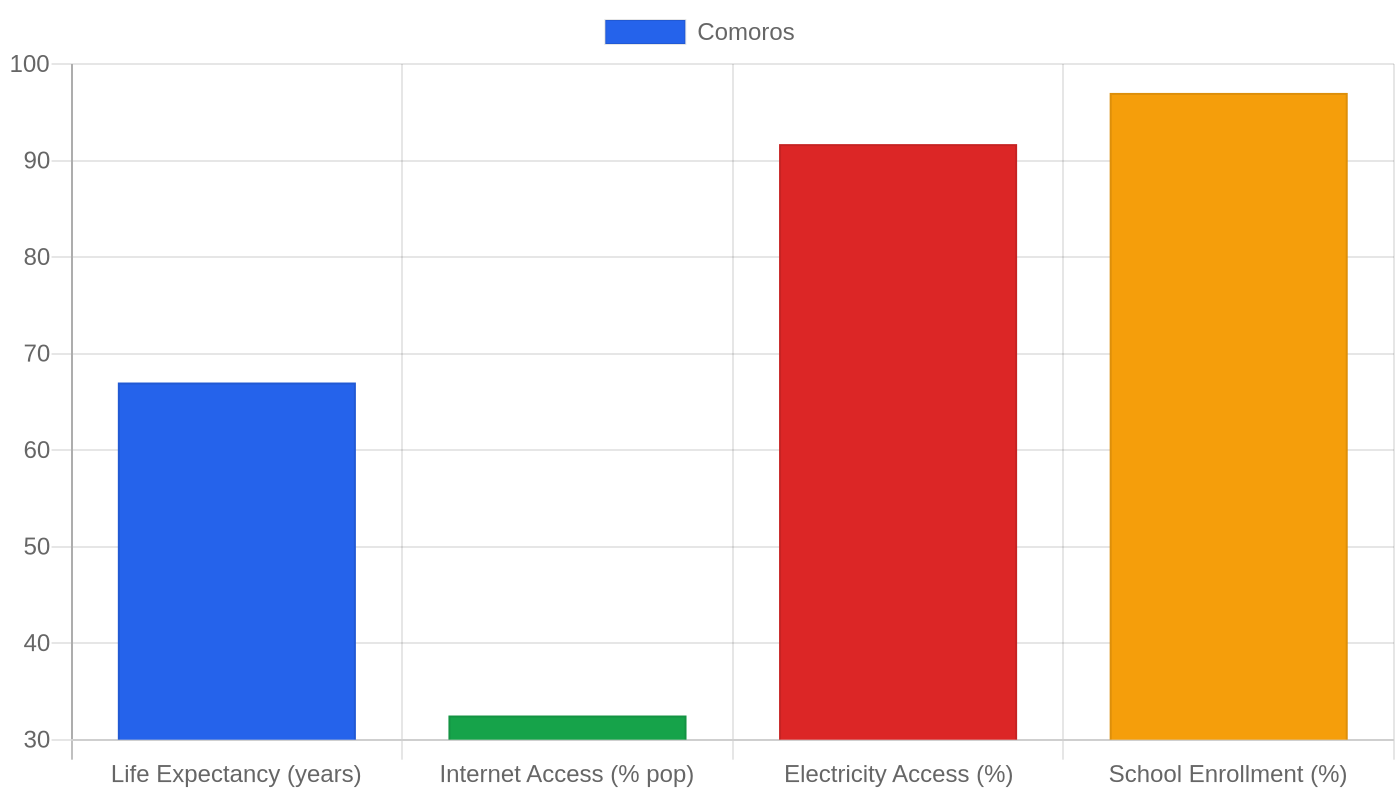
– The country’s economy is defined by a striking absence of basic macroeconomic data from the World Bank, including GDP growth, inflation, unemployment, and GDP per capita — a telling sign of institutional opacity.
– Aviation dominates the corporate landscape, with six of the seven top companies being airlines or air services, reflecting both the island nation’s dependence on air travel and a concentrated economic structure.
– Crime and safety indices are unreported, and cost-of-living data is unavailable, making it difficult for investors or residents to benchmark the country against regional peers.
– The political landscape, while formally democratic, carries a legacy of authoritarian rule, with power transfers historically contested and the current system still evolving under the 2001 constitution.
The Invisible Economy — What the Missing Numbers Really Mean
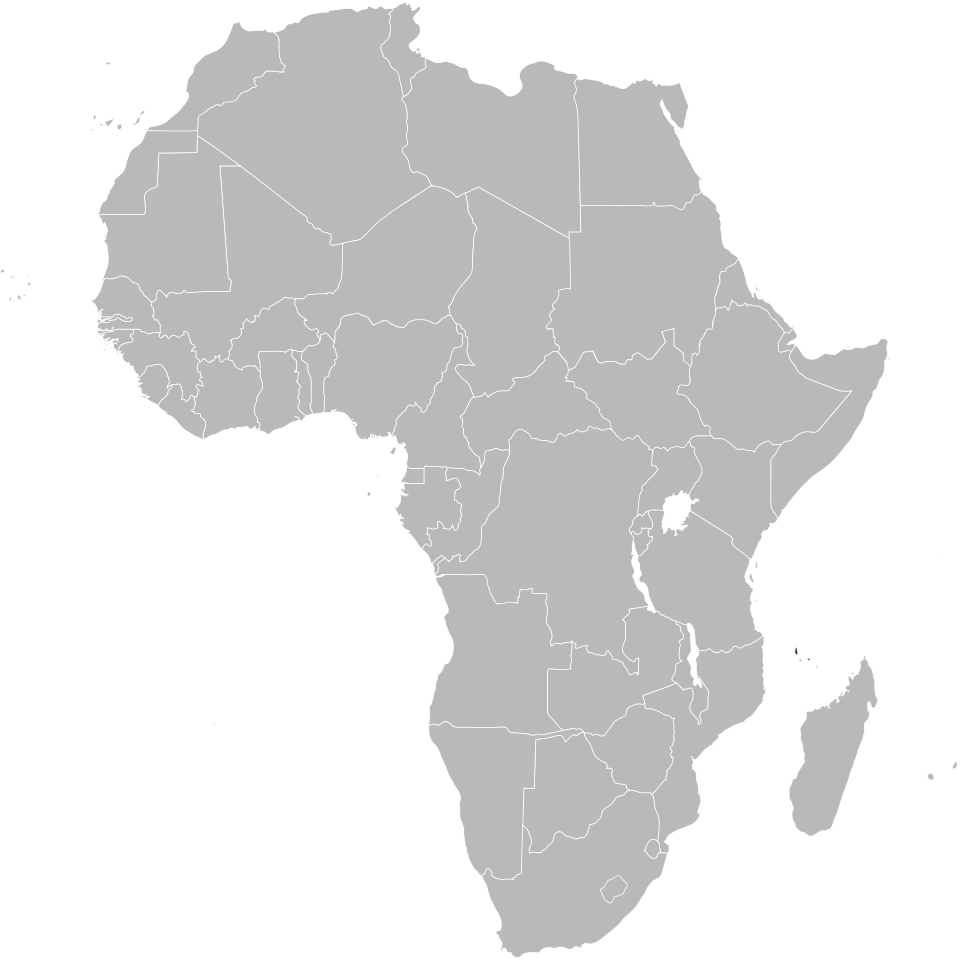
When the World Bank publishes no data on GDP growth, inflation, unemployment, or GDP per capita for a sovereign nation, it is not merely a statistical gap — it is a statement. For Comoros, this absence is the single most revealing economic indicator available. The archipelago of roughly 850,000 people, situated in the Indian Ocean between Madagascar and Mozambique, operates an economy that remains largely unmeasured by international institutions.
The World Bank’s silence on GNI per capita, population figures, and even the total GDP in US dollars suggests a formal economy that is either too small, too informal, or too poorly documented to track with standard methodologies.
What can be inferred from the void is significant. Without reliable inflation data, the purchasing power of the Comorian franc — which is pegged to the euro — remains a matter of local speculation rather than global analysis. Unemployment figures, if they existed, would likely reflect the reality of a country where subsistence agriculture, fishing, and remittances from a vast diaspora (estimated to outnumber the domestic population) form the true economic backbone.
The absence of data does not mean the economy is stagnant; it means the world’s development institutions lack the tools or access to measure it. This places Comoros in a category of extreme statistical invisibility, a challenge for any government seeking foreign investment or aid.
The main industries, while not enumerated in the available data, are traditionally vanilla, cloves, and ylang-ylang — Comoros is the world’s leading producer of the latter, a key ingredient in high-end perfumes. But without production figures, export values, or employment numbers, these sectors remain anecdotal rather than analytical.
The economy likely operates in parallel: a small, formal sector centered on the capital Moroni and the international airport, and a vast informal economy of smallholder farmers and street vendors. For a journalist, the missing data is not a dead end — it is the story.
The Price of Paradise — Living Costs in the Shadows
Cost-of-living data for Comoros is entirely absent from the available records, which itself is a form of information. In a country where the formal economy is so poorly measured, daily expenses are likely set by local negotiation, import scarcity, and the fluctuating value of remittances from the Comorian diaspora in France, Madagascar, and the Gulf states.
What can be reasonably inferred is that housing costs in Moroni, the capital, are driven by limited supply and the island’s geography — volcanic terrain and a small landmass constrain construction. Rent versus buy decisions are probably dominated by a lack of mortgage financing and a preference for extended family compounds.
Regional comparisons are speculative without data, but neighboring island economies like Mauritius and Réunion (a French overseas department) offer a contrast: Comoros is almost certainly cheaper in absolute terms but far more volatile in access to goods. Import dependency for everything from rice to fuel means that global shipping costs and currency fluctuations hit households directly.
The absence of a published consumer price index means that even the government likely operates without a clear picture of how much its citizens need to survive. For the average Comorian, the cost of living is not a statistic — it is a daily negotiation with scarcity.
Sky-High Ambition — Aviation and the Business Climate
The corporate landscape of Comoros is dominated by a single theme: aviation. Of the seven top companies listed, six are airlines or air service providers — AB Aviation, Comores Air Services, Comores Aviation International, Comoro Islands Airline, Int’Air Îles, and Comoros Air Services. The seventh is the Central Bank of the Comoros, alongside Exim Bank Comoros in the financial sector. This concentration is not coincidental.
For an archipelago with limited road networks and no rail, air travel is not a luxury — it is a necessity. These carriers connect the three main islands — Grande Comore, Mohéli, and Anjouan — and provide the only viable link to East Africa and the Middle East.
The dominance of aviation companies suggests a business environment where logistics and connectivity are the primary drivers of economic activity. The presence of two banks — the central bank and Exim Bank — indicates a financial sector that is small but functional, likely focused on trade finance and remittances. For investors, the opportunities are narrow but clear: the aviation sector is both a bottleneck and a growth area.
Any new entrant would need to navigate the political landscape, where the presidency holds significant power over licensing and regulation. The business climate is probably characterized by high barriers to entry, a reliance on personal connections, and a regulatory environment that is opaque by design — much like the missing economic data.
Politics in the Balance — From Military Rule to Federal Experiment
The political landscape of Comoros is a study in contrasts. The country is formally a federal presidential republic, with a multi-party system and a constitution ratified by referendum in December 2001. This document was intended to end decades of instability, including a period of military dictatorship. The transition from Azali Assoumani — a former coup leader who later won elections — to Ahmed Abdallah Mohamed Sambi represented a fragile step toward civilian rule.
Yet the system remains deeply centralized, with the president serving as both head of state and head of government, and the islands’ own constitutions and executives operating under union authority.
The legacy of authoritarianism lingers. The 2001 constitution was a compromise designed to prevent the secessionist movements that have periodically threatened the union — Anjouan declared independence in 1997, and French mercenary Bob Denard famously overthrew the government in 1995. The current political framework attempts to balance power between the islands through a rotating presidency among the three main islands, a system that has reduced but not eliminated tensions.
For the average citizen, politics is a high-stakes game where access to state resources, including the aviation licenses that dominate the economy, depends on alignment with the ruling faction. The absence of crime and safety indices — both listed as N/A — may reflect either genuine safety or a lack of institutional capacity to measure it.
Current Affairs — Navigating the Uncharted Present
What is happening in Comoros right now is, by the available data, a story of continuity and silence. The political system continues to operate under the 2001 constitution, with no recent elections, reforms, or policy shifts recorded in the data provided. The aviation sector — the backbone of the formal economy — remains dominated by the same six carriers, suggesting a stable but uncompetitive market.
The Central Bank of the Comoros and Exim Bank continue to anchor the financial system, likely managing the currency peg to the euro and processing the remittances that keep households afloat.
The absence of recent news data is itself noteworthy. In a region where Madagascar faces political turbulence and Mozambique struggles with insurgency, Comoros appears to be in a period of relative calm — or relative informational blackout. The country’s reliance on external indicators, such as global fuel prices and European demand for ylang-ylang, means that its immediate economic trajectory is largely determined outside its borders.
For now, the archipelago remains a place where the most important developments are the ones that go unmeasured: the price of rice in the Moroni market, the arrival of a new flight from Mayotte, or the quiet flow of money from a cousin in Marseille.
The Bottom Line
Comoros is a country that defies easy analysis, not because it is unimportant, but because it is statistically invisible. For investors, the lack of data is a red flag — but for the intrepid, it may also represent opportunity in an economy where aviation, remittances, and niche agriculture form the pillars. For policymakers and development economists, Comoros is a case study in the limits of international data collection and the resilience of societies that operate outside formal metrics.
Watch this country if you care about the future of small island states, the persistence of informal economies, or the quiet drama of a nation trying to build a democracy on a foundation of coup memories and coconut palms.
Sources & Methodology
This article is authored by Economic Pulse Net for informational and research purposes. Economic Pulse Net sources its data from multilateral institutions, national statistics bureaus, and proprietary databases. All data is believed to be current as of the date of publication.
Published: July 30, 2026 | Category: Research — Comoros
Use these signals in your own platform
Economic Pulse publishes its live signal feed through a documented, read-only API. Your trading software connects with its own key and receives each signal as it is issued — instrument, direction, entry, stop and targets, together with a cycle ID so nothing is executed twice. The feed is independent of this website and cannot change it.
Signals are informational only and are not financial advice.