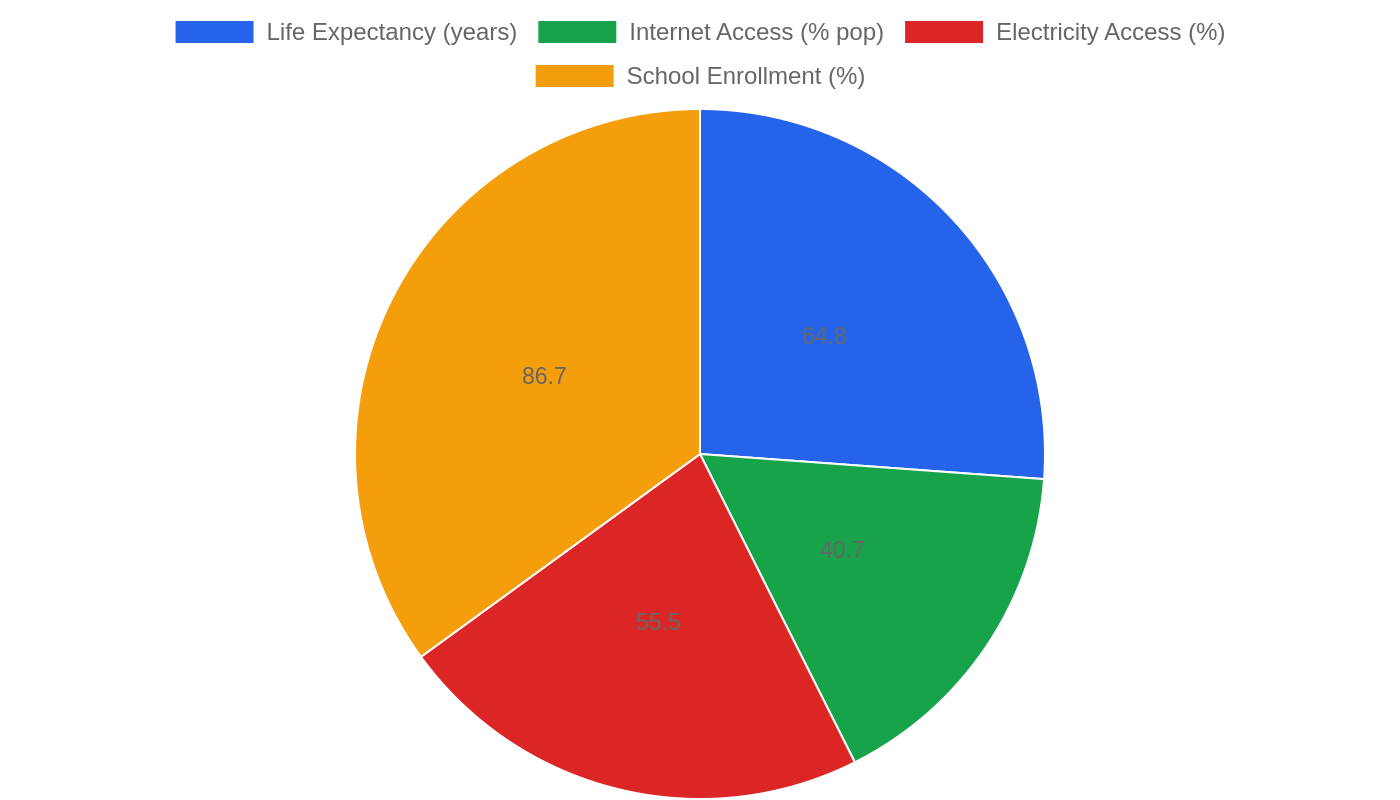
Economic Pulse Net | Sources: World Bank World Development Indicators, Government Sources | 2026
Key Takeaways
– Angola’s economy remains heavily dependent on its oil and gas sector, with Angola LNG standing as a flagship enterprise, yet the government is pushing for diversification into telecommunications, financial services, and consumer industries.
– The political landscape operates under a three-branch system with strong executive authority concentrated in the presidency, shaping both economic policy and investment climate.
– Major companies like Angola Cables and the Angola Stock Exchange and Derivatives signal a strategic shift toward building non-oil economic infrastructure.
– Despite abundant natural resources, the country faces significant challenges in translating mineral wealth into broad-based prosperity and improved quality of life.
– Investors and analysts should watch Angola’s progress in developing its capital markets and telecom sector as indicators of genuine economic transformation.
Black Gold and Beyond — Reading Angola’s Economic Pulse
The story of Angola’s economy is written in two languages: the language of hydrocarbons and the language of diversification. For decades, crude oil has been the lifeblood of this southwestern African nation, accounting for the vast majority of export revenues and government income. The World Bank data paints a picture of an economy in transition, though precise figures on GDP growth, inflation, and unemployment remain elusive in the latest reporting.
What is clear is that Angola’s economic trajectory is inextricably linked to global energy markets, making it vulnerable to price shocks that have historically sent the economy on a rollercoaster ride.
The presence of Angola LNG among the country’s top companies underscores the centrality of natural gas to the economic model. This liquefied natural gas venture represents a significant value-added step beyond crude oil extraction, allowing Angola to process and export a cleaner fuel to global markets. Yet the economy’s reliance on extractive industries creates a familiar challenge: how to build sustainable growth when your primary revenue source is finite and volatile.
The absence of clear GDP growth figures from the World Bank may itself be telling — suggesting either data collection challenges or an economy in flux where traditional metrics are difficult to pin down.
Inflation and unemployment data are similarly opaque, but the composition of Angola’s leading companies offers clues about where the economy is heading. Alongside energy giants, one finds Aeronáutica and Air 26 in consumer services, Alada and Ancar in consumer goods, and critically, the Angola Stock Exchange and Derivatives in financial services.
This mix suggests a deliberate effort to build the infrastructure of a modern, diversified economy — one where a domestic capital market can channel savings into productive investment, and where consumer-facing industries can absorb workers displaced from a shrinking formal sector.
The Price of Living in Luanda — Housing and Daily Expenses in Africa’s Costly Capital
Housing in Angola, particularly in the capital Luanda, has historically ranked among the most expensive in Africa. The cost of living data, while not providing specific numbers, points to a reality where basic necessities consume a significant portion of household income for most Angolans.
The disconnect between the country’s resource wealth and everyday affordability is stark: oil revenues have built impressive infrastructure in some areas, yet the average citizen faces steep prices for imported goods, including food and construction materials.
Renting in Luanda has long been the dominant option for most residents, as homeownership remains out of reach for all but the wealthiest families. The rental market is characterized by wide disparities — from luxury apartments in the upscale Miramar neighborhood to informal settlements on the city’s periphery. For international workers and the local elite, housing costs can rival those in major European capitals, while the majority of Angolans spend a disproportionate share of their income on shelter.
The cost of living challenge is compounded by the fact that many consumer goods are imported, making everyday expenses sensitive to exchange rate fluctuations and global supply chain disruptions.
From Oil Rigs to Trading Floors — Angola’s Evolving Investment Landscape
The roster of Angola’s top companies reads like a roadmap of where the country wants to go. Angola Cables, a telecommunications infrastructure firm, represents the push to become a digital hub for the region, connecting Africa to South America and Europe through submarine cable systems. This is not merely a utility play — it is a strategic bet that Angola can leverage its geographic position to become a data transit center for the Atlantic basin.
The Angola Stock Exchange and Derivatives, meanwhile, signals an ambition to create a formal capital market that can attract both domestic savings and foreign portfolio investment.
The business environment in Angola has traditionally been challenging, with bureaucracy, corruption, and the dominance of state-linked enterprises creating hurdles for private sector development. Yet the presence of companies like African Diamond Producers Association in basic materials suggests that Angola is also looking to develop its mineral wealth beyond petroleum. Diamonds, iron ore, and other resources offer diversification pathways, though they come with their own governance challenges.
For investors, the sectors to watch are telecommunications, financial services, and consumer goods — areas where private enterprise can potentially flourish if the regulatory environment continues to improve.
Power, Politics, and Personal Safety — Navigating Life in Angola
The political landscape in Angola is defined by a constitutional framework that concentrates significant authority in the executive branch. According to available data, the government is composed of three branches — executive, legislative, and judicial — with executive power exercised by the President, assisted by the Vice-President and the Council of Ministers.
This structure has provided stability since the end of the civil war in 2002, but critics argue it also concentrates power in ways that can stifle independent oversight and slow the pace of reform.
Crime and safety indices for Angola are not available in the current data, but the country’s reputation presents a mixed picture. Luanda, like many rapidly urbanizing African capitals, faces challenges with petty crime and occasional more serious incidents. The quality of life for Angolans varies enormously depending on one’s proximity to the oil economy. For those employed in the formal sector — particularly in oil, gas, and related services — living standards can be comfortable.
For the majority working in the informal economy, daily life involves navigating high prices, inadequate public services, and limited access to quality healthcare and education.
Winds of Change — What’s Happening in Angola Right Now
The most significant development in Angola’s current affairs is the quiet but determined effort to build non-oil economic institutions. The Angola Stock Exchange and Derivatives, while still in its early stages, represents a bet that the country can create a transparent, regulated marketplace for capital.
This matters because a functioning stock exchange can do what oil revenues alone cannot: mobilize domestic savings, provide exit options for investors, and price risk in a way that encourages long-term productive investment.
The telecommunications sector, anchored by Angola Cables, is another arena of transformation. As digital connectivity becomes a prerequisite for modern economic activity, Angola’s investments in fiber optic infrastructure position it as a potential regional hub. The consumer services companies on the top companies list — Aeronáutica, Air 26, Alada, Alfa 5 — suggest that domestic demand is growing, driven by an emerging middle class and urbanization.
The challenge for policymakers is to ensure that this growth translates into broad-based employment and does not merely concentrate wealth in the hands of those already connected to the resource economy.
The Bottom Line
Angola is a country in the middle of a difficult but necessary transition — from oil dependency to a more diversified economic model. Investors with patience and a long-term horizon should watch the development of the stock exchange and telecommunications infrastructure as leading indicators of genuine reform. For businesses in consumer goods, financial services, and digital infrastructure, Angola offers frontier market opportunities that come with corresponding risks.
The country’s ultimate success will be measured not by the volume of oil exported, but by whether the institutions being built today can deliver prosperity that reaches beyond the boardrooms of Luanda to the daily lives of its people.
Sources & Methodology
This article is authored by Economic Pulse Net for informational and research purposes. Economic Pulse Net sources its data from multilateral institutions, national statistics bureaus, and proprietary databases. All data is believed to be current as of the date of publication.
Published: July 20, 2026 | Category: Research — Angola
Use these signals in your own platform
Economic Pulse publishes its live signal feed through a documented, read-only API. Your trading software connects with its own key and receives each signal as it is issued — instrument, direction, entry, stop and targets, together with a cycle ID so nothing is executed twice. The feed is independent of this website and cannot change it.
Signals are informational only and are not financial advice.