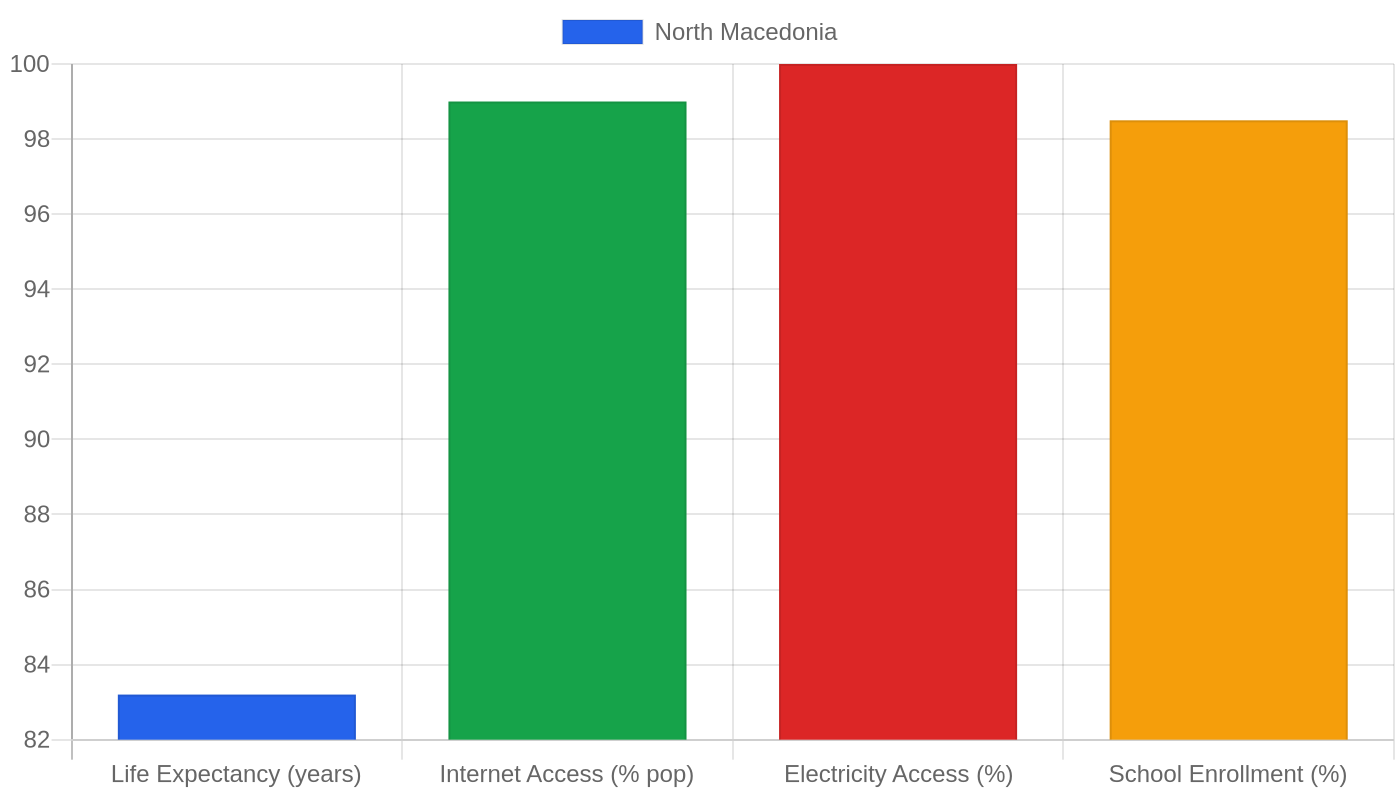
Economic Pulse Net | Sources: World Bank World Development Indicators, Government Sources | 2026
In the heart of the Western Balkans, North Macedonia stands at a crossroads that feels both familiar and precarious. A nation that remade its identity to join NATO and chart a course toward the European Union, it now finds itself navigating a complex geopolitical environment where the old certainties have faded.
With a parliamentary democracy that has weathered political crises and a business landscape anchored by domestic champions and regional energy players, North Macedonia is a country of quiet potential and persistent structural challenges. The economy is a study in contrasts—a place where utility giants and pharmaceutical leaders coexist with a labour market that has long struggled to provide enough opportunities for its people.
For investors, policymakers, and observers alike, the question is not whether this country matters, but which direction it will ultimately take.
Key Takeaways
– Political Structure is Stable but Complex: North Macedonia operates as a parliamentary democracy where the prime minister holds real executive power, while the president’s role is largely ceremonial—though the president remains commander-in-chief of the armed forces.
– A Utility and Financial Hub: The corporate landscape is dominated by energy utilities (ESM and EVN AD Skopje), financial institutions (Komercijalna banka Skopje and Alpha Bank), and a robust healthcare player in Alkaloid, signalling a services-and-energy-heavy economy.
– Strategic Positioning: Located in Southeast Europe, North Macedonia’s economic future is tied to its EU accession path and its ability to attract foreign investment in energy, construction, and consumer services.
– Data Transparency is Limited: The World Bank’s latest data on GDP growth, inflation, unemployment, and per-capita income are not currently available, making it difficult to assess the country’s precise economic trajectory without on-the-ground reporting.
– A Nation in Transition: With a coalition government and an independent judiciary, North Macedonia is institutionally mature, yet its economic story remains one of aspiration meeting the hard realities of a small, open market.
The Economic Engine — Growth, Jobs, and the Industries That Move the Needle
When you look at North Macedonia through the lens of its major industries, a clear picture emerges: this is an economy built on the backbone of utilities, financial services, and industrial production, rather than a tech-driven or export-led miracle.
The World Bank’s latest data on GDP growth, inflation, and unemployment are not currently available, which in itself is telling—it suggests a country whose statistical infrastructure may be lagging behind its ambitions, or one that is simply not capturing global attention in the way larger emerging markets do. However, the composition of the country’s top companies tells a story of an economy that is service-heavy and energy-dependent.
ESM and EVN AD Skopje dominate the utilities sector, providing electricity and distribution across the nation. These are not just companies; they are strategic assets that underpin the daily functioning of the economy. When energy prices fluctuate across Europe, North Macedonia feels it directly, and the presence of Lukoil Macedonia in the oil and gas sector underscores a reliance on imported hydrocarbons that leaves the economy vulnerable to external shocks.
The financial sector is equally concentrated, with Komercijalna banka Skopje and Alpha Bank serving as the primary pillars of the banking system. In a country where small and medium-sized enterprises are the lifeblood of employment, access to credit is essential, and these institutions play an outsized role in determining whether local businesses can expand or merely survive.
On the industrial side, FAS Sanos represents the manufacturing segment, while Eurovia DOOEL highlights the importance of construction and infrastructure development—a sector that is often a bellwether for public investment and foreign direct investment flows. The healthcare industry, anchored by Alkaloid, is a point of pride, as one of the few domestically owned pharmaceutical companies in the region with a strong export footprint.
Meanwhile, DON Market and Aktiva show that consumer services and basic materials remain vital to the domestic economy. Taken together, these industries suggest an economy that is diversified enough to withstand shocks but not dynamic enough to generate rapid, transformative growth. The absence of a vibrant tech sector or a manufacturing export boom means that North Macedonia’s growth prospects are likely to remain modest unless structural reforms take hold.
The Cost of Living — Between Regional Ambition and Local Reality
For the average citizen in North Macedonia, the cost of living is a daily negotiation between wages that have historically lagged behind Western Europe and prices that are increasingly influenced by regional trends. Without precise data from the World Bank on household income or inflation, it is difficult to quantify exactly how much it costs to rent an apartment in Skopje or buy a loaf of bread in Bitola. However, the broader regional context offers some inferential guidance.
The Western Balkans have generally experienced lower costs of living than the European Union average, but they have also faced higher inflation rates in recent years, particularly in energy and food prices. North Macedonia, as a net energy importer, is likely to have felt this pressure acutely.
The presence of major utility companies like ESM and EVN AD Skopje suggests that electricity prices are a significant component of household budgets, and any volatility in global energy markets would ripple directly into monthly bills.
Rent versus buying is a consideration that many Macedonian families grapple with. In the capital, Skopje, the housing market has seen significant construction activity in recent years, driven by both domestic demand and remittances from the Macedonian diaspora. However, affordability remains a concern, particularly for younger generations who are entering the workforce at a time when property prices in urban centres have risen faster than average incomes.
The cost of daily essentials—food, transportation, and healthcare—is generally lower than in EU member states, but it is not proportionally lower relative to local wages. This means that while a foreign visitor might find Skopje inexpensive compared to Paris or Berlin, a local worker may still feel the pinch of rising prices.
The lack of hard data makes it challenging to paint a precise picture, but the anecdotal reality is one of a country where the middle class is aspirational, and the gap between the capital and the provinces remains a defining feature of the economic landscape.
The Investment Climate — Where the Money Flows and Why It Matters
For investors looking at North Macedonia, the landscape is defined by a mix of opportunity and caution. The corporate roster is dominated by a handful of large players, which can be both a strength and a weakness. On one hand, the presence of established institutions like Komercijalna banka Skopje and Alkaloid provides a degree of stability and institutional knowledge that is reassuring to foreign partners.
On the other hand, the concentration of economic power in a few sectors—utilities, finance, and construction—means that the market is not particularly deep or broad. The energy sector is arguably the most interesting area for investment, given the ongoing transition away from coal and the need to modernise grid infrastructure.
ESM and EVN AD Skopje are central to this narrative, and any major infrastructure projects in renewable energy or grid modernisation would likely involve these entities as key counterparts.
The construction sector, represented by Eurovia DOOEL, is another area to watch, particularly if EU accession negotiations lead to increased funding for infrastructure projects. North Macedonia has long benefited from EU pre-accession funds, and these have historically been directed toward transportation, environmental protection, and regional development. For a country of roughly two million people, foreign direct investment has been modest but steady, with a focus on manufacturing, energy, and services.
The business environment, while improving, still faces challenges related to bureaucracy, judicial efficiency, and the unpredictability of policy shifts. However, the country’s strategic location—at the crossroads of European and Balkan trade routes—makes it an attractive hub for companies looking to serve a wider regional market.
The presence of Alpha Bank, a Greek institution, also signals a degree of cross-border financial integration that could deepen as the region becomes more economically interconnected.
Security, Politics, and the Quality of Life — A Democracy in the Making
North Macedonia’s political system is a study in institutional design. As a parliamentary democracy with a unicameral assembly of 120 seats, the country has built a system where power is concentrated in the hands of the prime minister, while the president plays a largely ceremonial role, albeit with the important responsibility of serving as commander-in-chief of the armed forces.
This structure has provided a degree of political stability, but it has also been tested by periods of polarisation and coalition fragility. The Assembly, or Sobranie, is the arena where the country’s political battles are fought, and the need to form coalitions means that governance is often a matter of negotiation rather than outright majorities. This can lead to policy gridlock, but it also ensures that no single party can dominate the political landscape without building consensus.
In terms of safety and quality of life, the available data is limited, with crime and safety indices not currently available from the World Bank. However, the broader regional context suggests that North Macedonia is a relatively safe country by global standards, with lower violent crime rates than many of its European neighbours. The judicial branch is independent and includes a constitutional court, which provides a check on executive power and upholds the rule of law.
For citizens, the quality of life is shaped by a mix of factors: access to healthcare, education, and public services, as well as the economic opportunities available. The presence of a robust pharmaceutical sector in Alkaloid suggests a degree of domestic capacity in healthcare, but the broader public health system remains underfunded, as is common across the Western Balkans. Political life is vibrant, with a lively civil society and a media landscape that is free but often polarised.
The country’s NATO membership and its long-running EU accession process are sources of national pride, but they also create expectations that are not always easily met.
What’s Happening Now — The Fresh Narrative on the Ground
Right now, North Macedonia is in a moment of anticipation and adjustment. The political landscape is shaped by a coalition government that must navigate the delicate balance between different ethnic communities, a feature of Macedonian politics since independence. The country’s ongoing EU accession process remains the central story, with reforms in the judiciary, public administration, and anti-corruption measures being closely monitored by Brussels.
At the same time, the economy is adjusting to a new reality of higher energy costs and global supply chain disruptions. The utility sector, led by ESM and EVN AD Skopje, is likely at the centre of these discussions, as the government weighs the need to maintain affordable energy prices against the imperative to invest in greener and more resilient infrastructure.
There is also a sense of cautious optimism about the potential for increased foreign investment, particularly in infrastructure and renewable energy, as the country positions itself as a gateway to the wider Balkan market. The presence of construction giant Eurovia DOOEL suggests that major projects are on the horizon, possibly funded by EU pre-accession instruments. However, the lack of fresh economic data from the World Bank makes it difficult to gauge the current momentum.
What is clear is that North Macedonia is a country that has made significant political strides—joining NATO, resolving the name dispute with Greece, and maintaining a functioning democracy—but it still faces the hard task of translating political stability into economic prosperity. The next few years will be critical, as the government seeks to balance reform with the demands of a population that is eager for tangible improvements in their daily lives.
The Bottom Line
North Macedonia is a country that deserves attention from anyone interested in the future of the Western Balkans. It is a nation that has proven its geopolitical maturity by joining NATO and pursuing EU membership, yet it remains economically fragile and dependent on a narrow range of industries. For investors, the opportunities lie in energy, construction, and financial services, but these come with the risks of a small market and a still-maturing institutional environment.
For policymakers and analysts, North Macedonia is a test case for whether a small, multi-ethnic democracy can achieve the kind of inclusive growth that keeps its citizens at home and its economy on an upward trajectory. It is not a country that will dominate headlines, but it is one whose quiet progress—or lack thereof—will shape the stability of the region for years to come. Watch this space, but watch it with patience.
Sources & Methodology
This article is authored by Economic Pulse Net for informational and research purposes. Economic Pulse Net sources its data from multilateral institutions, national statistics bureaus, and proprietary databases. All data is believed to be current as of the date of publication.
Published: August 04, 2026 | Category: Research — North Macedonia
Use these signals in your own platform
Economic Pulse publishes its live signal feed through a documented, read-only API. Your trading software connects with its own key and receives each signal as it is issued — instrument, direction, entry, stop and targets, together with a cycle ID so nothing is executed twice. The feed is independent of this website and cannot change it.
Signals are informational only and are not financial advice.