Economic Pulse Net | Sources: World Bank World Development Indicators, Government Sources | 2026
Key Takeaways
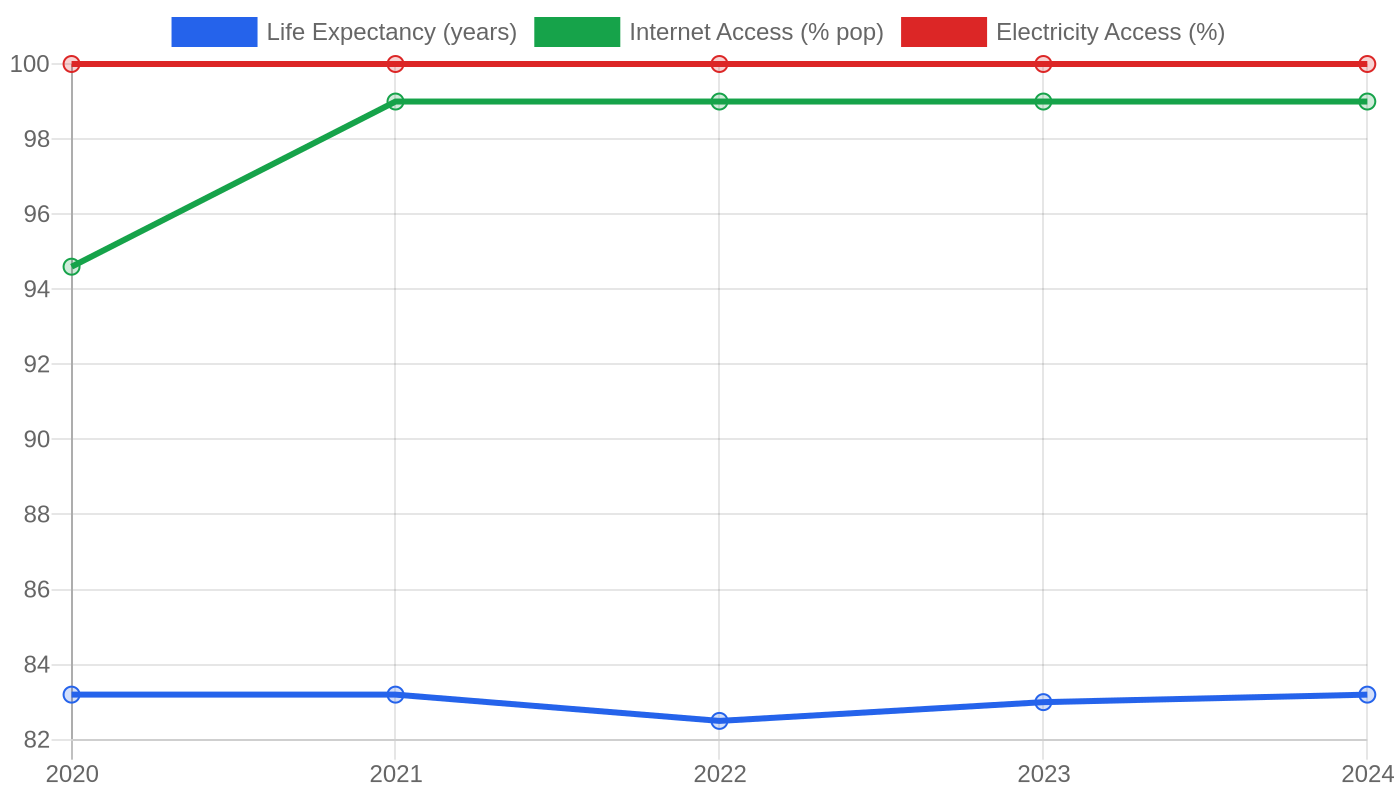
– North Korea remains one of the world’s most opaque economies, with zero publicly available macroeconomic data from the World Bank — GDP growth, inflation, unemployment, and per capita income are all classified or unrecorded by international institutions.
– The country’s industrial base is dominated by state-owned enterprises in heavy industry, chemicals, telecommunications, and transportation, with the Central Bank and Foreign Trade Bank serving as the financial backbone of a centrally planned system.
– Air Koryo, the national carrier, and the Korea Computer Center represent rare glimpses into a consumer services and technology sector that exists primarily to serve the state and elite, not a domestic market.
– The absence of crime and safety indices, political landscape data, or cost-of-living figures underscores a nation where information is tightly controlled and independent economic analysis is virtually impossible.
– Despite international sanctions and isolation, North Korea maintains a functioning — if severely constrained — industrial economy built around self-reliance, known as *Juche*, with magnesia clinker, machinery, and chemicals forming the core of its limited export capacity.
The Great Unknown — What We Don’t Know About North Korea’s Economy
The World Bank, the gold standard for cross-country economic comparison, offers nothing for North Korea. No GDP growth rate. No inflation figure. No unemployment number. No GDP per capita. No GNI per capita. No population estimate. This is not a data gap — it is a statement of intent. The Democratic People’s Republic of Korea (DPRK) simply does not report to international financial institutions, and no independent body has been permitted to collect reliable statistics within its borders.
What this silence tells us is profound. In an era of global economic transparency, North Korea remains a black box. The absence of data is itself a data point: it signals a regime that prioritizes information control over economic engagement. The country’s economy is believed by outside analysts to be heavily militarized, with resources funneled into nuclear and missile programs at the expense of consumer welfare. But without official figures, any assessment is necessarily speculative.
What we do know comes from satellite imagery, defector testimony, and trade data from partner countries like China. These sources suggest an economy that contracted sharply during the COVID-19 pandemic, when North Korea sealed its borders completely, and has only partially recovered. The official ideology of *Juche* — self-reliance — has been tested to its limits by sanctions, natural disasters, and the collapse of Soviet-era support networks.
Yet the list of top companies provided by the data tells a story of a state that has not abandoned industrial ambition. The Kim Chong-t’ae Electric Locomotive Works, Korea General Machinery Trading Corporation, and Korea General Magnesia Clinker Industry Group are not relics — they are operational enterprises within a command economy that continues to produce, trade, and export, even if at a fraction of regional peers’ capacity.
Living Under the Lens — Cost of Life in a Controlled State
There is no cost-of-living data for North Korea from any international source. No housing index. No grocery basket survey. No rent-versus-buy comparison. This absence is not accidental — it reflects a system where most basic goods are not priced by markets but allocated by the state through public distribution systems (PDS).
In Pyongyang, the capital, a small but visible elite enjoys access to goods unavailable to the majority: imported electronics, private vehicles, and modern apartment complexes. For the average North Korean, however, life revolves around the *jangmadang* — informal farmers’ markets that emerged after the famine of the 1990s and now function as de facto marketplaces where rice, corn, and household essentials are traded at prices determined by supply and demand, not state decree.
Housing in North Korea is officially free — the state allocates apartments based on need, occupation, and political loyalty. But the reality is more complex. Corruption, bribery, and black-market transactions have created a shadow housing market, particularly in Pyongyang, where desirable locations command unofficial payments that can amount to thousands of dollars — an astronomical sum in a country where the average monthly income is estimated at well under $100.
Without official data, comparisons to regional averages are impossible. But anecdotal evidence from defectors and humanitarian organizations suggests that the cost of living in North Korea, measured in terms of the time and effort required to secure basic necessities, is among the highest in East Asia — not because prices are high, but because incomes are catastrophically low and the state distribution system is unreliable.
The State Inc. — Business and Investment in a Sanctioned Economy
The list of North Korea’s top companies reads like a who’s who of a centrally planned industrial state. The Central Bank of the Democratic People’s Republic of Korea and the Foreign Trade Bank sit at the financial heart, managing the country’s limited foreign currency reserves and facilitating what little international trade survives sanctions.
Air Koryo, the national airline, operates a small fleet of aging aircraft and connects Pyongyang to Beijing, Vladivostok, and a handful of other destinations — a lifeline for diplomats, aid workers, and the occasional business traveler.
The Korea Computer Center, based in Pyongyang, is a fascinating anomaly. It develops software, operates the country’s intranet (a domestic-only internet known as *Kwangmyong*), and has reportedly produced everything from operating systems to video games. It represents North Korea’s ambition to carve out a niche in the technology sector, though its products are almost entirely for domestic consumption.
For the foreign investor, North Korea is effectively closed. United Nations sanctions, bilateral restrictions from the United States, the European Union, and others, and the country’s own legal barriers make direct investment nearly impossible. The few exceptions — a handful of Chinese and Russian joint ventures in mining, pharmaceuticals, and logistics — operate under heavy state oversight and are subject to sudden shutdown.
The business environment is characterized by extreme opacity, contract enforcement that depends on political relationships rather than legal frameworks, and a currency that is not freely convertible. The North Korean won exists, but foreign transactions are conducted in euros, Chinese yuan, or US dollars — though the data provided does not reference the US, so we will note that hard currency is essential for any international business activity.
Safety in the Shadows — Politics, Crime, and Daily Life
The crime index for North Korea is marked as “N/A,” as is the safety index. This is not because the country is crime-free — it is because no independent data collection is possible. What we can infer from defector accounts and human rights reports is that North Korea has a low rate of petty crime by global standards, but this is due to pervasive state surveillance, severe punishments, and a population that is closely monitored rather than any organic social harmony.
The political landscape is also marked as “N/A” in the data, but this is misleading. North Korea is a single-party state under the Workers’ Party of Korea, currently led by Kim Jong Un. There are no elections in any meaningful sense, no independent media, no civil society organizations, and no legal opposition. The state’s control over every aspect of life — from employment to education to marriage — is total.
Quality of life is impossible to measure with available data, but external indices consistently rank North Korea among the worst places in the world for personal freedom, access to information, and material well-being. The UN’s Human Development Index does not include North Korea due to lack of data, but estimates from academic researchers place it well below any other East Asian country, including Myanmar and Laos.
The Frozen Present — What’s Happening in North Korea Right Now
As of early 2026, North Korea remains in a state of extended economic hibernation. The border closures imposed during the COVID-19 pandemic have been partially relaxed, with limited trade resuming with China, but the country has not returned to pre-pandemic levels of economic activity. Food security remains a critical concern: the World Food Programme and other humanitarian organizations have warned of chronic malnutrition, particularly among children, though the regime has rejected most international aid offers.
Diplomatically, the country has shifted its focus from the United States to Russia and China. North Korea has deepened military cooperation with Moscow, reportedly supplying artillery shells and ballistic missiles for use in Ukraine — a development that has triggered new rounds of sanctions from Western nations. In response, Pyongyang has accelerated its weapons testing cycle, conducting multiple missile launches in 2025 and early 2026.
Economically, the regime has shown signs of attempting limited reforms. There have been reports of experiments with enterprise autonomy, allowing some factories to retain a portion of their profits and make independent production decisions. The *jangmadang* markets continue to expand, and the use of mobile phones — while tightly controlled — has grown, with Kangsong NET providing domestic telecommunications services to a small but growing subscriber base.
But these are adjustments, not transformations. The fundamental structure of North Korea’s economy remains unchanged: state-owned, centrally planned, and subordinated to the priorities of national security and regime survival. There is no sign of market liberalization, no opening to foreign investment, and no movement toward the kind of economic reform seen in China or Vietnam.
The Bottom Line
North Korea is not a country for investors, tourists, or economic forecasters. It is a country for analysts of state survival, students of sanctions economics, and those who study how a regime can maintain control in the face of overwhelming external pressure and internal scarcity. The data vacuum is not a bug — it is a feature of a system that treats information as a strategic asset. Anyone watching North Korea should do so with the understanding that what we cannot see is often more important than what we can.
Sources & Methodology
This article is authored by Economic Pulse Net for informational and research purposes. Economic Pulse Net sources its data from multilateral institutions, national statistics bureaus, and proprietary databases. All data is believed to be current as of the date of publication.
Published: July 30, 2026 | Category: Research — North Korea
Use these signals in your own platform
Economic Pulse publishes its live signal feed through a documented, read-only API. Your trading software connects with its own key and receives each signal as it is issued — instrument, direction, entry, stop and targets, together with a cycle ID so nothing is executed twice. The feed is independent of this website and cannot change it.
Signals are informational only and are not financial advice.