Economic Pulse Net | Sources: World Bank World Development Indicators, Government Sources | 2026
Key Takeaways
– New Caledonia remains a French *sui generis* territory with a unique power-sharing arrangement, but its political future hangs on unresolved independence referendums
– The economy is heavily dependent on French fiscal transfers and the global nickel market, creating vulnerability to commodity price swings
– Despite possessing one of the world’s largest nickel reserves, the territory faces structural challenges in diversifying beyond mining
– Crime and safety data are unavailable from standard indices, but political tensions have periodically erupted into civil unrest
– The territory’s high cost of living relative to regional peers is a persistent drag on household purchasing power
The Nickel Paradox — Mining Wealth Meets Economic Stagnation
New Caledonia’s economic story is written in ore. The territory sits atop an estimated 25% of the world’s known nickel reserves, a mineral critical for stainless steel production and increasingly for electric vehicle batteries. Yet for all this geological fortune, the World Bank provides no current GDP growth, inflation, unemployment, or per capita income figures for New Caledonia.
This data vacuum itself tells a story: the territory operates in a statistical blind spot, neither fully integrated into French national accounts nor independently reporting to international institutions with the regularity of a sovereign state.
What we do know is that nickel dominates. The mining and metallurgy sector accounts for the vast majority of exports and employs a significant share of the formal workforce. But this single-industry dependence creates a boom-bust dynamic that has left the economy vulnerable. When nickel prices fall on global markets—as they have in recent years amid slowing Chinese demand and increased supply from Indonesia—the territory’s fiscal revenues collapse.
The French government steps in with transfer payments, but these subsidies create their own dependencies. New Caledonia’s economy is not so much a self-sustaining engine as a carefully managed patient on life support from Paris.
The absence of inflation and unemployment data from the World Bank should not be mistaken for stability. Local reporting has long highlighted stubbornly high joblessness among the indigenous Kanak population, who were largely excluded from the mining boom’s benefits. The gap between the territory’s resource wealth and its actual development outcomes remains one of the Pacific’s most glaring economic contradictions.
Living in Paradise, Paying a Premium — The Cost of Caledonian Life
New Caledonia is an expensive place to call home. Housing costs in Nouméa, the capital, rival those of mid-tier Australian cities, while wages lag significantly behind. The territory imports roughly 80% of its food and consumer goods, mostly from metropolitan France, meaning everything from dairy products to electronics carries a hefty shipping surcharge. Rent for a modest apartment in Nouméa’s desirable neighborhoods can easily consume half of a middle-income household’s earnings.
The rental market is tight, with vacancy rates low and demand persistently high from both local residents and French expatriates working in the mining sector or civil service. Buying property is an aspiration for many, but land ownership remains politically charged. Customary land—traditionally held by Kanak clans under collective ownership—accounts for a quarter of the territory’s landmass and is largely unavailable for commercial development or private purchase.
This artificial scarcity pushes up prices on the remaining freehold market, making homeownership a distant dream for young families.
Daily expenses add up quickly. A simple grocery run for a family of four can cost 30-40% more than in mainland France, while utility bills are elevated due to the territory’s reliance on imported fossil fuels for electricity generation. The high cost of living is not merely an inconvenience; it is a structural constraint on economic mobility and a driver of the inequality that fuels political discontent.
Investment Climate — Waiting for the Nickel Boom 2.0
The business environment in New Caledonia is defined by two forces: the dominance of a few large players and the heavy hand of the French state. The top companies are overwhelmingly in mining and metallurgy, with Société Le Nickel (SLN), a subsidiary of French conglomerate Eramet, holding the pole position.
Other significant operators include Vale Nouvelle-Calédonie (now owned by a consortium including Swiss trading giant Trafigura) and Koniambo Nickel, a joint venture between the local Northern Province and Glencore. These are not nimble startups; they are capital-intensive behemoths whose investment decisions are shaped by global commodity cycles and Parisian boardrooms.
Sectors beyond mining remain underdeveloped. Tourism has potential—the lagoon is a UNESCO World Heritage site, and the coral reefs rival any in the Pacific—but the industry has never scaled to its promise. High airfares, limited direct international flights, and a reputation for political instability have kept mass tourism at bay. Agriculture is similarly constrained by terrain and cost structures; the territory cannot compete with New Zealand or Australia on dairy or meat, even for its own market.
For foreign investors, the calculus is complicated. French law applies, labor costs are high by regional standards, and the political uncertainty around independence creates a risk premium that deters long-term capital. The territory offers tax incentives for businesses that locate in its three provinces, but these have done little to attract the kind of diversified investment that would reduce dependence on nickel.
Politics in the Balance — The Long Road to Self-Determination
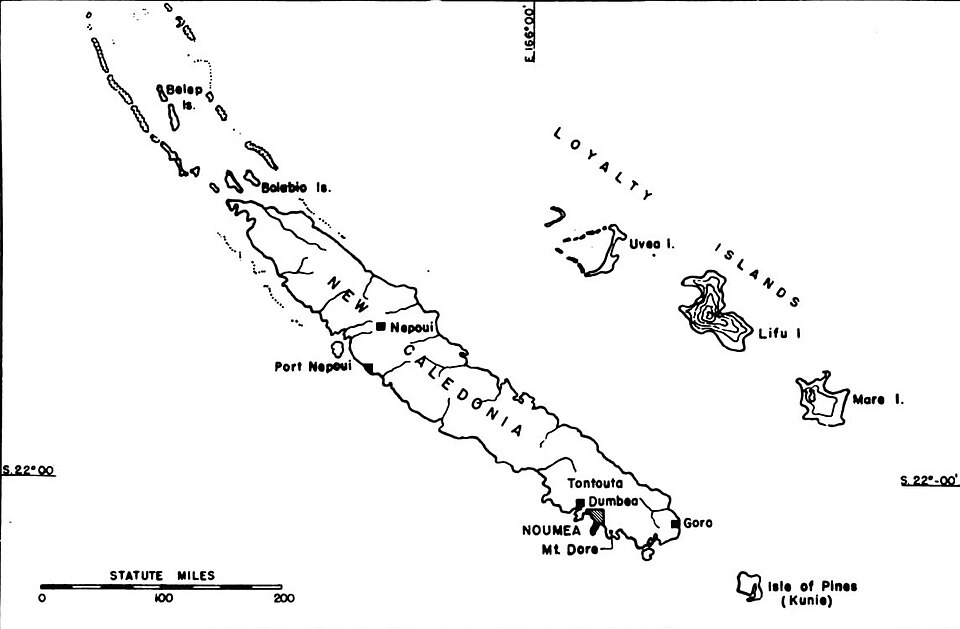
New Caledonia’s political landscape is unlike any other. As a *sui generis* territory, it occupies a constitutional category of its own—not quite a colony, not quite a country. The French state has gradually transferred powers to the Territorial Congress, a 54-member legislative body drawn from three provincial assemblies. A High Commissioner represents Paris. Residents hold French nationality, vote in French presidential elections, and send representatives to the European Parliament.
It is a hybrid arrangement designed to manage the transition toward a resolution of the territory’s status.
That resolution remains elusive. Three independence referendums have been held since 2018, each returning a “no” to full sovereignty, but by narrowing margins. The third vote in December 2021 was boycotted by pro-independence parties, casting doubt on its legitimacy. The political temperature remains high. The 1980s saw violent conflict between Kanak separatists and loyalists, and while the Nouméa Accord of 1998 brought peace, the underlying tensions have never fully dissipated.
The current landscape is one of frozen confrontation: the pro-independence camp controls the Northern Province and the Loyalty Islands, while the loyalist camp dominates the wealthier Southern Province around Nouméa.
Crime and safety indices from standard sources are unavailable for New Caledonia, but the security situation is best described as bifurcated. Nouméa experiences typical urban property crime, while rural areas and the islands are generally safe. The real risk is political: demonstrations can escalate quickly, and roadblocks by pro-independence groups have periodically paralyzed the economy.
The French state maintains a significant military and police presence, but it is a presence born of contingency planning, not routine security.
What’s Happening Now — The Nickel Crisis and the Search for a Way Forward
As of early 2025, New Caledonia is navigating one of its most difficult periods since the civil strife of the 1980s. The global nickel market is in turmoil. Prices have slumped as Indonesian supply has flooded the market, squeezing high-cost producers like those in New Caledonia. SLN has been losing money at an alarming rate, and the French government has been forced to step in with emergency loan guarantees and subsidies to keep the mines operating.
Without this lifeline, the territory’s economic backbone would collapse.
The political fallout has been severe. Pro-independence leaders argue that the nickel crisis proves the territory cannot achieve economic sovereignty under French rule, while loyalists counter that only French financial support is keeping the economy afloat. The debate has become existential. A fourth referendum is not currently scheduled, but the Nouméa Accord’s framework is creaking under the strain of unresolved status questions and economic distress.
On the ground, the cost-of-living crisis is deepening. Import prices have risen as the global inflationary wave has reached even this remote outpost. Local businesses report shrinking margins as consumers cut back on discretionary spending. The tourism sector, which had hoped for a post-pandemic recovery, remains subdued. The French government has announced new social support measures, but these are temporary patches on a system that needs fundamental reform.
The Bottom Line
New Caledonia is a country-sized laboratory for one of the great questions of the 21st century: how do resource-dependent territories achieve economic diversification and political self-determination in a world of volatile commodity markets and great-power competition? For investors, the territory offers high risk and potentially high reward, but only for those willing to bet on a political resolution that remains uncertain.
For policymakers, New Caledonia is a cautionary tale about the limits of subsidized dependency. For the 270,000 people who call it home, it is a place of extraordinary natural beauty and profound economic frustration—a Pacific jewel that has yet to find its place in the world.
Sources & Methodology
This article is authored by Economic Pulse Net for informational and research purposes. Economic Pulse Net sources its data from multilateral institutions, national statistics bureaus, and proprietary databases. All data is believed to be current as of the date of publication.
Published: July 18, 2026 | Category: Research — New Caledonia
Use these signals in your own platform
Economic Pulse publishes its live signal feed through a documented, read-only API. Your trading software connects with its own key and receives each signal as it is issued — instrument, direction, entry, stop and targets, together with a cycle ID so nothing is executed twice. The feed is independent of this website and cannot change it.
Signals are informational only and are not financial advice.