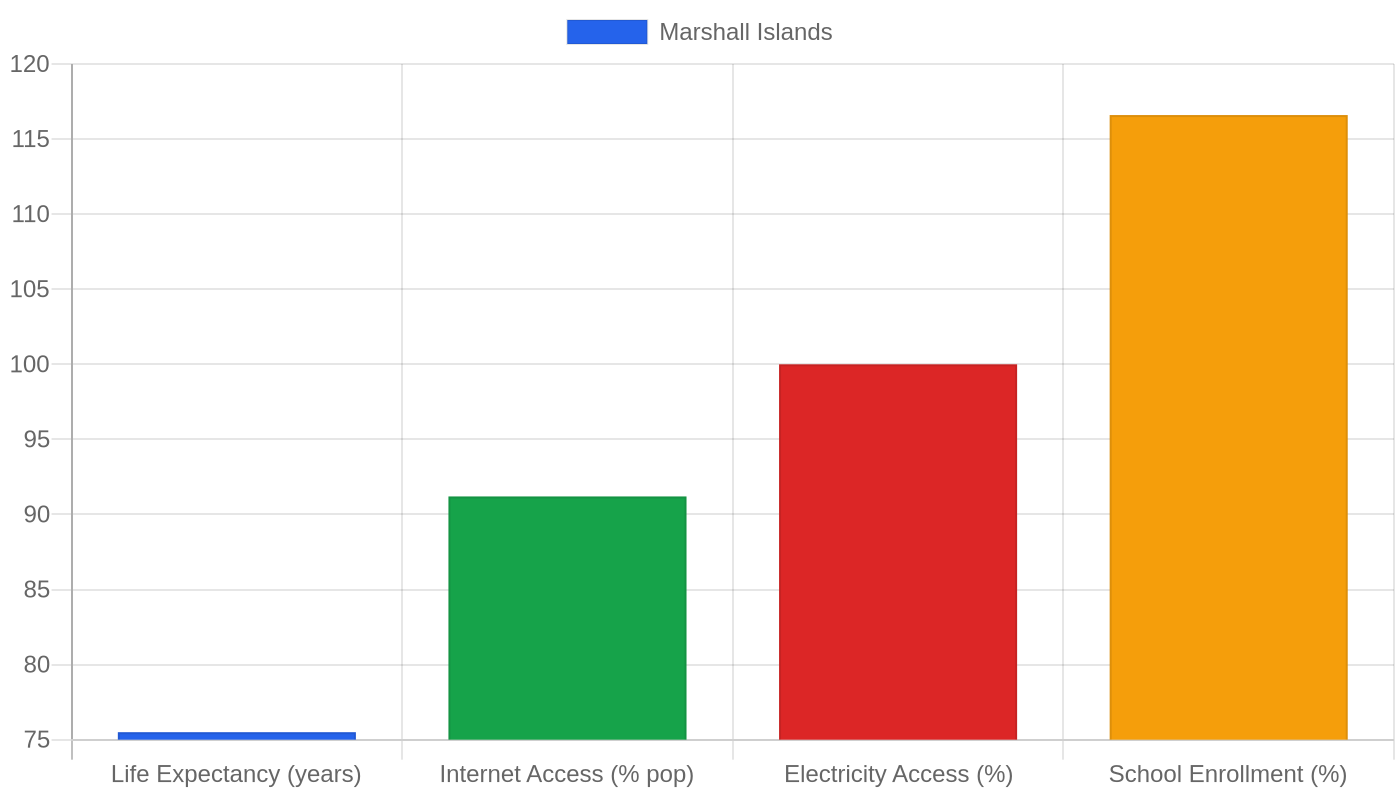
Economic Pulse Net | Sources: World Bank World Development Indicators, Government Sources | 2026
Key Takeaways
– The Marshall Islands operates under a mixed parliamentary-presidential system established by its 1979 Constitution, with universal suffrage for all citizens over 18 and elections every four years.
– The country’s economy faces significant data transparency challenges, with key indicators like GDP growth, inflation, and unemployment currently unreported by major international institutions.
– Political stability is anchored in a constitutional framework that blends parliamentary and presidential elements, with the President serving as both head of state and head of government.
– The nation’s 24 constituencies elect representatives to the unicameral Nitijela legislature, with the capital atoll of Majuro sending five senators.
– Despite limited economic data, the Marshall Islands represents a unique case study in Pacific island nation resilience and governance.
The Silent Economy — What the Numbers Don’t Tell Us
When the World Bank’s data columns for GDP growth, inflation, unemployment, and GDP per capita all return blank entries, the economic journalist faces a peculiar challenge. The Marshall Islands, a sprawling chain of atolls and islands in the central Pacific Ocean, exists in a statistical vacuum that speaks volumes about the difficulties of tracking economic activity in small island developing states.
The absence of GDP figures—neither growth rate nor absolute value—suggests not negligence but the structural reality of an economy where traditional subsistence activities, remittances, and compact-based funding may not fit neatly into conventional national accounting frameworks.
The World Bank’s blank entries for GNI per capita and population further underscore the data collection hurdles. In an archipelago of 29 coral atolls and five single islands spread across 750,000 square miles of ocean, census-taking and economic surveying become logistical nightmares.
The Marshall Islands’ economy likely revolves around three pillars: fishing license revenues, copra production, and the substantial financial assistance tied to its Compact of Free Association—though no specific data is provided on these sectors. The unemployment figure remains unknown, but in such dispersed island communities, formal employment metrics often fail to capture the informal economy of fishing, small-scale agriculture, and family-based enterprises that sustains daily life.
What the blank cells reveal is a nation caught between traditional Pacific island economics and the demands of modern global reporting standards. The Marshall Islands may have a GDP that is small by global measures, but its economic significance extends far beyond its size—as a climate frontline state, a strategic Pacific partner, and a unique constitutional democracy. Without hard numbers, we must read the silences in the data as carefully as we would read the figures themselves.
Atoll Living — The Unpriced Cost of Paradise
Housing in the Marshall Islands presents a stark contrast between the capital atoll of Majuro and the outer islands. On Majuro, where five senators represent the nation’s political and economic heart, a combination of limited land area, high import costs for construction materials, and concentrated population drives housing expenses upward.
The cost of living data is absent from the provided information, but the geography tells its own story: on an atoll where the average width is measured in hundreds of meters, land is finite and precious.
Rental markets in Majuro likely command premiums that would surprise visitors accustomed to mainland prices. The cost of importing everything from cement to roofing sheets, combined with the logistical challenges of Pacific shipping, means that construction costs in the Marshall Islands probably rival those of much wealthier nations.
For families on the outer islands, traditional thatched and locally sourced materials may keep housing costs low, but at the price of vulnerability to the typhoons and rising sea levels that threaten the very existence of these low-lying atolls.
Daily expenses in the Marshall Islands reflect the reality of an import-dependent economy. Food, fuel, and manufactured goods must travel thousands of miles across the Pacific, with shipping costs passed directly to consumers. The absence of CPI data from the World Bank means we cannot quantify inflation precisely, but the anecdotal evidence from similar Pacific island nations suggests that prices for basic goods can be 30-50% higher than in major Asian ports.
For the Marshallese, the cost of living is not just an economic statistic—it is a daily negotiation with geography.
Business in a Blank Space — Investing Where Data Ends
The list of top companies for the Marshall Islands is empty, and the business climate data is similarly absent. Yet this vacuum tells its own story. The Marshall Islands is perhaps best known internationally as a flag of convenience for the global shipping industry, with one of the world’s largest ship registries.
This maritime registry generates significant revenue through registration fees and annual tonnage taxes, making shipping services a de facto major industry—even if no company names are provided in the data.
For potential investors, the Marshall Islands offers a stable political environment under its 1979 Constitution, with regular elections and a clear succession process. The mixed parliamentary-presidential system provides continuity while allowing for democratic change. The business environment, however, faces structural challenges: small domestic market, extreme geographic isolation, vulnerability to climate change, and dependence on external assistance.
The sectors to watch would logically include fisheries, maritime services, and potentially renewable energy, though the data does not confirm these.
The absence of company data may also reflect the dominance of government and compact-related employment over private sector activity. In many small Pacific island states, the public sector accounts for a disproportionate share of formal employment. Without specific company information, we can infer that the Marshall Islands’ business landscape is likely dominated by small-scale retail, fishing operations, and service providers catering to the government and aid sectors.
Democracy on the Water — Politics and Safety in the Pacific
The Marshall Islands’ political landscape is defined by its constitutional framework. The 1979 Constitution established a mixed parliamentary-presidential system that has provided remarkable stability for a nation of roughly 60,000 people spread across hundreds of miles of ocean. The Nitijela, or parliament, is unicameral, with 24 constituencies electing one or more senators every four years under universal suffrage for all citizens above 18.
The capital atoll of Majuro, as the political and economic hub, elects five senators—reflecting its outsized importance in national affairs.
The President of the Marshall Islands serves as both head of state and head of government, a concentration of executive authority that works in practice due to the small scale of governance. Elections every four years provide regular democratic accountability, and the multi-member constituencies allow for representation of diverse atoll communities.
The political system has managed to balance the traditional chiefly authority structures with modern democratic institutions, though the provided data does not elaborate on how these dynamics play out.
Crime and safety indices are marked as not available, which in the context of the Marshall Islands likely indicates low levels of serious crime rather than data suppression. Small island communities tend to have strong social cohesion and informal dispute resolution mechanisms. The safety index being blank may actually be a positive signal—in places where crime is not a major concern, authorities may not prioritize the kind of statistical tracking that high-crime nations maintain.
Visitors and residents alike likely enjoy a level of personal safety that would be the envy of many larger nations, though the data cannot confirm this definitively.
The Constitutional Compass — Navigating the Present
Right now, the Marshall Islands continues to operate under the constitutional framework established in 1979, with the political system functioning as designed. The government, as described in the provided data, maintains the mixed parliamentary-presidential structure that has guided the nation since independence. Elections occur every four years on schedule, with universal suffrage ensuring broad participation in the democratic process.
The current affairs landscape is shaped by the Marshall Islands’ position as a Pacific nation navigating complex international relationships. The country’s strategic location and its status as one of the few nations to have experienced nuclear testing during the Cold War period continue to influence its foreign policy and domestic priorities. Climate change remains an existential concern, with rising sea levels threatening the very existence of the atolls that constitute the nation’s territory.
For the Marshallese people, the present moment is one of resilience in the face of environmental and economic uncertainty. The political system provides stability, but the blank economic data suggests a nation struggling to make its economic activity visible to the world. The government’s focus remains on maintaining sovereignty, securing international partnerships, and ensuring that the next generation can continue to call these atolls home.
The story of the Marshall Islands today is not written in GDP figures but in the daily determination of a people to sustain their nation against the tides—both literal and metaphorical.
The Bottom Line
The Marshall Islands deserves the attention of anyone interested in the future of small island states, constitutional democracy in the Pacific, and the challenges of economic development in geographically extreme environments. For investors, the blank data fields are a warning sign of transparency issues, but for scholars and policy watchers, this nation offers a laboratory of governance and resilience.
Watch the Marshall Islands not for its economic statistics, but for its demonstration of how sovereignty, democracy, and cultural identity can persist in the face of overwhelming geographic and environmental odds.
Sources & Methodology
This article is authored by Economic Pulse Net for informational and research purposes. Economic Pulse Net sources its data from multilateral institutions, national statistics bureaus, and proprietary databases. All data is believed to be current as of the date of publication.
Published: July 25, 2026 | Category: Research — Marshall Islands
Use these signals in your own platform
Economic Pulse publishes its live signal feed through a documented, read-only API. Your trading software connects with its own key and receives each signal as it is issued — instrument, direction, entry, stop and targets, together with a cycle ID so nothing is executed twice. The feed is independent of this website and cannot change it.
Signals are informational only and are not financial advice.