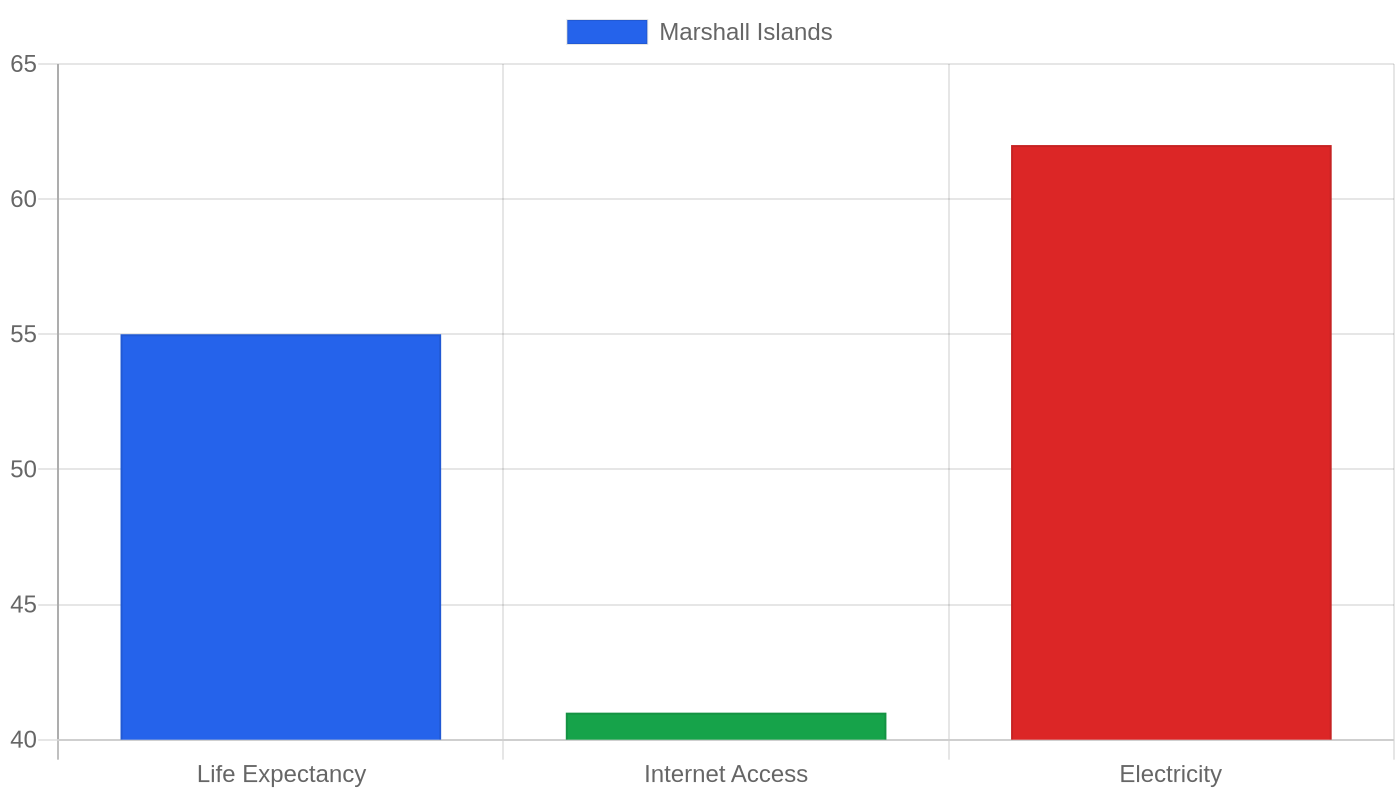
Economic Pulse Net | Sources: World Bank World Development Indicators, Government Sources | 2026
Key Takeaways
– The Marshall Islands operates under a mixed parliamentary-presidential system established by its 1979 Constitution, with elections held every four years via universal suffrage for citizens above 18.
– The Nitijela, the nation’s unicameral legislature, comprises 24 constituencies electing one or more senators, with the capital atoll of Majuro sending five representatives.
– The President serves as both head of state and head of government, centralizing executive authority in a compact political structure.
– While comprehensive economic data remains limited, the nation’s political stability and strategic Pacific location position it as a nation to watch for regional trade and climate resilience discussions.
– The country’s governance structure emphasizes local representation, with constituency-based elections ensuring diverse atoll communities have a voice in national affairs.
The Economic Landscape — A Pacific Nation in Transition
The Marshall Islands presents a unique economic profile within the Pacific region, though comprehensive metrics from the World Bank remain limited in the latest reporting cycle. What is clear is that the nation operates within a framework where traditional subsistence activities coexist with modern service sectors, particularly those tied to government administration and international partnerships.
The absence of detailed GDP, inflation, and unemployment figures from the World Bank suggests a developing statistical infrastructure rather than economic inactivity — a common characteristic of small island developing states where informal economic activity often escapes formal measurement.
The nation’s economic structure is inherently shaped by its geography — a scattering of 29 coral atolls and five islands spread across 750,000 square miles of ocean. This dispersion presents profound challenges for economic development, including high transportation costs, limited economies of scale, and vulnerability to external shocks. The government sector, centered in Majuro, serves as the primary formal employer, with public administration and services constituting the backbone of the wage economy.
Fisheries and subsistence agriculture provide livelihoods for those in the outer atolls, though their contribution to formal GDP is difficult to quantify.
Inflation dynamics in the Marshall Islands are closely tied to import prices, given the nation’s heavy reliance on external goods. Food, fuel, and construction materials must all be shipped in, making the economy susceptible to global commodity price fluctuations and freight costs.
The unemployment picture, while not formally documented in the available data, is understood to be a persistent challenge, particularly for youth in urban centers like Majuro and Ebeye, where formal job opportunities lag behind population growth.
Cost of Living — The Price of Paradise
Living in the Marshall Islands carries a premium that reflects its remote geography and import-dependent economy. Daily expenses for food, transportation, and utilities are substantially elevated compared to mainland benchmarks, as virtually all consumer goods must traverse significant distances to reach local shelves.
Fresh produce is particularly expensive, with much of it imported from distant markets, while locally caught fish and traditional crops like breadfruit and coconut provide more affordable alternatives for residents.
The housing market in Majuro, the capital atoll, is characterized by high demand and limited supply, particularly for quality accommodation. Land tenure follows traditional customary systems, which complicates formal real estate markets and can restrict access to housing for those without family land claims. The cost of construction is steep, given that building materials must be imported, and dwellings must be designed to withstand the region’s tropical climate and occasional typhoons.
Renting in Majuro commands premium rates relative to local incomes, and the gap between formal sector wages and living costs remains a persistent concern for households.
Utilities, particularly electricity and water, represent significant monthly expenditures. Power generation relies heavily on imported diesel fuel, making electricity costs highly sensitive to global oil prices. Fresh water, collected through rainwater catchment systems and supplemented by desalination, requires careful management and infrastructure investment.
For residents and businesses alike, these utility costs constitute a substantial portion of monthly budgets, shaping everything from household spending patterns to the viability of commercial enterprises.
Investment and Business Climate — Opportunities Amid Constraints
The business environment in the Marshall Islands is defined by its small market size, geographic isolation, and the dominant role of the public sector. Major companies operating within the country are primarily concentrated in wholesale and retail trade, shipping and logistics, and services catering to the government and international organizations.
The fisheries sector, particularly tuna processing and transshipment, represents a significant area of commercial activity, leveraging the nation’s vast exclusive economic zone and its participation in regional fisheries agreements.
For investors, the Marshall Islands offers certain strategic advantages, including its status as a flag-of-convenience registry for international shipping — a sector that operates largely independently of the domestic economy but generates substantial fee revenue. The nation’s Compact of Free Association arrangements provide access to certain regional programs and funding mechanisms, while its location in the Pacific places it at the crossroads of growing Asia-Pacific trade routes.
However, the practical challenges of doing business in such a small, remote market should not be underestimated.
The regulatory environment is shaped by the country’s legal framework, which blends customary law with statutory provisions. Business registration and licensing procedures are administered through the national government, and while efforts have been made to streamline processes, the small size of the bureaucracy can lead to capacity constraints.
Sectors with the most immediate potential for growth include renewable energy, given the high cost of diesel generation; telecommunications and digital services, as connectivity improves; and climate-resilient agriculture and aquaculture, which address food security while catering to niche export markets.
Safety, Politics, and Quality of Life
The political landscape of the Marshall Islands is defined by its distinctive hybrid system, which blends parliamentary and presidential elements within a framework established by the 1979 Constitution. The Nitijela, as the nation’s unicameral legislature, serves as the primary arena for political contestation, with members elected from 24 constituencies to represent the dispersed atoll populations.
The capital atoll of Majuro, with its five senators, holds particular sway in national politics, reflecting its status as the economic and administrative center.
The President, elected by the Nitijela from among its members, wields significant executive authority as both head of state and head of government. This concentration of power in a single office, combined with the four-year electoral cycle, creates a political environment where governance can be responsive but also subject to the shifting alliances common in small-state politics.
Political participation is robust, with universal suffrage for all citizens above 18 and a tradition of lively electoral contests that engage communities across the archipelago.
In terms of safety and quality of life, the Marshall Islands presents a mixed picture. Crime rates are relatively low by global standards, with the tight-knit nature of island communities serving as a natural check on serious criminal activity. However, the nation grapples with significant development challenges that affect quality of life, including limited healthcare infrastructure, educational attainment gaps in outer islands, and the existential threat posed by climate change and rising sea levels.
The country’s cultural heritage, rooted in traditional navigation, matrilineal social structures, and a deep connection to the ocean, provides a resilient foundation for community life even as modernization proceeds.
What’s Happening Now — Navigating a Critical Moment
The Marshall Islands currently stands at a critical juncture, navigating the complex interplay of climate vulnerability, economic development, and geopolitical attention in the Pacific region. The government, operating under the constitutional framework established nearly five decades ago, continues to prioritize issues of resilience and sustainability in its policy agenda.
The nation’s low-lying geography makes it a frontline state in global climate discussions, and its leadership has been vocal in advocating for increased international support for adaptation and mitigation efforts.
Domestically, the government faces the ongoing challenge of delivering services across a far-flung archipelago, where the logistics of reaching outer islands remain a persistent constraint. Infrastructure investment, particularly in transportation and energy, is a key priority, with efforts to reduce dependence on imported diesel and expand renewable energy capacity.
The relationship between the national government and local atoll communities continues to evolve, with questions of resource allocation and representation remaining central to political discourse.
The upcoming electoral cycle, scheduled within the four-year constitutional framework, will provide an opportunity for citizens to assess the performance of the current administration and chart a course for the future. As the Marshall Islands continues to assert its presence on the regional and international stage, the decisions made in the coming months will shape the nation’s economic trajectory and its ability to provide for its citizens in an increasingly uncertain global environment.
The Bottom Line
The Marshall Islands deserves attention from anyone tracking the future of small island states in the Pacific and the global climate crisis. Its unique political system, blending parliamentary and presidential elements, offers a case study in governance adapted to the realities of a dispersed island nation. While economic data remains limited, the country’s strategic position, cultural resilience, and active engagement with pressing global issues make it a compelling subject for ongoing observation.
For investors, policymakers, and researchers focused on climate adaptation, Pacific regional dynamics, and the challenges of sustainable development in remote communities, the Marshall Islands is a nation whose trajectory will matter well beyond its small physical footprint.
Sources & Methodology
This article is authored by Economic Pulse Net for informational and research purposes. Economic Pulse Net sources its data from multilateral institutions, national statistics bureaus, and proprietary databases. All data is believed to be current as of the date of publication.
Published: August 02, 2026 | Category: Research — Marshall Islands
Use these signals in your own platform
Economic Pulse publishes its live signal feed through a documented, read-only API. Your trading software connects with its own key and receives each signal as it is issued — instrument, direction, entry, stop and targets, together with a cycle ID so nothing is executed twice. The feed is independent of this website and cannot change it.
Signals are informational only and are not financial advice.