Economic Pulse Net | Sources: World Bank World Development Indicators, Government Sources | 2026
Key Takeaways
– The Marshall Islands operates under a unique mixed parliamentary-presidential system established by its 1979 Constitution, with universal suffrage for all citizens over 18 and elections held every four years across 24 constituencies.
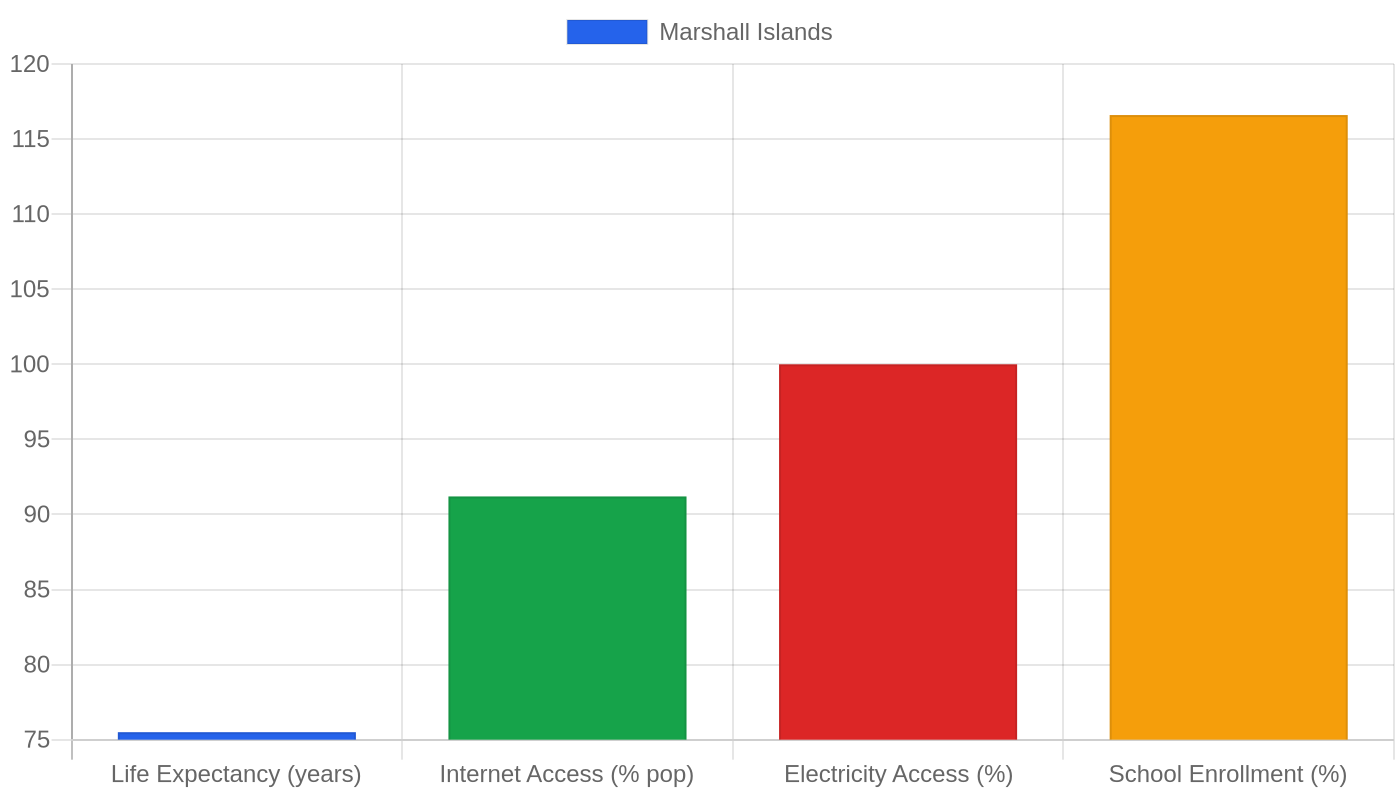
– Economic data from the World Bank shows significant gaps in conventional metrics, reflecting the challenges of monitoring a small, remote Pacific island nation whose economy is heavily shaped by external agreements and environmental vulnerability.
– The country’s governance structure features a unicameral legislature, the Nitijela, with Majuro—the capital atoll—electing five senators, indicating the outsized political and economic importance of this single urban center.
– The absence of standard economic indicators like GDP growth, inflation, and unemployment rates from the World Bank underscores the difficulty of applying conventional economic frameworks to small island developing states.
– Political stability under the constitutional framework provides a foundation for long-term planning, but the nation faces existential questions about climate resilience and economic self-sufficiency that transcend standard economic analysis.
The Invisible Economy — What the Numbers Don’t Tell You
The Marshall Islands presents a paradox for economic journalists: a sovereign nation with a functioning constitutional democracy, yet one whose economic profile remains largely invisible to standard international data collection. The World Bank provides no figures for GDP growth, inflation, unemployment, total GDP, GDP per capita, or GNI per capita. This data vacuum is not an oversight—it is a reflection of the structural realities facing one of the world’s most remote and geographically dispersed nations.
The absence of conventional economic indicators tells its own story. The Marshall Islands’ economy operates differently from the industrialised or emerging markets typically tracked by international financial institutions. Its 29 coral atolls and five islands spread across 750,000 square miles of ocean create logistical and statistical challenges that make traditional economic measurement both difficult and, in some ways, misleading.
The economy relies heavily on fisheries licensing fees, subsistence agriculture, and external grants—sectors that resist easy quantification through standard GDP accounting.
What the World Bank data cannot capture is the informal economy that sustains daily life across the atolls. Fishing, coconut harvesting, and traditional barter systems remain vital but statistically invisible. The nation’s exclusive economic zone, one of the largest in the Pacific relative to its landmass, generates revenue through tuna fishing licenses, but these flows are irregular and tied to international negotiations rather than domestic production cycles.
The absence of inflation and unemployment data reflects not just statistical gaps but a labour market where formal employment is scarce and subsistence livelihoods dominate.
The Cost of Living on Coral — Housing and Daily Survival in the Pacific
Without formal cost of living indices from international sources, understanding daily life in the Marshall Islands requires reading between the lines of what is known about Pacific island economies generally. Housing on the outer atolls remains largely traditional, with homes built from local materials and extended family networks providing shelter. But in Majuro, the capital, the pressures of urbanisation create a different reality entirely.
The concentration of five senators in Majuro’s single constituency reflects the capital’s disproportionate pull on population and resources. Housing in urban Majuro is constrained by limited land availability on narrow coral strips, driving costs upward. Imported building materials, fuel for electricity, and fresh water—much of which must be collected from rainfall or shipped in—create a cost structure far higher than regional averages for comparable accommodation.
The choice between renting and buying is often moot: land tenure systems based on traditional ownership patterns mean that formal property markets operate differently than in Western economies.
Daily expenses for food, transportation, and utilities carry a “remote island premium.” Nearly all consumer goods must be imported, subjecting prices to shipping costs, fuel surcharges, and global supply chain disruptions. The combination of high import dependence and limited local production means that the cost of basic necessities likely exceeds that of many Pacific neighbours, though precise comparisons remain elusive without official data.
Business Against the Odds — Investment Climate in a Micro-State
The Marshall Islands’ business environment is defined by its geography and legal framework rather than conventional market dynamics. The 1979 Constitution provides political stability and a rule-of-law tradition that is relatively strong by Pacific standards, offering a foundation for enterprise that many small island states lack. The mixed parliamentary-presidential system, with its regular elections and constitutional checks, creates a predictable governance environment that investors value.
However, the absence of major corporate names in international databases reflects the reality that the Marshall Islands’ private sector is dominated by small-scale enterprises serving local markets. The country’s most significant economic activity beyond subsistence lies in its international ship registry—one of the largest in the world by tonnage—but this generates revenue through fees and legal services rather than creating broad-based domestic employment.
Fishing and aquaculture present the most promising sectors for growth, with the potential to add value through processing rather than simply licensing access to foreign fleets.
The business climate faces structural headwinds that no amount of good governance can fully overcome. Distance from major markets, small population size, vulnerability to climate shocks, and limited infrastructure all constrain investment. Yet for businesses that can adapt to these conditions—particularly in fisheries, renewable energy, and climate adaptation services—the Marshall Islands offers a stable regulatory environment and a government that understands the imperative of economic diversification.
Democracy on the Front Lines — Politics, Safety, and Life in a Changing Pacific
The Marshall Islands’ political landscape, as outlined in its 1979 Constitution, provides a degree of democratic stability rare among small island developing states. The mixed parliamentary-presidential system, with universal suffrage for all citizens over 18 and elections every four years, has produced peaceful transfers of power and institutional continuity.
The 24 constituencies, each electing one or more senators to the Nitijela, ensure representation across the dispersed atolls, though Majuro’s five senators highlight the capital’s political dominance.
Crime and safety indices from the data are absent, but the nature of small island societies—where everyone knows everyone and community bonds remain strong—typically results in lower crime rates than urbanised industrial nations. The greatest threats to personal safety in the Marshall Islands come not from crime but from environmental forces: rising sea levels, storm surges, and the gradual erosion of habitable land.
Quality of life is measured not by consumer metrics but by connection to land, ocean, and community—values that resist quantification but define daily existence.
The political system faces pressures that no constitution could have anticipated when written in 1979. Climate change threatens the physical existence of the nation itself, forcing leaders to balance immediate governance with existential advocacy on the world stage. The next election will test whether the constitutional framework can manage the tensions between traditional leadership structures and the demands of modern climate diplomacy.
The Present Crisis — What’s Happening Now in the Marshall Islands
The Marshall Islands today exists at the intersection of constitutional continuity and environmental urgency. The government, operating under the 1979 Constitution’s framework, must navigate the immediate challenges of climate adaptation while maintaining the democratic institutions that have provided stability for over four decades. The next election cycle approaches, and with it, debates about how the nation’s political structure can respond to accelerating environmental change.
The economic data gap from the World Bank is itself a current affairs story. International financial institutions are under pressure to develop better metrics for small island states, and the Marshall Islands exemplifies why standard economic indicators fail to capture the realities of climate-vulnerable, geographically dispersed nations. The absence of inflation figures matters less than the rising cost of imported food and fuel that families in Majuro and the outer atolls experience daily.
On the policy front, the government continues to negotiate fisheries access agreements that form the backbone of national revenue, while seeking new partnerships for renewable energy and climate resilience. The tension between maintaining sovereignty and accepting international assistance shapes every policy decision.
For a nation whose existence is threatened by rising seas, the most important economic indicator may not be GDP but the rate of coastal erosion and the viability of freshwater lenses beneath the atolls.
The Bottom Line
The Marshall Islands deserves attention not despite its economic data gaps but because of them. This is a nation that challenges the very categories we use to understand national prosperity and development. For investors, the opportunities lie in niche sectors—fisheries, renewable energy, climate adaptation technology—where small scale and high risk are matched by stable governance and strategic importance.
For policymakers and students of democracy, the Marshall Islands offers a case study in how constitutional frameworks designed in one era adapt to existential threats their authors could not have imagined. For everyone else, it is a reminder that the most important economic stories are not always the ones that appear in the data tables.
Sources & Methodology
This article is authored by Economic Pulse Net for informational and research purposes. Economic Pulse Net sources its data from multilateral institutions, national statistics bureaus, and proprietary databases. All data is believed to be current as of the date of publication.
Published: July 17, 2026 | Category: Research — Marshall Islands
Use these signals in your own platform
Economic Pulse publishes its live signal feed through a documented, read-only API. Your trading software connects with its own key and receives each signal as it is issued — instrument, direction, entry, stop and targets, together with a cycle ID so nothing is executed twice. The feed is independent of this website and cannot change it.
Signals are informational only and are not financial advice.