Economic Pulse Net | Sources: World Bank World Development Indicators, Government Sources | 2026
Key Takeaways
– Guinea-Bissau has a tragic political distinction: from independence in 1974 until 2019, no president successfully completed a full five-year term — a record of instability that has crippled economic planning.
– The country operates as a republic with a highly centralized government structure, though multi-party governance only emerged in mid-1991, making it one of Africa’s youngest democracies.
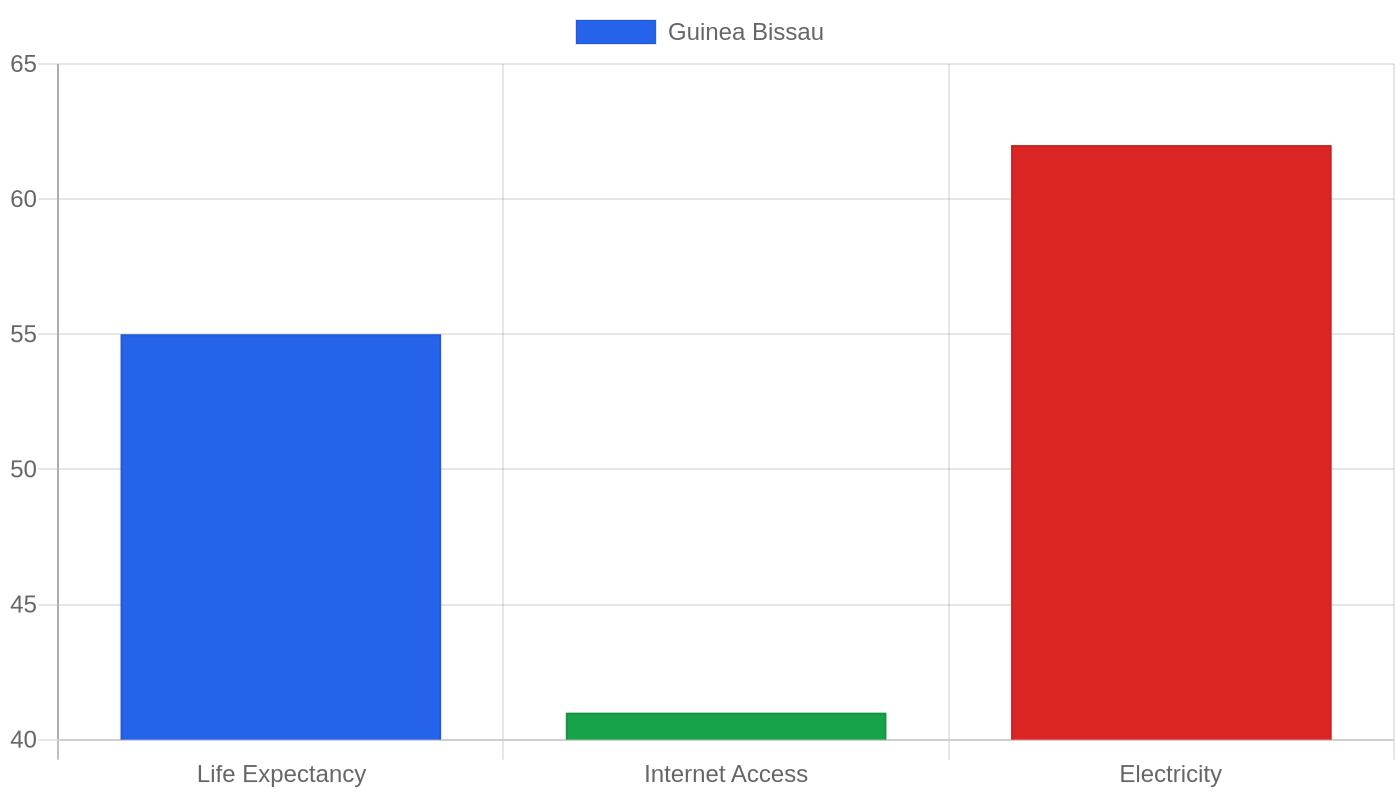
– Despite possessing rich natural resources including fisheries and potential for cashew exports, the absence of reliable World Bank economic data — on GDP growth, inflation, unemployment, or per capita income — speaks volumes about the state’s capacity to measure and manage its own economy.
– The political landscape remains the single most important factor shaping Guinea-Bissau’s economic trajectory, with coups and constitutional crises regularly derailing development.
The Invisible Economy — What the Missing Numbers Tell Us
When the World Bank cannot provide GDP growth figures, inflation rates, or unemployment data for a country, that absence is itself a data point. Guinea-Bissau’s economic profile is defined not by what is known, but by what is not. The World Bank reports no GDP figure, no GDP per capita based on purchasing power parity, and no GNI per capita. This is not a data collection failure — it is a symptom of state fragility.
The country’s economy is largely informal, subsistence-based, and heavily dependent on a single cash crop: cashew nuts. Without reliable national statistics, it is impossible to say with certainty whether the economy is growing or shrinking, whether prices are stable or spiraling, or whether unemployment is rising or falling. What analysts do know is that the absence of data reflects an absence of institutional capacity. A government that cannot measure inflation cannot effectively manage monetary policy.
A state that does not track employment cannot design meaningful job programs.
The implications are severe. International investors require data to assess risk. Development partners need metrics to evaluate aid effectiveness. Without basic economic statistics, Guinea-Bissau remains largely invisible to global capital markets and struggles to attract the foreign investment that could diversify its economy away from cashew dependency.
The country’s economic story is not one of boom or bust — it is one of chronic opacity, where the most important economic indicator is the continued functioning of the state itself.
The Cost of Living in a Cash Economy
Housing costs, daily expenses, and the price of basic goods in Guinea-Bissau are extraordinarily difficult to quantify without official data. What can be inferred is that in a country where the state cannot provide basic economic statistics, the cost of living is likely shaped by scarcity, informality, and volatility. Most urban residents in Bissau, the capital, live in informal housing arrangements, with rent paid in cash and prices negotiated face-to-face rather than set by market indices.
The absence of reliable inflation data from the World Bank suggests that price stability is not guaranteed. In West African regional context, countries that share the CFA franc currency zone — which Guinea-Bissau joined in 1997 — typically experience more stable prices than neighbors with floating currencies. However, the peg to the euro provides only partial protection. When global cashew prices fall, local purchasing power collapses, and the cost of imported rice — the dietary staple — can spike dramatically.
For the average Guinean, daily life is a constant negotiation between income from small-scale agriculture or informal trade and the rising cost of essentials. Without formal banking infrastructure, most transactions occur in cash, and savings are held in kind — in livestock, cashew stocks, or building materials.
The cost of living is not a statistic published by a national bureau; it is a lived reality of precarity, where a bad harvest or a political crisis can mean the difference between eating two meals a day or one.
Investing in Uncertainty — Business Climate in a High-Risk State
The list of top companies in Guinea-Bissau is effectively blank — not because no businesses exist, but because the formal corporate sector is so underdeveloped that it cannot be meaningfully ranked. The main industries that drive the economy — cashew processing, fishing, and small-scale agriculture — operate largely outside the formal tax and regulatory system. For any investor considering Guinea-Bissau, the primary question is not about market potential but about political risk.
The country’s political framework is defined by its constitution as a republic, but the reality on the ground is far messier. The government has historically been highly centralized, with power concentrated in the presidency and the prime minister’s office. Multi-party governance was not introduced until 1991, meaning the country has only three decades of democratic experience — and much of that has been interrupted by coups, assassinations, and constitutional crises.
The fact that no president served a full five-year term from independence in 1974 until José Mário Vaz finally achieved that milestone in 2019 is not a historical curiosity; it is the single most important fact for any business considering a long-term commitment.
Sectors with potential include fisheries — Guinea-Bissau’s waters are among the richest in West Africa — and cashew processing, which could add value to the country’s primary export. But without political stability, reliable electricity, functioning ports, and a predictable legal system, these opportunities remain theoretical.
The business climate is not hostile so much as absent: there is little formal economy to invest in, and the informal economy is difficult to access without deep local knowledge and tolerance for risk.
The Curse of the Presidency — Politics and the Quality of Life
Guinea-Bissau’s crime and safety indices are listed as not available, but the country’s reputation for instability is well-documented. The political landscape is the lens through which all other quality-of-life issues must be viewed. From independence in 1974 until 2019, the presidency was a revolving door — leaders were overthrown, assassinated, or forced from office before completing their terms. This pattern of chronic instability has profound effects on daily life.
When the state cannot guarantee political continuity, it cannot deliver basic services. Schools close during crises. Hospitals run short of medicine. Police and military become politicized. The rule of law weakens. For ordinary Guineans, quality of life is not measured in GDP per capita or safety indices — it is measured in days without political violence, weeks with electricity, and months without a coup rumor.
The country’s position as a transit point for drug trafficking between South America and Europe has further destabilized politics, with narco-trafficking networks infiltrating state institutions.
The happiness data is absent, but one can infer that a country where political survival is uncertain and economic opportunity is scarce does not rank highly on subjective well-being measures. Yet Guinea-Bissau persists. Its people are resilient, its culture rich, and its potential — in fisheries, agriculture, and tourism — remains untapped. The tragedy is not that the country is poor; it is that political instability has consistently prevented it from becoming anything else.
2024 and Beyond — Can the Cycle Be Broken?
The most recent political milestone — José Mário Vaz completing his full term in 2019 — offers a sliver of hope. For the first time in 45 years, the constitutional transfer of power occurred as scheduled. This does not mean Guinea-Bissau has solved its political problems, but it does suggest that the institutional framework, however fragile, is capable of functioning.
Current affairs in the country center on whether this precedent can be repeated. The government continues to operate as a centralized republic, with the president as head of state and the prime minister as head of government, but tensions between these two poles of power have historically triggered crises. The international community, including the Economic Community of West African States and the United Nations, maintains a presence in Bissau, working to strengthen democratic institutions and prevent backsliding.
On the economic front, the lack of updated World Bank data means that any assessment of current conditions is necessarily speculative. However, global cashew prices, regional security dynamics in West Africa, and the state of the fishing industry remain the key variables. If Guinea-Bissau can maintain political stability through another electoral cycle, it may finally attract the investment needed to build the statistical infrastructure that would allow the world to see its economy clearly.
If the cycle of instability resumes, the country will remain what it has always been: a place of enormous potential and persistent disappointment.
The Bottom Line
Guinea-Bissau is a country for the patient and the brave — development economists, conflict resolution specialists, and investors with a very long time horizon and a high tolerance for risk. The absence of basic data from the World Bank is not a flaw in the reporting; it is the story. This is a state that has struggled for half a century to build the institutions necessary for economic management and political stability.
For those watching West Africa’s fragile democracies, Guinea-Bissau is the canary in the coal mine: if this country can break its cycle of instability, it offers hope for the region. If it cannot, it remains a warning.
Sources & Methodology
This article is authored by Economic Pulse Net for informational and research purposes. Economic Pulse Net sources its data from multilateral institutions, national statistics bureaus, and proprietary databases. All data is believed to be current as of the date of publication.
Published: July 24, 2026 | Category: Research — Guinea Bissau
Use these signals in your own platform
Economic Pulse publishes its live signal feed through a documented, read-only API. Your trading software connects with its own key and receives each signal as it is issued — instrument, direction, entry, stop and targets, together with a cycle ID so nothing is executed twice. The feed is independent of this website and cannot change it.
Signals are informational only and are not financial advice.