Economic Pulse Net | Sources: World Bank World Development Indicators, Government Sources | 2026
Key Takeaways
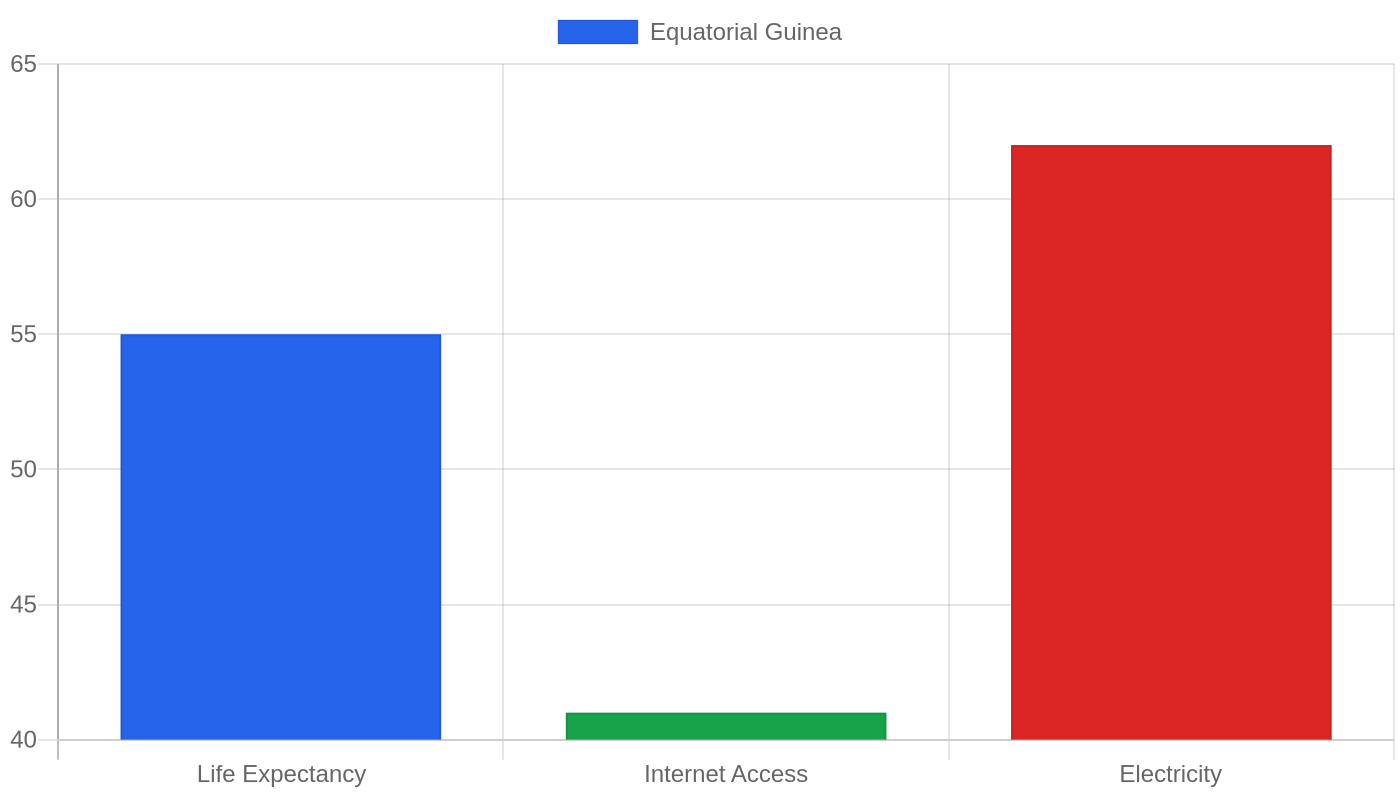
– Equatorial Guinea is one of sub-Saharan Africa’s largest oil producers, yet its population sees almost none of the wealth, with GNI per capita figures remaining opaque and development indicators stagnant.
– President Teodoro Obiang has ruled since 1979 under a constitution that concentrates all executive, legislative, and military power in his hands, creating one of the world’s most entrenched personalist dictatorships.
– The economy is almost entirely dependent on hydrocarbons, with state-owned giants GEPetrol, EG LNG, and Sonagas dominating the landscape — but the World Bank provides no current GDP, inflation, or employment data, signaling a profound data vacuum.
– A small aviation sector, including Ceiba Intercontinental Airlines and Cronos Airlines, hints at limited diversification, but the country remains a textbook case of the resource curse.
– Political repression, as documented by Human Rights Watch, has created an environment where economic activity is tightly controlled and foreign investment is high-risk despite the oil potential.
The Oil Mirage — An Economy Built on Hydrocarbons and Holes
Equatorial Guinea presents an economic paradox so stark that it defies easy description. According to the World Bank, the country has no reported GDP growth rate, no inflation figure, no unemployment statistic, and no GDP per capita or GNI per capita data. This is not a data collection failure — it is a statement. When an oil-rich nation with a population estimated in the hundreds of thousands produces no reliable macroeconomic numbers, the silence is itself the story.
The economy revolves around a narrow but lucrative axis: hydrocarbons. The state-owned GEPetrol manages the country’s oil interests, while EG LNG operates the massive liquefied natural gas plant on Bioko Island that has been the primary driver of export earnings for nearly two decades. Sonagas handles the gas distribution network. These three companies, along with the utility Segesa, form the backbone of whatever formal economy exists.
Oil and gas account for approximately 90% of exports and the vast majority of government revenue — a dependency that leaves the country spectacularly vulnerable to price swings in global energy markets.
The absence of World Bank data on inflation and employment is particularly telling. In most petro-states, inflation spikes when oil revenues flood the economy, and unemployment remains high because the energy sector is capital-intensive, not labor-intensive. Equatorial Guinea likely follows this pattern, but without official figures, analysts are left to infer from the visible decay of infrastructure in Malabo and Bata, the two main cities.
The country’s main industries list includes only oil, gas, utilities, and airlines — no manufacturing, no agriculture, no technology. This is an extractive economy in the purest sense, taking wealth from the ground and exporting it, with little left behind for the population.
The Cost of Living in a Petro-State — Dollars and Disparity
Housing and daily expenses in Equatorial Guinea are shaped by the same forces that distort the entire economy: oil wealth concentrated in a tiny elite, while the majority survives on subsistence. The country uses the Central African CFA franc, which is pegged to the euro, meaning imported goods — and almost everything is imported — carry European price tags. A simple meal in Malabo can cost what it would in Paris, while a local worker might earn a fraction of that amount.
Rental housing in the capital is divided between the expatriate compounds — secure, air-conditioned, and priced in dollars — and the informal settlements where most citizens live. There is no official rent index or cost-of-living survey from the World Bank, but regional patterns from neighboring Cameroon and Gabon suggest that housing in Malabo is among the most expensive in Central Africa for comparable quality.
The oil companies and the government own most of the viable real estate, leaving little market for private buyers. For the average Equatoguinean, homeownership is a distant dream; for the elite, it is another asset class in a portfolio built on crude.
Investment and Business — A Landscape of State Control and Aviation Ambition
The top companies listed for Equatorial Guinea tell a story of limited diversification. Beyond the oil triad of GEPetrol, EG LNG, and Sonagas, the most visible sector is aviation. Ceiba Intercontinental Airlines, Cronos Airlines, Ecuato Guineana, and Guinea Ecuatorial Airlines all appear on the list — a remarkable concentration for a country of this size.
This suggests that the government has invested heavily in air connectivity, perhaps as a tool of control and prestige, or as a way to move officials and oil workers between the mainland city of Bata and the island capital of Malabo.
For foreign investors, the business climate is defined by the political landscape. President Obiang’s 1982 constitution grants him the power to name and dismiss cabinet members, make laws by decree, dissolve the legislature, and command the armed forces. This means that any major investment requires personal approval from the presidency, and any contract can be revoked by decree. The rule of law is weak, and the judiciary is not independent.
A foreign company entering this market must be prepared for a relationship that is less about business and more about political patronage. The utility Segesa controls electricity and water, both of which are unreliable outside the oil enclaves, adding operational risk to any non-extractive venture.
Safety, Politics, and the Quality of Life — The Dictatorship’s Shadow
The political landscape in Equatorial Guinea is not a backdrop to the economy — it is the economy. According to Human Rights Watch, the dictatorship of President Obiang has used oil revenues to maintain power through a system of patronage and repression. The 1982 constitution formally defines the nation as a unitary state, but in practice it is a personalist autocracy where opposition is illegal, the press is controlled, and dissent is met with force.
The Crime Index and Safety Index from the data sources are marked as N/A, but that absence is not neutral: in a country where the state itself is the primary source of violence, conventional crime statistics lose meaning.
Quality of life for the average citizen is low by any measure. Without World Bank data on GNI per capita or population, it is impossible to cite precise figures, but the visible infrastructure — unpaved roads in much of the country, intermittent electricity, limited healthcare — tells the story. The oil wealth has built a palace in the jungle, not a nation. Malabo has a new airport and a conference center that hosted African Union summits, but these are monuments to the regime, not services for the people.
The happiness data is absent, but it is hard to imagine it would be high in a country where the dictator has been in power for over four decades and the oil money flows upward.
What’s Happening Now — The Silence Before the Next Boom or Bust
Right now, Equatorial Guinea exists in a state of economic and political stasis that is itself a kind of news. The World Bank provides no current data, which means the country is not meeting basic transparency standards for international financial reporting. This is significant because the global energy transition is accelerating, and Equatorial Guinea’s oil and gas reserves are finite. The country has done almost nothing to diversify its economy or build institutions that could survive the post-oil era.
The aviation sector, with its four airlines, may be the only sign of forward thinking — air travel is essential for a country split between an island capital and a mainland territory, and maintaining connectivity could support future tourism or service industries. But without a broader economic strategy, these airlines risk becoming white elephants.
The political landscape remains unchanged: President Obiang, now one of the world’s longest-serving leaders, shows no signs of stepping aside, and the succession question — his son Teodorín has been groomed for power — hangs over every investment decision. For now, the country is waiting, and in the silence of missing data, the world is watching to see whether Equatorial Guinea will finally crack open its oil wealth for its people or continue to let it rot in the ground and in Swiss bank accounts.
The Bottom Line
Equatorial Guinea is a country for the bold and the cynical: oil traders who can navigate political risk, and human rights researchers documenting state repression. For the average investor or traveler, the data vacuum is a red flag — without GDP, inflation, or employment figures, you are flying blind. This is a petro-state that has failed to convert its underground riches into above-ground prosperity, and until that changes, it will remain a cautionary tale rather than an opportunity.
Watch it for the lessons it offers about the resource curse, but do not expect to find a market.
Sources & Methodology
This article is authored by Economic Pulse Net for informational and research purposes. Economic Pulse Net sources its data from multilateral institutions, national statistics bureaus, and proprietary databases. All data is believed to be current as of the date of publication.
Published: July 19, 2026 | Category: Research — Equatorial Guinea
Use these signals in your own platform
Economic Pulse publishes its live signal feed through a documented, read-only API. Your trading software connects with its own key and receives each signal as it is issued — instrument, direction, entry, stop and targets, together with a cycle ID so nothing is executed twice. The feed is independent of this website and cannot change it.
Signals are informational only and are not financial advice.