Economic Pulse Net | Sources: World Bank World Development Indicators, Government Sources | 2026
Key Takeaways
– Equatorial Guinea remains one of sub-Saharan Africa’s most significant oil and gas producers, with state-linked giants GEPetrol, EG LNG, and Sonagas dominating the economic landscape.
– The country’s political system, anchored by President Teodoro Obiang and the 1982 constitution, concentrates extensive executive powers — from decree-making to cabinet appointments — shaping every facet of the business environment.
– Despite its hydrocarbon wealth, Equatorial Guinea faces the classic resource-curse dilemma: building sustainable economic diversification while navigating a complex political landscape that international watchdogs describe as deeply authoritarian.
– The aviation sector shows surprising vitality, with multiple carriers — Ceiba Intercontinental Airlines, Cronos Airlines, Ecuato Guineana, and Guinea Ecuatorial Airlines — positioning for regional connectivity.
– For investors and analysts, the central question is not whether Equatorial Guinea has resources, but whether its institutional framework can translate those resources into broad-based prosperity.
Hydrocarbon Heft and the Diversification Dilemma
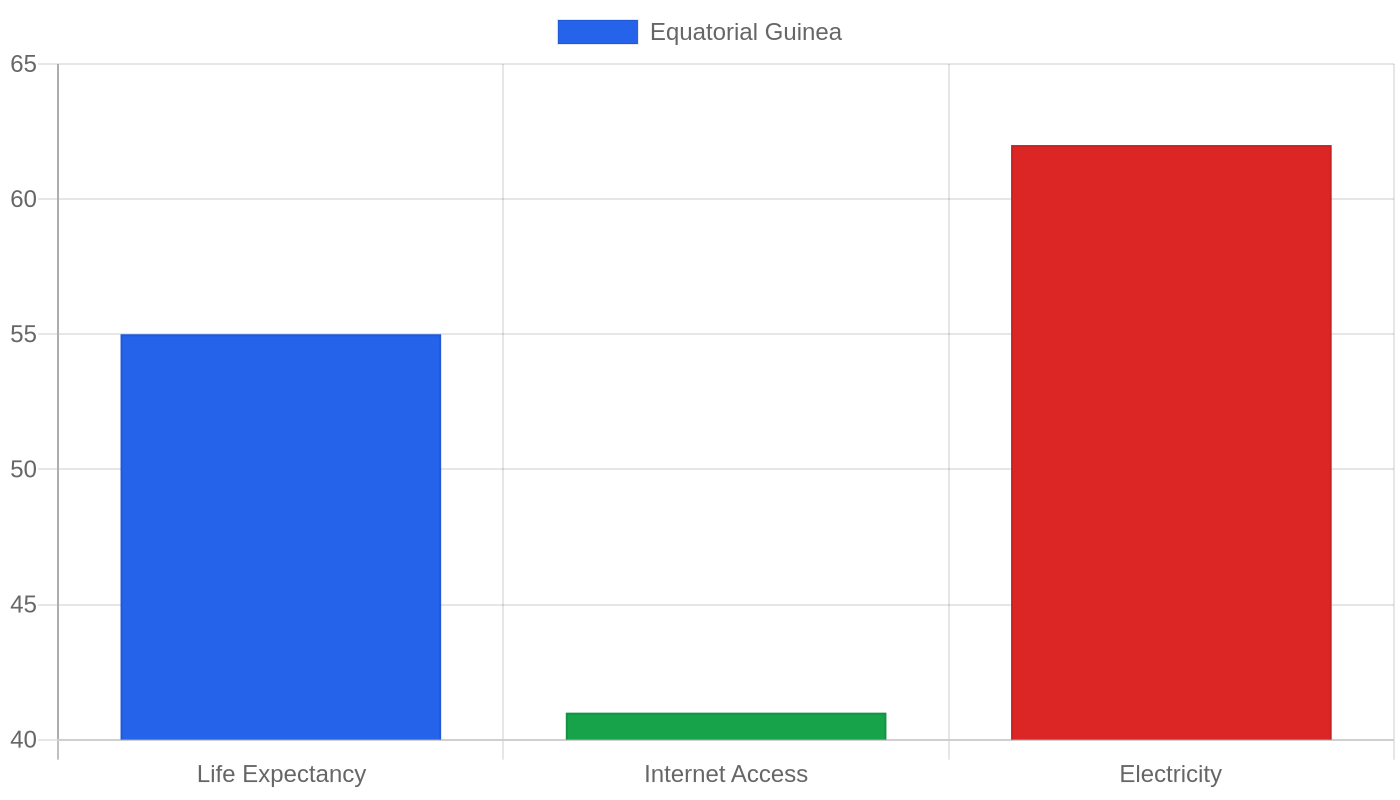
The economic story of Equatorial Guinea is written in barrels of oil and cubic feet of natural gas. According to World Bank data, the country’s headline economic indicators — GDP growth, inflation, unemployment, and GDP per capita — remain unpublished in the latest datasets, a telling sign of the statistical opacity that characterises this Central African nation. What is clear, however, is the commanding role that hydrocarbons play in the national economy.
The corporate landscape is dominated by four major energy players: GEPetrol, the national oil company; EG LNG, which operates the country’s liquefied natural gas facility; and Sonagas, which manages the gas sector. These state-linked entities form the backbone of government revenue and export earnings.
The absence of reliable macroeconomic data is itself a story. For a country that has been a significant oil producer since the mid-1990s, the failure to publish consistent growth and inflation figures raises questions about economic governance and transparency. Analysts watching Equatorial Guinea must therefore rely on sectoral signals and corporate activity rather than official statistics.
The energy sector, while mature, faces global headwinds as the world transitions away from fossil fuels, making diversification not just a policy preference but an existential necessity. Yet the institutional machinery to drive that diversification — transparent budgeting, independent regulation, and a predictable legal framework — remains conspicuously underdeveloped.
The World Bank’s silence on Equatorial Guinea’s economic data speaks volumes about the challenges of assessing — and investing in — this opaque but resource-rich market.
Housing and the Cost of Living in Malabo
For those living and working in Equatorial Guinea, the cost of living is shaped by a peculiar paradox: a country with substantial oil revenues that nonetheless struggles to deliver affordable, high-quality housing and consumer goods. With no official cost-of-living indices published by the World Bank or other international bodies, prospective expatriates and investors must rely on anecdotal evidence and regional comparisons.
What is known is that Equatorial Guinea, like many hydrocarbon-dependent African states, has historically experienced elevated prices for imported goods, housing, and services in its main urban centres of Malabo and Bata, where the oil industry’s presence drives demand for premium accommodation.
The rental market in Malabo, the capital, has traditionally catered to a mix of diplomatic staff, oil company executives, and international consultants — a demographic willing to pay a premium for security and amenities. For ordinary Equatoguineans, however, the housing situation is far more challenging, with limited formal housing stock and a construction sector that has struggled to keep pace with urbanisation.
The comparison with regional neighbours is instructive: while Equatorial Guinea’s oil wealth should, in theory, translate into better infrastructure and lower costs, the reality is that poor logistics, limited local manufacturing, and dependence on imports keep consumer prices stubbornly high. Until the country diversifies its economy and improves its business climate, the cost of living is likely to remain a significant barrier to both foreign talent and domestic prosperity.
Investment Climate: State Giants and the Business Frontier
Equatorial Guinea’s investment landscape is defined by the outsized presence of state-controlled enterprises. Beyond the energy trio of GEPetrol, EG LNG, and Sonagas, the country’s most visible corporate actors are its airlines — Ceiba Intercontinental Airlines, Cronos Airlines, Ecuato Guineana, and Guinea Ecuatorial Airlines.
This concentration of state-owned carriers is curious for a nation of roughly 1.5 million people, suggesting either ambitious regional connectivity plans or the classic African pattern of prestige projects that struggle with commercial viability. For investors, this state-heavy landscape presents both opportunities and risks: partnerships with state entities are often essential, but they come with political exposure and governance concerns.
The utilities sector, represented by Segesa, the national electricity company, highlights both the challenges and opportunities of infrastructure investment. Reliable power remains a chronic issue across much of sub-Saharan Africa, and Equatorial Guinea is no exception. A modernised utility sector would unlock enormous productivity gains, but it requires capital, technical expertise, and — crucially — a regulatory environment that encourages private participation.
The business climate in Equatorial Guinea remains difficult for outsiders to navigate, with the political system’s centralisation of power creating an environment where commercial success often depends on political connections. For the intrepid investor, the rewards could be substantial — particularly in sectors like construction, logistics, and professional services that support the oil and gas industry — but the risks are equally pronounced.
Politics, Power, and the Price of Stability
The political landscape of Equatorial Guinea is dominated by President Teodoro Obiang, who has held power since 1979. According to the 1982 constitution, the president wields extensive powers: he names and dismisses cabinet members, makes laws by decree, dissolves the Chamber of Representatives, negotiates and ratifies treaties, and serves as commander-in-chief of the armed forces. The constitution defines the nation as a unitary state, a provision that reinforces the centralisation of authority in the presidency.
This concentration of power has profound implications for every aspect of life in Equatorial Guinea, from economic policy to civil liberties.
Human Rights Watch has described the Obiang government as a dictatorship, and the president’s use of oil revenues has been a persistent source of international concern. The absence of published crime and safety indices makes it difficult to quantify public security, but the broader picture is of a state where political stability is maintained through control rather than consent.
For the international community, Equatorial Guinea presents a uncomfortable dilemma: a reliable energy supplier with a troubling human rights record. For the Equatoguinean people, the oil wealth has brought some improvements in infrastructure and public services, but the benefits have been unevenly distributed, and the political system offers few avenues for accountability or change.
The quality of life in Equatorial Guinea is thus a study in contrasts — oil wealth coexisting with political repression, modern infrastructure alongside persistent poverty.
Current Affairs: The Search for a Post-Oil Strategy
Right now, Equatorial Guinea stands at a crossroads. The global energy transition, accelerating investment in renewable energy, and the volatility of hydrocarbon prices are forcing the government to confront a future beyond oil and gas. The state-owned energy companies — GEPetrol, EG LNG, and Sonagas — are under pressure to maximise value from existing reserves while the government explores new sectors.
The prominence of multiple national airlines in the corporate landscape suggests a push toward positioning Equatorial Guinea as a regional transport hub, though the commercial viability of these carriers remains unproven.
The political succession question also looms over the country’s near-term future. President Obiang, one of the world’s longest-serving leaders, has groomed his son, Teodoro Obiang Mangue, for leadership, but the transition — when it comes — will be a moment of profound uncertainty. For international partners, including energy companies and regional organisations, the coming years will require careful navigation of a political system that shows few signs of liberalising.
The country’s economic future depends on whether it can leverage its hydrocarbon wealth to build the institutions, infrastructure, and human capital needed for a diversified economy. The window for that transformation is narrowing, and the decisions made in the next few years will determine whether Equatorial Guinea becomes a post-oil success story or a cautionary tale of resource wealth squandered.
The Bottom Line
Equatorial Guinea is a country that rewards patient, well-connected observers and punishes those who expect transparency and predictability. For energy companies, it remains a significant — if mature — hydrocarbon province. For investors in infrastructure, aviation, and professional services, the opportunities are real but conditional on navigating a political landscape where the president’s word carries more weight than any regulation.
For political risk analysts and human rights researchers, the country is a case study in the intersection of oil wealth and authoritarian governance. Equatorial Guinea is not a market for the faint-hearted, but for those who understand its dynamics, it offers a unique window into the challenges and possibilities of resource-rich Africa.
Sources & Methodology
This article is authored by Economic Pulse Net for informational and research purposes. Economic Pulse Net sources its data from multilateral institutions, national statistics bureaus, and proprietary databases. All data is believed to be current as of the date of publication.
Published: August 02, 2026 | Category: Research — Equatorial Guinea
Use these signals in your own platform
Economic Pulse publishes its live signal feed through a documented, read-only API. Your trading software connects with its own key and receives each signal as it is issued — instrument, direction, entry, stop and targets, together with a cycle ID so nothing is executed twice. The feed is independent of this website and cannot change it.
Signals are informational only and are not financial advice.