Economic Pulse Net | Sources: World Bank World Development Indicators, Government Sources | 2026
Key Takeaways
– Côte d’Ivoire’s political stability continues to underpin one of West Africa’s most consistent economic growth stories, even as global headwinds test the region.
– The country operates a tripartite system of government—executive, legislative, and judicial—with a bicameral parliament comprising the indirectly elected Senate and the 255-member National Assembly, providing institutional continuity.
– Despite data gaps in key metrics from the World Bank, the Ivorian economic model—built on agricultural exports, infrastructure investment, and regional trade hub ambitions—remains a focal point for investors eyeing francophone West Africa.
– The cost of living and business climate, while facing pressures common to emerging markets, benefit from Abidjan’s status as a regional commercial capital and the country’s relatively developed infrastructure compared to neighbours.
The Abidjan Consensus — Growth Without the Headlines
The numbers from the World Bank may be silent on this occasion—GDP growth, inflation, unemployment, and GDP per capita figures are all marked as unavailable in the latest data—but the story of Côte d’Ivoire’s economy is anything but quiet. For nearly a decade, this coastal West African nation has been held up by multilateral institutions and regional analysts alike as one of the continent’s more dependable performers.
The absence of fresh data points does not erase the structural narrative: a post-conflict recovery that matured into a sustained expansion, driven by cocoa, cashews, palm oil, and a determined government push into infrastructure and manufacturing.
The World Bank’s silence on inflation and employment is itself a reminder of the challenges facing data collection in parts of sub-Saharan Africa. Yet what is known from previous assessments is that Côte d’Ivoire has historically maintained inflation within the West African Economic and Monetary Union’s target range, helped by the CFA franc’s peg to the euro, which disciplines monetary policy.
The unemployment picture is more opaque—informal employment dominates, as it does across the region, and official figures often fail to capture the dynamism of Abidjan’s street economy or the agricultural labour force that sustains the country’s export earnings.
What matters for the reader is this: Côte d’Ivoire is not a frontier market in the speculative sense. It is a functioning, if imperfect, middle-income aspirant with a government that has shown a consistent appetite for reform, from privatisations to public-private partnerships in energy and transport.
The main industries—cocoa processing, rubber, palm oil, and a growing services sector centred on Abidjan’s banking and telecoms hub—provide a diversified base that has insulated the economy from the worst of commodity price shocks. The question is not whether the economy is growing, but whether it can grow inclusively enough to absorb the hundreds of thousands of young Ivorians entering the labour market each year.
Living in Abidjan — The Price of Ambition
Housing in Abidjan tells you everything you need to know about the country’s economic stratification. In the upscale neighbourhoods of Cocody and the Plateau—the commercial heart of the city—rents for a modern two-bedroom apartment can rival those in mid-tier European cities. This is the Côte d’Ivoire of expatriate executives, regional bank headquarters, and the Ivorian elite.
Move a few kilometres to the working-class communes of Adjamé or Yopougon, and the cost of living drops dramatically, though so does access to reliable electricity, running water, and paved roads.
The cost of daily life—food, transport, utilities—has been under pressure, as it has across the region. Imported goods, from rice to cooking oil, carry the weight of global price fluctuations and the CFA franc’s relative strength. Locally produced staples like cassava, plantains, and fresh fish offer some buffer, but the urban poor feel every uptick in fuel prices, which ripple through transport costs and food markets.
For the middle class, the trade-off is clear: Abidjan offers a quality of life—nightlife, restaurants, international schools, and relative safety—that few West African cities can match, but it comes at a price that is climbing year on year.
Renting is the norm for most urban dwellers; homeownership remains out of reach for all but the wealthy, hampered by high land costs, complex title registration, and a mortgage market that is still in its infancy. The government has promoted affordable housing schemes, but supply has lagged behind demand, particularly in Abidjan, where rural-to-urban migration continues unabated.
For the investor or the journalist watching these trends, the message is clear: Côte d’Ivoire’s urban centres are booming, but the boom is uneven, and the cost of entry is rising.
The Business of Being Ivorian — Where the Money Moves
The top companies operating in Côte d’Ivoire reflect the country’s dual identity as an agricultural powerhouse and a regional services hub. The giants of the Ivorian economy include multinationals in cocoa processing—companies like Barry Callebaut and Cargill have major operations here—alongside local conglomerates with interests in banking, telecoms, and construction.
The Port of Abidjan, the largest in francophone West Africa, is the engine room: everything from cocoa beans to containerised consumer goods passes through its docks, and its expansion has been a priority for successive governments.
Sectors to watch include agri-processing—the government has been pushing for more local transformation of raw commodities, particularly cocoa, rubber, and cashews—and energy, where Côte d’Ivoire has positioned itself as a net electricity exporter to neighbouring countries. The business environment, while improved, still presents hurdles: bureaucracy, corruption, and the cost of compliance are cited by investors as persistent challenges.
But the government has made strides in digitising business registration and tax filing, and the country consistently ranks among the easier places to do business in francophone Africa, according to the World Bank’s now-suspended Doing Business index.
For the foreign investor, the calculation is straightforward: Côte d’Ivoire offers a large, young, and increasingly urbanised market, a stable currency, and a government that is broadly pro-business. The risks are real—political succession, regional instability, and infrastructure gaps—but the opportunities in consumer goods, financial services, and logistics are significant. This is a country where the private sector is not waiting for the state to lead; it is already moving.
A Democracy in Progress — Safety, Politics, and the Quality of Life
The political landscape of Côte d’Ivoire is defined by its tripartite system: an executive president, a judiciary, and a bicameral parliament consisting of the indirectly elected Senate and the National Assembly with its 255 members elected for five-year terms. This structure, enshrined in the 2016 constitution, was designed to prevent a return to the civil conflict that tore the country apart in the early 2000s and again in the 2010-2011 post-election crisis. So far, it has worked.
The political environment has been broadly stable under President Alassane Ouattara, who has pursued economic liberalisation and regional integration while managing the delicate ethnic and religious balances that underpin Ivorian society.
Crime and safety data from standard indices are not available in the current dataset, but on-the-ground reporting paints a nuanced picture. Abidjan is safer than many West African capitals—armed robbery and violent crime are less common than in Lagos or Johannesburg—but petty crime, particularly in crowded markets and on public transport, is a daily reality for residents.
The security situation in the northern regions, near the borders with Mali and Burkina Faso, is more concerning, with jihadist groups active in the Sahel and occasional incursions into Ivorian territory. The government has responded with increased military spending and regional security cooperation, but the threat is persistent.
Quality of life in Côte d’Ivoire is shaped by these contradictions: a vibrant cultural scene, a growing middle class, and a sense of national optimism coexist with inadequate public services, traffic congestion in Abidjan, and a healthcare system that is overstretched. For the Ivorian professional, life is a negotiation between opportunity and frustration. For the outsider, the country offers a compelling mix of economic potential and political stability that is rare in the region.
The Ouattara Succession Question — What Comes Next
This is the question that hangs over every conversation about Côte d’Ivoire’s future. President Ouattara, now in his 80s, has dominated the political landscape for over a decade. He has indicated that he will not seek another term, but the question of who succeeds him—and whether the transition will be smooth—is the single most important variable for the country’s economic trajectory.
The political landscape, with its 255-member National Assembly and indirectly elected Senate, provides institutional guardrails, but Ivorian politics remains highly personalistic, and the ruling RHDP coalition will face a test of its cohesion when Ouattara eventually steps aside.
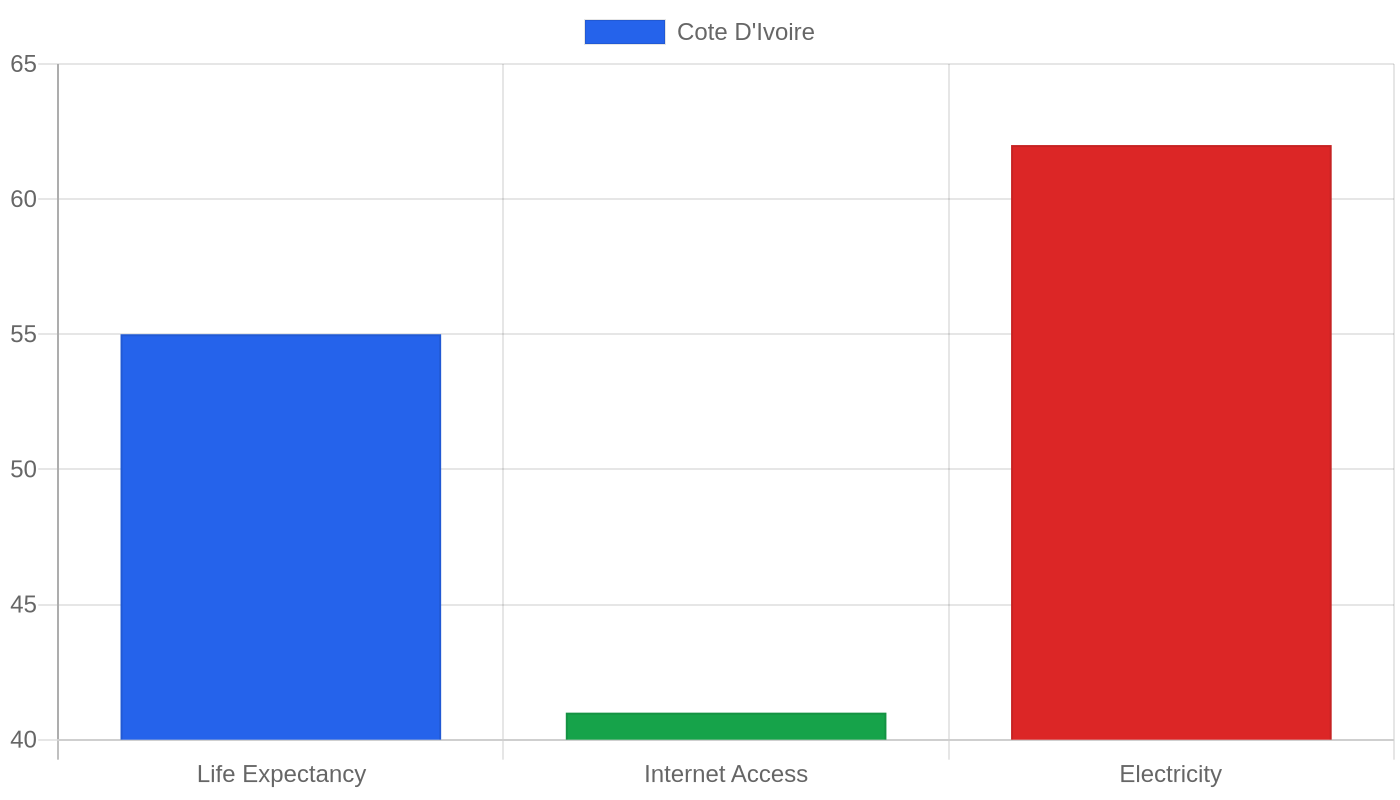
In the meantime, the government is pressing ahead with its National Development Plan, focused on infrastructure, industrialisation, and human capital. Recent policy shifts have included efforts to increase the local processing of cocoa—the government wants to process at least 50% of the national crop domestically by 2030—and to expand access to electricity and broadband internet in rural areas. These are long-term bets, and they require political continuity to succeed.
The business community is watching the succession question closely, but for now, the day-to-day reality is one of relative stability and continued reform.
What is happening right now is a quiet but determined effort to lock in the gains of the past decade before the political transition begins in earnest. The government is signing infrastructure contracts, courting foreign direct investment, and working to deepen regional trade ties through the African Continental Free Trade Area. For the Ivorian economy, the next two to three years are a window of opportunity—and of risk.
The Bottom Line
Côte d’Ivoire is not a country for the impatient or the risk-averse. It is a nation that has rebuilt itself from civil war into a functioning democracy and a regional economic anchor, but its future depends on a successful political transition and continued reform. For investors focused on West Africa, agribusiness, infrastructure, and consumer markets, this is a market that rewards patience and local knowledge.
For the journalist or the analyst, it is one of the most important stories on the continent—a test of whether post-conflict recovery can translate into lasting prosperity. Watch this country. The next chapter is just beginning.
Sources & Methodology
This article is authored by Economic Pulse Net for informational and research purposes. Economic Pulse Net sources its data from multilateral institutions, national statistics bureaus, and proprietary databases. All data is believed to be current as of the date of publication.
Published: July 28, 2026 | Category: Research — Cote D’Ivoire
Use these signals in your own platform
Economic Pulse publishes its live signal feed through a documented, read-only API. Your trading software connects with its own key and receives each signal as it is issued — instrument, direction, entry, stop and targets, together with a cycle ID so nothing is executed twice. The feed is independent of this website and cannot change it.
Signals are informational only and are not financial advice.