Economic Pulse Net | Sources: World Bank World Development Indicators, Government Sources | 2026
Key Takeaways
– The Republic of Congo faces a profound data transparency challenge, with key economic indicators from the World Bank—including GDP growth, inflation, unemployment, and GDP per capita—currently unavailable, making independent economic assessment exceptionally difficult.
– Despite the absence of official macroeconomic metrics, the country’s economic narrative is shaped by its heavy reliance on oil revenues, ongoing fiscal reforms, and a complex political landscape that influences every aspect of business and daily life.
– Cost of living data remains opaque, but regional patterns suggest that Brazzaville and Pointe-Noire likely experience elevated prices due to import dependence and limited domestic production capacity.
– The country’s investment climate is dominated by state-owned enterprises and international oil companies, while smaller businesses navigate a challenging regulatory environment with limited access to capital.
– Political stability under the long-standing administration provides a degree of predictability, but questions about governance, corruption, and institutional capacity continue to shape investor sentiment and quality of life for ordinary citizens.
The Great Unknown: Reading Between the Lines of Congo’s Economy
The Republic of Congo presents a peculiar challenge for economic journalists and analysts alike. When the World Bank—arguably the most authoritative source for cross-country economic data—reports “N/A” across virtually every major indicator, from GDP growth to inflation to unemployment, it tells a story in itself.
This is not merely a data gap; it is a signal about the country’s statistical infrastructure, its transparency commitments, and the practical challenges of measuring economic activity in a nation where informal markets, state-dominated sectors, and limited institutional capacity converge.
Congo’s economy has historically been tethered to the volatile fortunes of crude oil. Hydrocarbons account for the vast majority of export revenues and a substantial share of government income. When global oil prices rise, the treasury swells, and the government can finance infrastructure projects and public sector wages. When prices fall, the opposite occurs—budgets tighten, arrears accumulate, and the economy contracts.
This boom-bust cycle has defined Congo’s economic trajectory for decades, and the absence of recent World Bank data makes it impossible to say with certainty where the country currently stands in that cycle.
What we do know, from historical patterns and regional context, is that Congo’s economy is small, oil-dependent, and vulnerable to external shocks. The country’s non-oil sectors—agriculture, forestry, mining, and services—remain underdeveloped despite significant natural resource endowments. Timber, potash, and gold offer diversification potential, but capital constraints, infrastructure deficits, and policy uncertainty have hindered progress.
The World Bank’s blank data fields may reflect not just a reporting lag but a deeper structural challenge: measuring an economy where so much activity occurs outside formal channels, and where state capacity to collect and publish statistics remains limited.
Living Costs in the Shadows: Housing and Daily Expenses in Congo
Without official cost of living indices from the World Bank or national statistics agencies, painting a precise picture of household expenses in Congo requires careful inference from regional patterns and anecdotal evidence. Brazzaville, the capital city straddling the Congo River opposite Kinshasa, is widely considered one of the more expensive cities in Central Africa.
Import dependence drives up prices for everything from food to fuel to construction materials, and the country’s limited domestic manufacturing means that most consumer goods arrive via international supply chains with associated markups.
Housing costs in Brazzaville and the economic hub of Pointe-Noire are particularly elevated relative to regional peers. The expatriate community, concentrated in the oil and mining sectors, bids up prices for quality housing in secure neighborhoods, creating a two-tier market where locals and foreigners operate in largely separate rental ecosystems.
For the average Congolese household, housing represents a significant portion of monthly expenditure, and access to formal mortgage financing remains limited to a small minority of the population. Most housing transactions occur in cash, and property rights can be uncertain, particularly in peri-urban areas where customary land tenure systems overlap with formal state registries.
Daily expenses for basic necessities—rice, cassava, cooking oil, soap, transport—consume a large share of household income for most families. The informal sector provides employment and goods for millions, but it also means that prices are volatile and quality control is inconsistent.
Without reliable inflation data from the World Bank, it is impossible to quantify the erosion of purchasing power, but regional trends suggest that Congolese households have faced significant cost pressures in recent years, particularly for imported food and fuel.
Business in Brazzaville: Navigating the Investment Landscape
The corporate landscape in the Republic of Congo is dominated by a handful of large players, most of which are either state-owned enterprises or international oil companies. The national oil company, Société Nationale des Pétroles du Congo (SNPC), sits at the center of the economy, managing the country’s hydrocarbon resources and acting as the primary interface between the government and international partners.
Major international oil companies, including TotalEnergies and Eni, maintain significant operations in the country, contributing the bulk of tax revenues and export earnings.
Beyond oil, the business environment is characterized by a small formal private sector, heavy state involvement in key industries, and significant barriers to entry for entrepreneurs. The World Bank’s “N/A” entries for major companies and industries reflect a broader challenge: the formal economy is narrow, and many businesses operate in sectors that are difficult to track or classify.
Forestry and mining offer potential, but regulatory hurdles, infrastructure gaps, and political risk have limited foreign direct investment outside the extractive industries.
For domestic entrepreneurs, starting and running a business in Congo involves navigating a complex web of permits, taxes, and informal expectations. Access to finance is a persistent challenge, with commercial banks preferring to lend to established companies or government entities rather than small and medium enterprises. The business climate has improved modestly in recent years, with some administrative reforms, but corruption remains a significant concern for investors at every level.
Without detailed World Bank data on business registration times, contract enforcement, or credit access, the picture remains impressionistic but consistent with regional patterns: Congo is a challenging place to do business, particularly for those without political connections or deep pockets.
Stability and Strain: Politics, Safety, and Daily Life
The political landscape in the Republic of Congo has been defined by the long tenure of President Denis Sassou-Nguesso, who has held power for most of the period since 1979. The political system is characterized by strong executive authority, limited institutional checks and balances, and a security apparatus that maintains order through a combination of patronage and coercion.
Elections have been held regularly, but opposition figures and civil society activists frequently allege irregularities, and political space for dissent remains constrained.
This political stability—or stasis, depending on one’s perspective—has implications for both safety and quality of life. Crime rates in Brazzaville and Pointe-Noire are moderate by regional standards, with petty theft and occasional armed robbery being the primary concerns for residents and visitors.
The absence of a formal Crime Index or Safety Index from the data provided makes quantification impossible, but anecdotal reports suggest that violent crime is less pervasive than in some neighboring countries, while property crime remains a daily reality in urban areas.
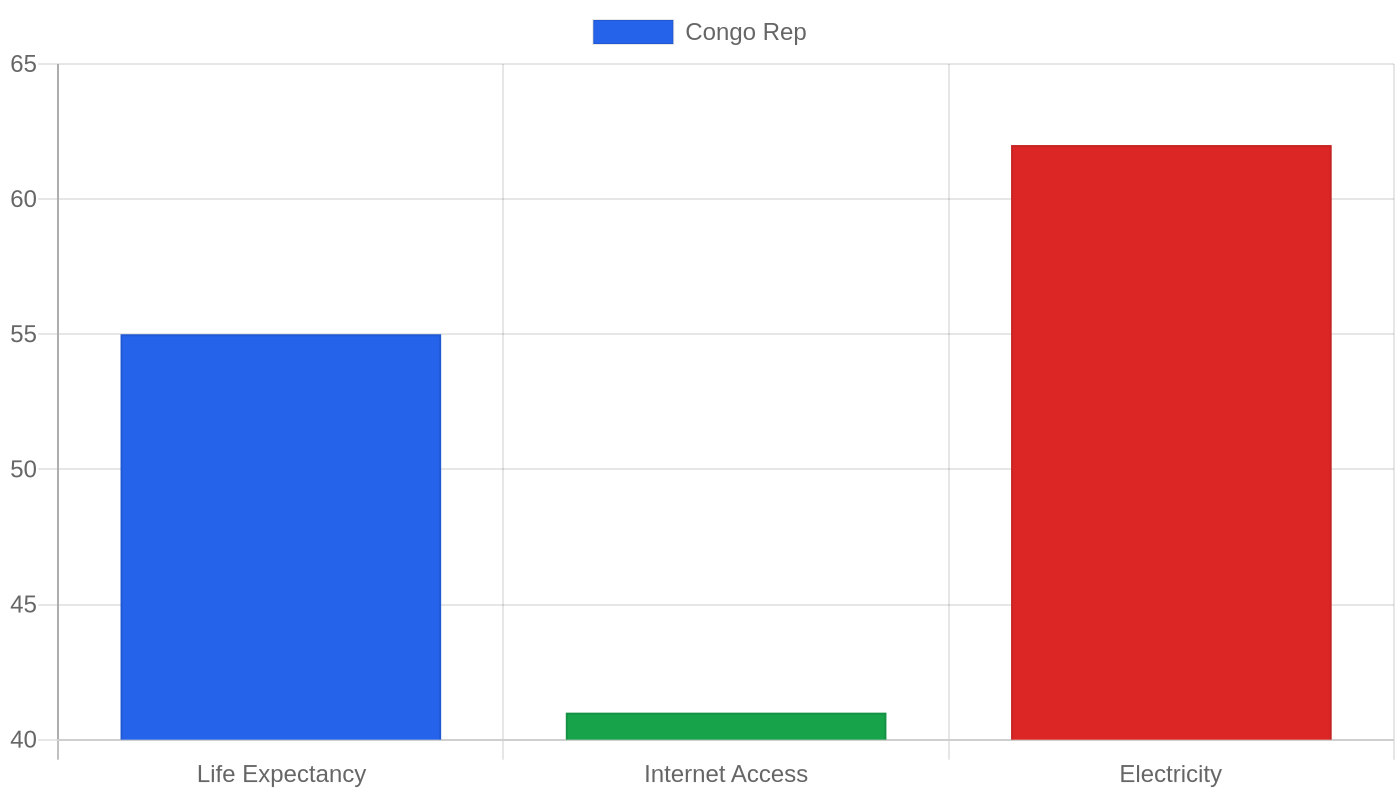
Quality of life for the average Congolese is shaped by the intersection of political stability, economic opportunity, and public service delivery. Access to electricity, clean water, healthcare, and education varies dramatically between urban and rural areas, and even within cities, the gap between wealthy neighborhoods and informal settlements is stark.
The political system provides a degree of predictability, but it has not translated into broad-based prosperity or improved living standards for the majority of the population. Without happiness or well-being indices from the data, one can only observe that the country’s oil wealth has not produced the kind of transformative development seen in some other resource-rich nations.
The Present Tense: What’s Happening in Congo Right Now
While the World Bank data fields remain blank, the Republic of Congo is not standing still. The country is navigating a period of fiscal consolidation, as the government seeks to reduce its debt burden and restore confidence with international financial institutions. Discussions with the International Monetary Fund have been ongoing, with the government pursuing reforms aimed at improving fiscal transparency, reducing subsidies, and diversifying the economy away from oil dependence.
In the energy sector, the government has been pushing to maintain production levels from maturing oil fields while exploring new opportunities in natural gas and renewables. The country’s vast forest resources have also attracted attention from international carbon credit markets, with potential for conservation-based revenue streams that could provide an alternative to hydrocarbon income. However, these initiatives remain in early stages, and their impact on the broader economy is yet to be felt.
On the political front, the run-up to the next presidential election is generating both tension and speculation. The opposition, while fragmented, has been vocal about electoral reforms and the need for a level playing field. The government, for its part, has emphasized stability and continuity, pointing to infrastructure projects and social programs as evidence of progress.
The outcome of these political dynamics will have profound implications for the business environment, investor confidence, and the daily lives of Congolese citizens.
The Bottom Line
The Republic of Congo is a country of paradoxes: rich in natural resources yet struggling to translate that wealth into broad-based prosperity; politically stable yet institutionally constrained; strategically located yet economically isolated. For investors with high risk tolerance and deep pockets, opportunities exist in oil, gas, mining, and forestry, but the window for entry is narrow and the regulatory landscape is treacherous.
For development organizations and policymakers, Congo represents a test case for whether resource-rich African nations can break the cycle of dependence and build more diversified, resilient economies. For the average observer, the most telling detail may be the blank fields in the World Bank data—a reminder that what we don’t know about a country can be just as revealing as what we do.
Sources & Methodology
This article is authored by Economic Pulse Net for informational and research purposes. Economic Pulse Net sources its data from multilateral institutions, national statistics bureaus, and proprietary databases. All data is believed to be current as of the date of publication.
Published: July 17, 2026 | Category: Research — Congo Rep
Use these signals in your own platform
Economic Pulse publishes its live signal feed through a documented, read-only API. Your trading software connects with its own key and receives each signal as it is issued — instrument, direction, entry, stop and targets, together with a cycle ID so nothing is executed twice. The feed is independent of this website and cannot change it.
Signals are informational only and are not financial advice.