Economic Pulse Net | Sources: World Bank World Development Indicators, Government Sources | 2026
Key Takeaways
– The Democratic Republic of Congo remains one of the world’s most resource-rich nations, yet comprehensive economic data from the World Bank remains limited, underscoring the challenges of data collection in a country marked by institutional fragility.
– With the World Bank reporting no current figures for GDP growth, inflation, or unemployment, observers must rely on qualitative assessments and regional context to understand the country’s economic trajectory.
– The DRC’s economic story is fundamentally tied to its mineral wealth, which continues to attract international attention even as infrastructure deficits and political uncertainty persist.
– For investors and policymakers, the DRC represents a high-risk, potentially high-reward frontier market where patience and local knowledge are essential.
– The absence of reliable baseline data itself tells a story — one of a state still struggling to build the institutional capacity needed for modern economic governance.
The Numbers Gap: What We Don’t Know Tells Us More Than What We Do
The World Bank’s latest economic indicators for the Democratic Republic of Congo present a striking void. No GDP growth figure. No inflation rate. No unemployment statistics. No per capita income data. For most countries, such gaps would be an administrative footnote. For the DRC, they are a diagnostic tool.
When an economy the size of the DRC’s operates without comprehensive statistical tracking, it signals deeper structural challenges. The country has struggled for decades to establish the institutional frameworks that make economic measurement possible — functioning statistical agencies, reliable banking systems, and formal sector registration. This is not merely an academic concern.
Without baseline data, international lenders cannot calibrate assistance, investors cannot price risk accurately, and the government cannot design evidence-based policy.
What we do know is that the DRC sits on some of the most valuable untapped mineral deposits on the African continent. Cobalt, copper, gold, and coltan form the backbone of what formal economic activity exists. These resources have historically attracted foreign operators and, at times, fueled conflict. The absence of reliable macroeconomic data means that the true scale of this economic activity — both formal and informal — remains a matter of estimation rather than measurement.
The employment picture is equally opaque. In the absence of official unemployment figures, observers note that the vast majority of Congolese workers operate in the informal economy, often in agriculture or small-scale trade. This is a labor market that functions, but largely outside the visibility of the state. The implications are profound: without employment data, there can be no effective social protection systems, no meaningful labor policy, and no accurate picture of poverty.
The Cost of Living: Navigating Daily Life in a Frontier Economy
For ordinary Congolese households, the cost of living is a daily negotiation with scarcity. Without official inflation data from the World Bank, the lived experience of price pressure must be understood through the lens of regional dynamics. The DRC shares borders with nine countries, and its eastern provinces in particular have long been integrated into cross-border trade networks where prices fluctuate with security conditions and currency movements.
Housing in major urban centers like Kinshasa presents a stark divide. Formal, secure housing in the capital commands premium prices that place it out of reach for most residents, while the majority of the urban population lives in informal settlements where access to water, electricity, and sanitation is unreliable. The concept of a housing market in the Western sense applies only to a thin layer of the population — expatriates, political elites, and a growing middle class tied to the extractive industries.
For the average household, daily expenses are dominated by food and transportation. Markets remain the primary source of provisions, and prices can vary dramatically between neighborhoods and across seasons. The informal economy provides both employment and goods, but it also means that households face price volatility without the cushion of formal financial services. Savings, where they exist, are often held in assets that can be quickly liquidated — livestock, jewelry, or foreign currency.
Investment and Business Climate: The Promise and Peril of Extractive Wealth
The DRC’s investment climate is defined by a fundamental tension: extraordinary natural resource wealth alongside significant operational challenges. The country’s mining sector continues to attract major international players drawn by the scale and quality of its mineral deposits. Cobalt, in particular, has become strategically important in the global transition to electric vehicles, positioning the DRC at the center of a supply chain that the world’s largest economies cannot ignore.
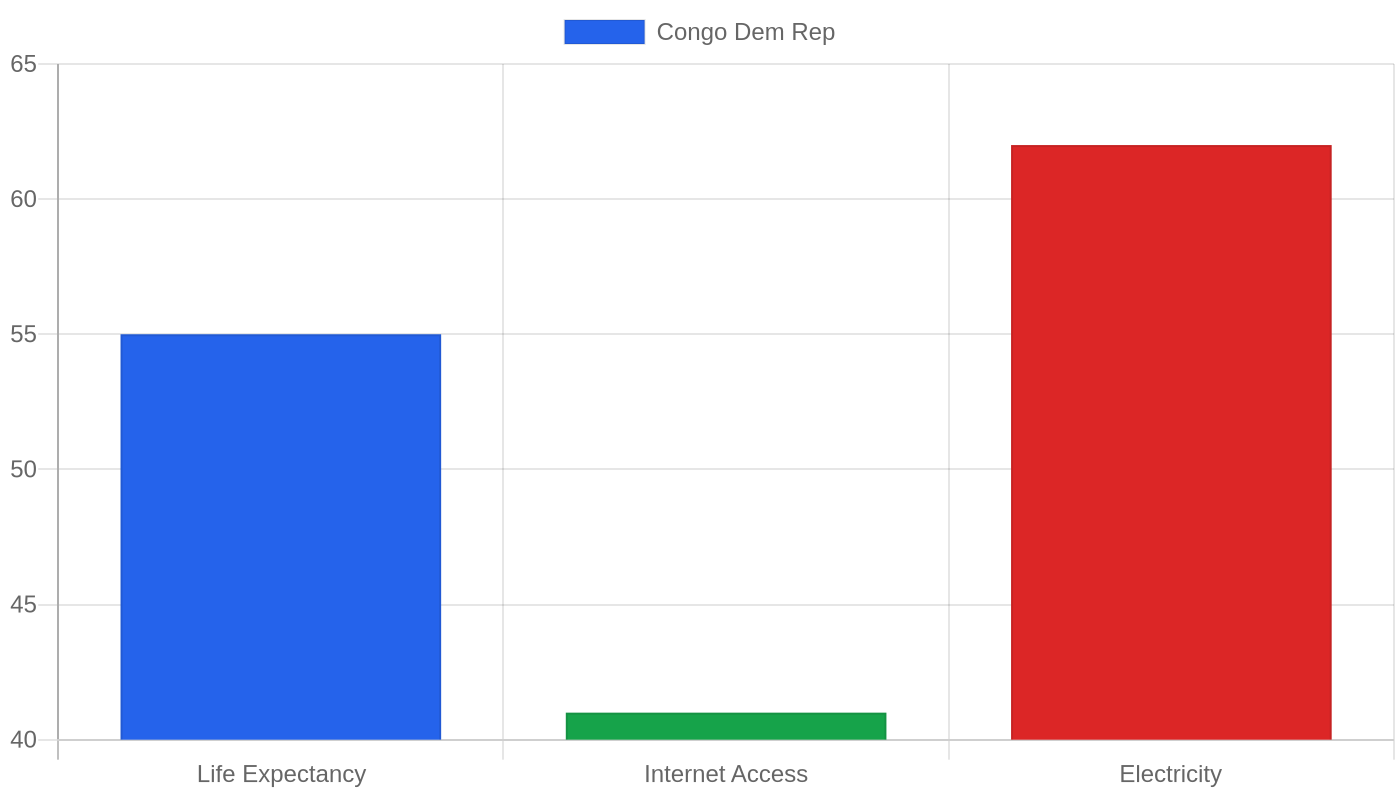
However, doing business in the DRC requires navigating a complex landscape. Infrastructure deficits — particularly in energy and transportation — add significant costs to any operation. The country’s road network is among the least developed in Africa, and electricity access remains a critical constraint for both industrial and residential users. Companies that succeed in the DRC are typically those with deep pockets, long time horizons, and sophisticated risk management capabilities.
The formal business environment has shown signs of gradual improvement in recent years, with efforts to streamline company registration and strengthen legal frameworks. Yet corruption remains a pervasive challenge, and the gap between formal regulations and actual practice can be wide. For smaller investors, the barriers to entry are substantial. For larger multinationals, the potential rewards justify the complexity.
The sectors attracting the most attention beyond mining include agriculture, where vast tracts of arable land remain underutilized, and telecommunications, where mobile money has begun to expand financial inclusion.
Safety, Politics, and Quality of Life: The Human Reality
The security situation in the DRC remains the single greatest factor shaping quality of life and economic potential. The World Bank data provides no crime index or safety index, but the broader context is well established: the eastern provinces have experienced decades of armed conflict, and the state’s capacity to provide security is uneven across the national territory. In many areas, communities rely on local militias, traditional authorities, or international peacekeeping forces for protection.
This security deficit has profound economic consequences. It displaces populations, disrupts agricultural cycles, and deters investment outside the most protected zones. It also shapes the political landscape, with governance challenges in the east frequently dominating the national agenda. The country’s political institutions remain young and fragile, with democratic processes still consolidating after decades of authoritarian rule and civil conflict.
Quality of life in the DRC is difficult to quantify without reliable data, but the qualitative picture is clear: most Congolese face significant challenges in accessing basic services. Healthcare, education, and clean water remain scarce in many regions. Life expectancy and literacy rates lag regional averages, and the country consistently ranks near the bottom of international human development indices.
And yet, observers also note the extraordinary resilience of Congolese communities — vibrant markets, rich cultural traditions, and a strong entrepreneurial spirit that persists despite formidable obstacles.
What’s Happening Now: A Critical Juncture
The DRC currently stands at a moment of both opportunity and uncertainty. The global demand for critical minerals has elevated the country’s strategic importance in ways that were unimaginable a decade ago. International attention is focused on the DRC’s cobalt and copper resources, and there is growing pressure — from foreign governments, multinational corporations, and civil society — for the country to translate this mineral wealth into broader economic development.
At the same time, the security situation in the eastern provinces remains volatile, with ongoing conflict continuing to displace populations and disrupt economic activity. The humanitarian consequences are severe, and the instability serves as a constant reminder of the fragility of the country’s progress. For the government, the challenge is to maintain control over its territory while creating the conditions for investment and growth.
There are signs of cautious optimism. Efforts to improve mining governance, increase transparency, and attract responsible investment have gained traction. The country’s young population represents a potential demographic dividend, provided that education and employment opportunities can be expanded. Regional integration efforts, particularly within the African Continental Free Trade Area, offer new markets for Congolese goods.
But these opportunities remain contingent on sustained political will and tangible improvements in security and governance.
The Bottom Line
The Democratic Republic of Congo is a country of superlatives — vast, resource-rich, and strategically important — yet one whose potential remains largely unrealized. For investors with high risk tolerance and long time horizons, the DRC offers opportunities that few other markets can match. For policymakers and international organizations, it represents a test case for whether resource wealth can be transformed into broad-based development.
And for the Congolese people, it is home — a place of immense challenges and enduring hope. The world would do well to watch this country closely, because what happens in the DRC will matter far beyond its borders.
Sources & Methodology
This article is authored by Economic Pulse Net for informational and research purposes. Economic Pulse Net sources its data from multilateral institutions, national statistics bureaus, and proprietary databases. All data is believed to be current as of the date of publication.
Published: August 05, 2026 | Category: Research — Congo Dem Rep
Use these signals in your own platform
Economic Pulse publishes its live signal feed through a documented, read-only API. Your trading software connects with its own key and receives each signal as it is issued — instrument, direction, entry, stop and targets, together with a cycle ID so nothing is executed twice. The feed is independent of this website and cannot change it.
Signals are informational only and are not financial advice.