Economic Pulse Net | Sources: World Bank World Development Indicators, Government Sources | 2026
Key Takeaways
– The Central African Republic operates as a presidential republic with executive power shared between a President and Prime Minister, but governance remains fragile amid ongoing security challenges.
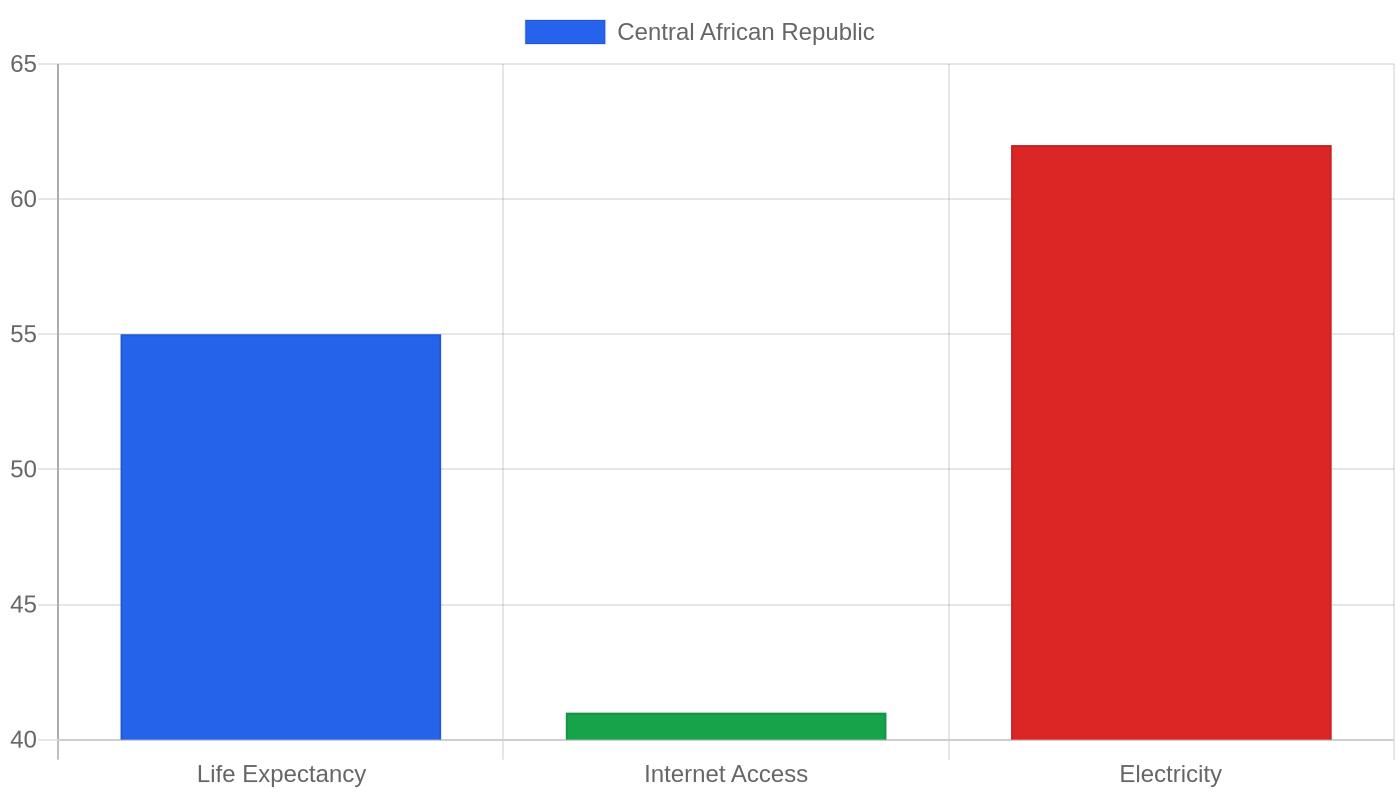
– Despite vast natural resource wealth, the country faces profound economic data gaps, with the World Bank unable to provide GDP growth, inflation, unemployment, or per capita income figures — a telling indicator of institutional fragility.
– Cost of living, housing markets, and business climate data remain largely unquantified by international agencies, reflecting the country’s informal economy and limited statistical infrastructure.
– Crime and safety indices are unavailable, underscoring the difficulty of tracking security in a nation where armed groups control significant territory.
– The Central African Republic remains a country to watch for its strategic resources and geopolitical significance, but investors and observers must contend with extreme uncertainty and data opacity.
The Invisible Economy — What the Missing Numbers Tell Us
When the World Bank cannot provide GDP growth, inflation rates, or unemployment figures for a country, it signals something far deeper than a mere statistical gap. In the Central African Republic, the absence of basic economic data is itself the story. The World Bank’s dataset for this nation is nearly empty — no GDP, no GDP per capita, no GNI per capita, no population figures, no inflation CPI, no unemployment rate.
This is not administrative oversight; it is a reflection of a state that struggles to project authority over its territory and economy.
The Central African Republic’s economy operates largely outside formal channels. With vast swaths of the country controlled by armed groups, government statisticians cannot conduct reliable surveys. Cross-border trade goes unrecorded. Diamond and gold mining — the country’s most valuable extractive industries — often bypass official channels entirely. The agricultural sector, which employs the majority of the population, is subsistence-based and resistant to conventional measurement.
What economists do understand is that the Central African Republic is one of the world’s poorest nations, rich in resources but crippled by decades of instability. The country sits on deposits of diamonds, gold, uranium, and timber, yet its people see almost none of that wealth. Without reliable inflation data, it is impossible to know how rising global food and fuel prices are affecting households — though anecdotal evidence from humanitarian organizations suggests severe strain.
The unemployment figures remain blank, but in a country where formal wage jobs are a rarity, the concept of unemployment itself becomes nearly meaningless.
The World Bank’s empty cells are not a failure of data collection alone. They are a map of state weakness, a measure of how far the Central African Republic still must travel to build the basic infrastructure of a modern economy. For now, the country’s economic story must be told in the gaps — in what the numbers refuse to reveal.
Living in Limbo — The Unpriced Cost of Existence
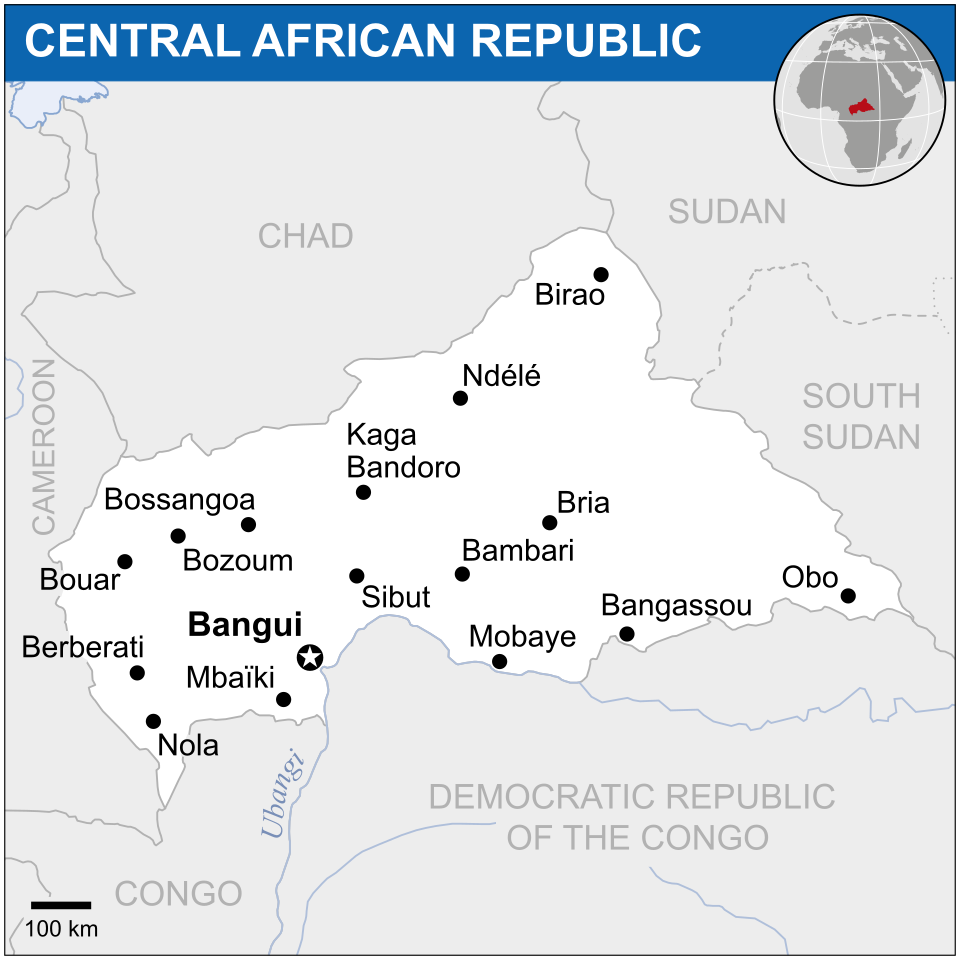
Cost of living data for the Central African Republic is essentially nonexistent in international databases, but that does not mean life is cheap. In Bangui, the capital, prices for imported goods — from rice to cooking oil to fuel — are notoriously high, inflated by the logistics of landlocked access and poor road infrastructure. A country that must fly or truck nearly everything across borders from Cameroon or the Democratic Republic of Congo pays a premium for every sack of grain and every liter of petrol.
Housing costs are similarly opaque. There is no reliable rental index, no comparative data on purchase prices. What is known is that Bangui’s limited formal housing stock is expensive relative to local incomes, while the vast majority of the population lives in informal settlements constructed from mud brick, thatch, and salvaged materials.
The concept of “rent versus buy” is a luxury calculus available only to a tiny elite of government officials, international aid workers, and expatriate businesspeople.
Daily expenses for the average Central African — who survives on subsistence farming, small-scale trade, or remittances — are measured not in currency but in access. Is the road passable to market? Are armed groups blocking the route? Has the rains come for the cassava harvest? These are the real economic indicators.
Compared to regional averages inferred from neighboring countries, the Central African Republic likely has a higher cost for basic necessities due to its isolation and insecurity, yet far lower nominal incomes. It is a brutal arithmetic: paying more for less, while earning almost nothing.
The Business of Survival — Investment in a Broken State
The Central African Republic’s top companies are not listed on any major exchange, nor are they household names beyond the country’s borders. The private sector is dominated by small-scale traders, artisanal miners, and a handful of firms serving the extractive industries and the aid economy. Telecommunications, banking, and retail are present but thin, with most formal businesses concentrated in Bangui.
For investors, the Central African Republic presents a paradox. The country possesses extraordinary mineral wealth — diamonds, gold, uranium, and untapped oil reserves. The agricultural potential is significant: coffee, cotton, and timber could all be export earners. Yet the business environment is among the world’s most challenging. Without reliable cost of living or inflation data, without safety indices, without even a clear population count, due diligence becomes an exercise in guesswork.
Sectors to watch include mining, where Chinese and Russian interests have made inroads, and the nascent renewable energy sector, where solar projects could bypass the country’s failing grid. But the political landscape — a presidential republic where executive power is exercised by the government and legislative power is vested in both government and parliament — remains volatile. Governments change, contracts are renegotiated, and armed groups can disrupt operations overnight.
The Central African Republic is a market for the risk-tolerant and the well-connected, not for the faint of heart.
The Unfinished Republic — Politics and Security in the Shadows
The Central African Republic formally operates as a presidential republic, with the President as head of state and a Prime Minister as head of government. Executive power is exercised by the government, while legislative power is vested in both the government and parliament. On paper, it is a functioning democracy. In practice, the state’s writ barely extends beyond Bangui.
Crime and safety indices are unavailable from international sources, and this absence is itself revealing. The Central African Republic has been plagued by cycles of rebellion, coups, and communal violence since independence from France in 1960. Armed groups control much of the countryside, extracting resources, taxing movement, and imposing their own forms of justice. The capital is relatively secure, but banditry, kidnapping, and intercommunal clashes remain risks.
Quality of life — measured by any standard — is among the lowest in the world. Healthcare is minimal, education is disrupted, and life expectancy is short. The happiness data that exists for other countries does not appear in the provided dataset for the Central African Republic, but it is safe to assume that a nation recovering from decades of conflict, with limited access to basic services, does not rank highly.
The political framework of the presidential republic provides a structure, but it has yet to deliver stability or prosperity to its citizens.
The View from Bangui — What Is Happening Right Now
As of 2026, the Central African Republic remains a nation in flux. The political landscape, as described in the data, continues to operate within the framework of a presidential republic, but the government’s control over the country is contested. Armed groups that signed peace agreements have not fully disarmed, and new factions periodically emerge.
The capital, Bangui, is calm but tense, a city where the presence of international peacekeepers and national security forces is a constant reminder of the fragility beneath the surface.
Economically, the country’s data gaps persist, but there are signs of tentative activity. Mining concessions continue to attract foreign interest, particularly from Russia and China, who see the Central African Republic as a source of strategic minerals. The government has made efforts to formalize the diamond trade, seeking to comply with the Kimberley Process to gain access to legitimate international markets. Progress is slow, but the direction is toward greater regulation.
Inflation and cost of living pressures, while unquantified, are felt acutely. Global food and fuel price volatility hits the Central African Republic harder than most, given its dependence on imports. The government has attempted subsidies and price controls, but enforcement is weak. Meanwhile, the population continues to grow — even without precise World Bank figures, the demographic pressure is visible in Bangui’s expanding informal settlements and the competition for scarce resources in the countryside.
The Central African Republic is not at war, but it is not at peace. It is not growing, but it is not collapsing. It exists in a gray zone of persistent crisis, where the formal economy is a ghost and the real economy is a daily struggle for survival. For now, that is the story the empty data tells.
The Bottom Line
The Central African Republic is a country for the long-haul observer — the diplomat, the humanitarian, the resource geologist, the geopolitical strategist — not for the conventional investor or tourist. Its empty economic data is a warning sign, but also an invitation: this is a nation where the future is unwritten, where the potential for transformation is as vast as the risks. Those who watch the Central African Republic watch it for what it could become, not for what it is today.
In a world of data-rich economies, this silent nation still speaks in the language of possibility and peril.
Sources & Methodology
This article is authored by Economic Pulse Net for informational and research purposes. Economic Pulse Net sources its data from multilateral institutions, national statistics bureaus, and proprietary databases. All data is believed to be current as of the date of publication.
Published: July 20, 2026 | Category: Research — Central African Republic
Use these signals in your own platform
Economic Pulse publishes its live signal feed through a documented, read-only API. Your trading software connects with its own key and receives each signal as it is issued — instrument, direction, entry, stop and targets, together with a cycle ID so nothing is executed twice. The feed is independent of this website and cannot change it.
Signals are informational only and are not financial advice.