Economic Pulse Net | Sources: World Bank World Development Indicators, Government Sources | 2026
Key Takeaways
– Burkina Faso operates under a semi-presidential system established by its 1991 constitution, with presidential term limits set at two five-year terms following a 2000 amendment — yet political continuity has been tested by repeated coups and instability.
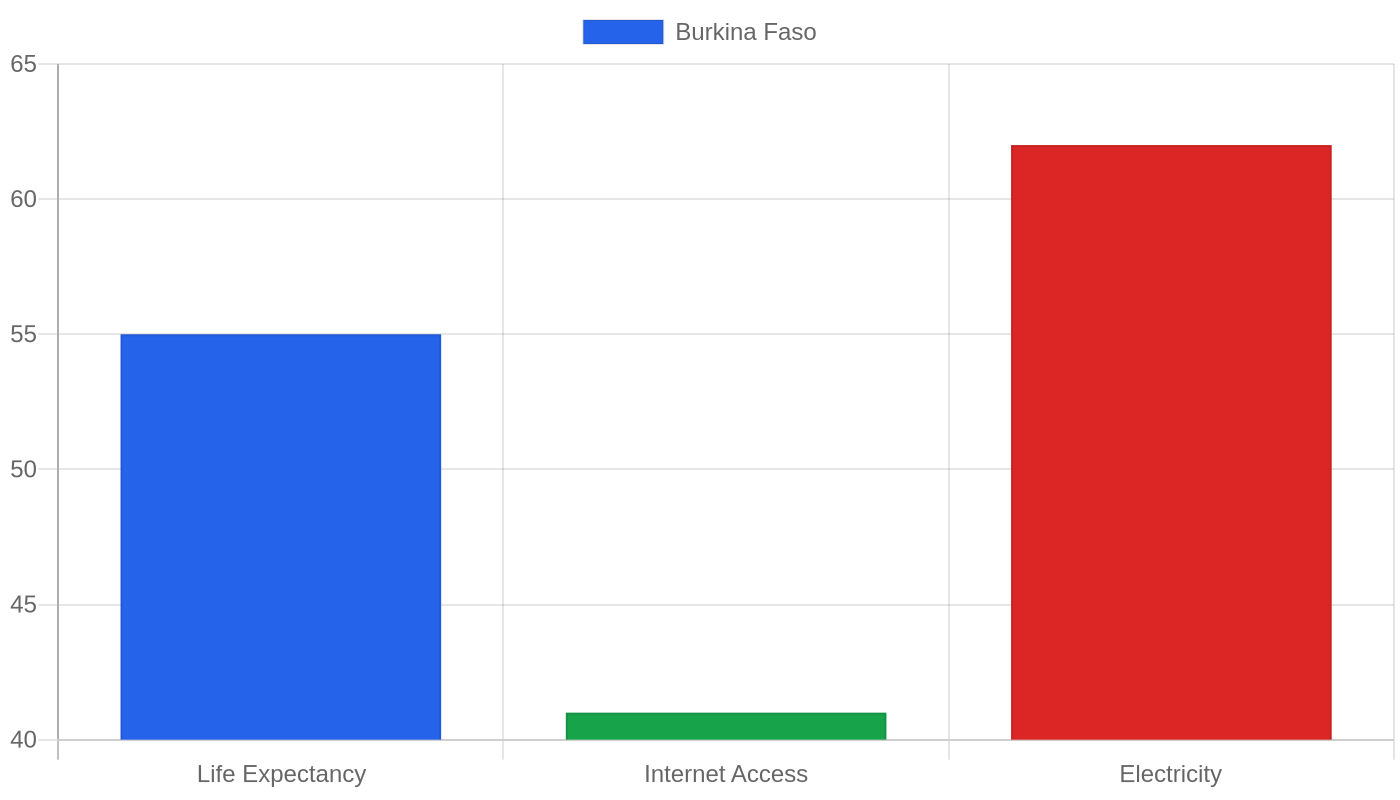
– The country’s economic data infrastructure presents significant gaps, with the World Bank reporting no current figures for GDP growth, inflation, unemployment, or GDP per capita — a reflection of the profound disruption to data collection and governance.
– Key industries remain undefined in available data, but the country’s top companies span consumer services, utilities, industrials, and consumer goods, suggesting a small but diverse formal economy anchored by state-linked enterprises.
– Air Burkina, the national airline, and Société Nationale d’électricité du Burkina Faso (SONABEL), the state electricity utility, are among the most prominent corporate entities, highlighting the dominance of infrastructure and transport in the formal sector.
– The absence of crime and safety indices, combined with a political system that has been amended but not necessarily stabilised, paints a picture of a country where governance challenges overshadow measurable economic indicators.
The Incomplete Picture — What the Data Tells Us About a Fragile Economy
When the World Bank publishes no GDP growth figure, no inflation rate, no unemployment statistic, and no GDP per capita or GNI per capita for a country, it is not merely a data gap. It is a statement. For Burkina Faso, the absence of these fundamental economic indicators from the World Bank’s dataset speaks to a nation whose statistical infrastructure has been severely compromised, likely by years of political turbulence, security crises, and institutional fragility.
The lack of a GDP figure means we cannot quantify whether the economy is expanding or contracting. Without an inflation CPI, we cannot assess the purchasing power of Burkinabé citizens. The missing unemployment rate leaves us blind to the labour market’s health. Yet the very absence of these numbers is itself a critical data point.
It suggests that the government’s capacity to collect, verify, and report basic economic statistics has been disrupted — a common symptom of states grappling with insurgency, displacement, and governance vacuums.
What we do know is that Burkina Faso’s economy, such as it is, rests on a narrow base. The main industries are not listed in the available data, but the roster of top companies offers clues. Air Burkina, the national carrier, operates in consumer services, connecting the landlocked nation to regional and international markets. Société Nationale d’électricité du Burkina Faso, the state electricity utility, indicates that energy infrastructure remains a core economic function.
SONAPOST, the national postal service, sits in the industrials category, suggesting logistics and communications still matter. Tovio, a consumer goods company, and Naganagani and Sahelis Productions, both in consumer services, round out a corporate landscape that is heavily weighted toward services rather than manufacturing or extractive industries.
This is not an economy built on oil, minerals, or large-scale agriculture — at least not as reflected in the available data. It is an economy of state utilities, a struggling airline, and small service providers. The absence of mining or agricultural giants from the top companies list is notable, given that gold mining and cotton production have historically been significant in Burkina Faso. Either these sectors are not captured in the data, or the formal economy is even smaller than one might expect.
The Cost of Living — A Story the Numbers Cannot Tell
No data is available on housing costs, rent versus buy dynamics, or daily expenses in Burkina Faso. The cost of living indices are blank. This is not unusual for a country where informal markets dominate and where much of the population lives in rural areas, growing their own food and building their own shelters. In such contexts, formal price data is notoriously difficult to collect and often meaningless when applied to the majority of citizens.
What can be inferred is that Burkina Faso, as one of the world’s poorest countries by historical measures, likely has a cost of living that is low in absolute terms but high relative to average incomes. Housing in the capital, Ouagadougou, and the second city, Bobo-Dioulasso, would command a premium, while rural housing is often self-built and outside any formal market.
Rent versus buy calculations are largely irrelevant when homeownership is often informal and inherited, and when formal rental markets serve only a thin layer of the urban elite.
The absence of regional cost-of-living comparisons in the data prevents us from benchmarking against neighbours like Mali, Niger, or Côte d’Ivoire. But it is safe to assume that the economic pressures facing Burkinabé households — food price volatility, transport costs, and access to basic utilities — are acute, even if unmeasured. The lack of an inflation CPI from the World Bank only deepens the uncertainty.
Business in the Balance — The Companies That Define Burkina Faso’s Formal Economy
The top companies in Burkina Faso, as identified in the available data, offer a window into the country’s formal business environment. Air Burkina, the flag carrier, is a consumer services company that has long struggled with financial viability, fleet age, and competition from regional carriers. Its continued presence on the list of top companies suggests that the state still sees value in maintaining a national airline, despite the economic drain it often represents.
Naganagani and Sahelis Productions, both in consumer services, are less well-known but indicate that there is some domestic market for media, entertainment, or hospitality services. Tovio, in consumer goods, may be manufacturing or distributing household products. SONAPOST, the postal service, is an industrial company by classification, but its role in logistics, payments, and government services makes it a critical piece of infrastructure.
The most significant name on the list is likely Société Nationale d’électricité du Burkina Faso — SONABEL. As the state electricity utility, it is the backbone of modern economic activity. Without reliable power, factories cannot run, hospitals cannot operate, and households cannot refrigerate food or charge phones. SONABEL’s presence among the top companies underscores the centrality of energy to Burkina Faso’s development prospects.
Yet the utility has historically faced challenges with generation capacity, grid reliability, and collection rates.
For investors, the business climate in Burkina Faso is shaped by these realities: a small formal sector dominated by state-linked enterprises, limited industrial diversification, and significant infrastructure gaps. The political landscape, with its history of constitutional amendments and coups, adds a layer of risk that no spreadsheet can capture.
The 1991 constitution established a semi-presidential system, and the 2000 amendment reduced presidential terms to five years with a two-term limit — but constitutional provisions have not guaranteed political stability.
Security, Politics, and the Quality of Life Question
The crime and safety indices for Burkina Faso are not available in the provided data. This is a gap that speaks volumes. In a country that has been battling a jihadist insurgency since 2015, with large swathes of territory outside government control and hundreds of thousands of people displaced, conventional crime indices may be beside the point. The primary threat to safety is not petty crime but armed conflict, terrorism, and the breakdown of state authority in the north and east.
Politically, Burkina Faso has been on a turbulent journey. The constitution of 2 June 1991 established a semi-presidential government, with a president elected for seven years and the power to dissolve parliament. The 2000 amendment reduced the presidential term to five years and imposed a two-term limit, preventing successive re-election. That amendment took effect during the 2005 elections.
But constitutional engineering could not prevent the popular uprising that ousted President Blaise Compaoré in 2014, nor the subsequent coups in 2022 that brought the current military junta to power.
The quality of life in Burkina Faso, while not quantified in the available data, is undoubtedly affected by these realities. Displacement, food insecurity, and limited access to healthcare and education are well-documented challenges in the Sahel region. The lack of happiness or well-being indices in the data set means we cannot cite specific figures, but the broader context — a landlocked Sahelian country facing climate change, demographic pressure, and insurgency — suggests a population under severe stress.
What’s Happening Now — A Nation at a Crossroads
The most striking feature of the available data for Burkina Faso is what it does not contain. There are no recent news items, no live indicators, no policy announcements, no reform updates. This absence is itself a form of news. It suggests that Burkina Faso has, in some respects, fallen off the radar of international economic data collectors and news aggregators. For a country that has experienced multiple coups in recent years, that is a worrying sign.
What can be said is that Burkina Faso remains in a state of political and security flux. The military junta that took power in 2022 has promised to restore civilian rule, but timelines have been vague and the security situation remains dire. The withdrawal of French forces and the turn toward Russian mercenaries, reported elsewhere but not in this dataset, has reshaped the country’s international alignments.
Economically, the suspension of some foreign aid and the disruption of mining operations in conflict zones have likely deepened the recession that the World Bank’s missing GDP figure hints at.
For the businesses that remain — Air Burkina, SONABEL, SONAPOST, and others — the operating environment is one of extreme uncertainty. Currency risk, fuel shortages, and supply chain disruptions are daily realities. Yet the fact that these companies are still listed as top enterprises suggests that some economic activity continues, even if it cannot be reliably measured.
The Bottom Line
Burkina Faso is a country where the data gaps are as revealing as the data points. For economists, development practitioners, and investors, the absence of basic statistics from the World Bank should be a red flag — not just about data collection, but about the underlying stability of the state. This is a nation to watch for those interested in the intersection of governance failure, security crisis, and economic collapse in the Sahel. But it is not a country for the faint of heart or the risk-averse.
The bottom line is that Burkina Faso’s story is still being written, and the chapters ahead will depend on whether the junta can deliver security, whether the economy can survive without reliable data, and whether the people can endure another year of uncertainty.
Sources & Methodology
This article is authored by Economic Pulse Net for informational and research purposes. Economic Pulse Net sources its data from multilateral institutions, national statistics bureaus, and proprietary databases. All data is believed to be current as of the date of publication.
Published: July 21, 2026 | Category: Research — Burkina Faso
Use these signals in your own platform
Economic Pulse publishes its live signal feed through a documented, read-only API. Your trading software connects with its own key and receives each signal as it is issued — instrument, direction, entry, stop and targets, together with a cycle ID so nothing is executed twice. The feed is independent of this website and cannot change it.
Signals are informational only and are not financial advice.