Economic Pulse Net | Sources: World Bank World Development Indicators, Government Sources | 2026
Key Takeaways
– The United States remains the world’s oldest surviving federation, a political structure that has proven remarkably durable for over two centuries and continues to shape global economic governance.
– As a federal republic of 50 states plus Washington D.C., the country’s economic policymaking is uniquely fragmented across state and federal levels, creating both friction and innovation hubs.
– The U.S.
presidential system of government has become a template adopted by many newly independent states worldwide, making American political and economic stability a matter of global concern.
– The country asserts sovereignty over five unincorporated territories and several uninhabited island possessions, extending its economic footprint beyond the continental mainland.
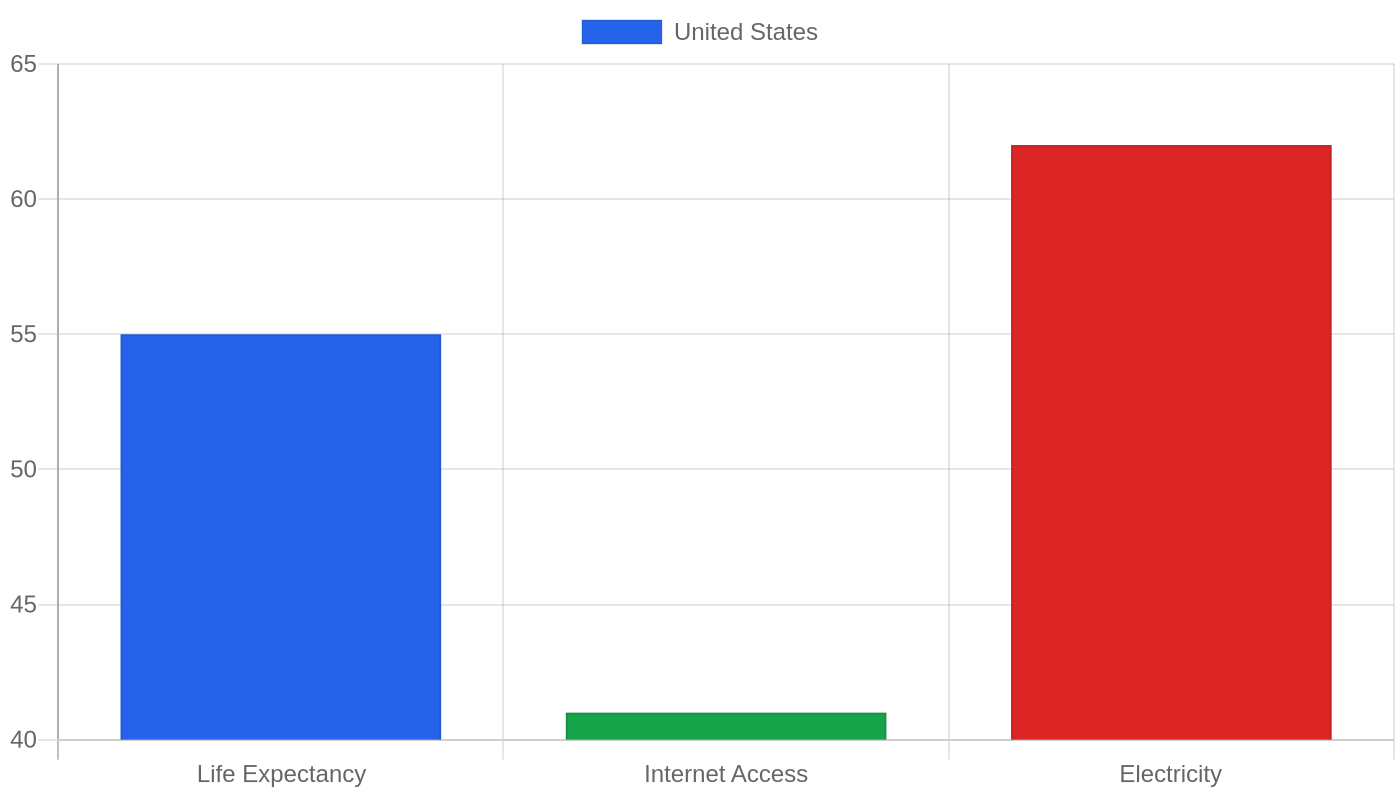
– While current quantitative indicators from the World Bank are not available at this time, the structural features of the American economy — its federalist structure and constitutional framework — continue to define its long-term trajectory.
The Architecture of American Economic Power
The United States operates as a federal republic, a structure that fundamentally shapes how its economy functions in ways that centralised nations do not experience. This is not merely a political detail — it has profound economic consequences. The Constitution of the United States serves as the foundational document that governs everything from interstate commerce to property rights, creating a predictable legal environment that businesses and investors have relied upon for generations.
What makes the American system distinctive is its layered governance. Economic policy is not made in one place but negotiated across federal institutions, state legislatures, and local authorities. This creates a competitive dynamic where states effectively compete for businesses and talent through different tax structures, regulatory regimes, and infrastructure investments.
For economists, this is a natural laboratory of policy experimentation — what works in one state can be adopted by others, while failures remain contained.
The presidential system that the United States pioneered has been adopted, in whole or in part, by many newly independent states following decolonisation. This means that American economic and political developments are watched closely not just for their domestic impact but for what they signal about the viability of this governance model worldwide. When the American economy sneezes, the institutional frameworks of dozens of other nations feel the draught.
The country’s territorial composition — 50 states, a federal capital district, five unincorporated territories, and several uninhabited island possessions — means its economic statistics aggregate vastly different regional economies. A technology boom in one state can mask manufacturing decline in another, which is why understanding the American economy requires looking beneath national averages at the federalist dynamics that drive regional divergence.
The Cost of Living Puzzle — A Nation of Micro-Economies
One of the most misunderstood aspects of the American economy is that there is no single “cost of living” — there are approximately fifty of them. The federal structure means that housing costs, taxation, and daily expenses vary dramatically between states and even between cities within the same state. This is not a minor detail but a defining feature of how Americans experience their economy.
The rent-versus-buy calculation that dominates housing discussions in most countries plays out differently across the American landscape. In some regions, homeownership remains the primary wealth-building mechanism for middle-class families; in others, particularly high-cost urban centres, renting has become the only realistic option even for well-compensated professionals.
This divergence is a direct consequence of the federalist system, where land-use policies, zoning regulations, and housing construction rules are set locally rather than nationally.
What makes this system workable is labour mobility. Because the United States is a single market with a common currency and relatively uniform legal framework for business, workers can and do move between states in search of better economic opportunities. This internal migration acts as a pressure valve, allowing the overall economy to adjust to regional shocks without the kind of prolonged crises that affect nations with more rigid internal structures.
The practical implication for observers is that American cost-of-living data must always be understood as a range rather than a single point. A family’s economic experience in the American heartland bears little resemblance to that of a household on the coasts, yet both are captured in national statistics. This is not a flaw in the data but a reflection of the country’s fundamental design as a federation of distinct economic zones.
Business, Investment, and the Competitive Federalism Advantage
The American business environment is best understood as a marketplace of regulatory regimes rather than a single unified system. Because states have significant authority over corporate law, taxation, and labour regulations, companies effectively have options about which legal environment they operate within. This competitive federalism has been a consistent driver of innovation and a key reason why the United States has remained attractive to both domestic and foreign investment.
For investors, this creates a unique risk-and-reward profile. A company that succeeds in navigating one state’s regulatory environment may face entirely different challenges in another. This complexity is a cost, but it is also a source of resilience — the American economy does not rise or fall on the fortunes of any single policy framework or political administration at the state level.
The constitutional protections that underpin the American system provide a level of legal certainty that many other markets cannot match. Contract enforcement, property rights, and dispute resolution mechanisms are all anchored in a constitutional framework that has remained remarkably stable since the country’s founding. This legal predictability is often cited as a fundamental advantage for long-term investment planning.
The country’s status as the world’s oldest surviving federation is not merely a historical curiosity — it is a stress-tested institutional design. The system has weathered civil conflict, economic depressions, world wars, and fundamental social transformation while maintaining its core structure. For businesses and investors, this institutional durability represents a form of insurance that is difficult to quantify but impossible to overstate.
Politics, Safety, and the Quality of Life Equation
The American political landscape is defined by its federal structure, which distributes power across multiple levels of government in ways that can appear chaotic but serve important functions. The presidential system creates clear accountability at the national level, while state governments provide counterweights to federal authority. This separation of powers is deliberate — it makes rapid, sweeping change difficult but also protects against concentrated abuses of power.
This political design has direct implications for quality of life. Public services — from education to infrastructure to public safety — are primarily delivered at the state and local level, meaning that the quality of government services varies significantly across the country. Americans do not experience “the government” as a single entity but as a patchwork of different agencies and jurisdictions, each with its own effectiveness and priorities.
The constitutional framework that binds this system together has proven adaptable enough to accommodate dramatic social and economic change while stable enough to provide continuity. This combination of adaptability and stability is rare among nations and represents a significant quality-of-life factor — Americans can generally rely on the rules of the game remaining consistent even as the game itself evolves.
For those considering the United States as a destination for business or residence, this political structure cuts both ways. The complexity of navigating multiple jurisdictions is a genuine cost, but the system’s resilience and its protection of individual economic freedom are benefits that have attracted immigrants and investors for generations. The American experiment in federalism remains very much an ongoing project, and its outcomes continue to shape the lives of millions.
What’s Happening Right Now — The Federalist Experiment Under Pressure
The United States is currently navigating a period where its federal structure is being tested in new ways. The relationship between state and federal authority has become a subject of intense political debate, with significant implications for how the economy operates. Businesses watching these developments are trying to discern whether the system is evolving toward greater centralisation or holding its decentralised course.
The country’s unincorporated territories and island possessions have also become points of economic and political discussion, as questions about their status and economic development continue to surface. These areas represent unique economic zones with distinct legal and regulatory frameworks, adding another layer of complexity to the American economic picture.
What makes the current moment particularly significant is the convergence of several structural debates simultaneously. Questions about the proper scope of federal power, the economic role of state governments, and the constitutional limits of various policy approaches are all being contested in real time. This is not an abstract constitutional debate — it has concrete implications for tax policy, regulatory enforcement, and the business environment.
For economic observers, the key insight is that American federalism is not a static system but a living institution that is constantly being renegotiated. The outcomes of these current debates will shape the American business environment for years to come, determining everything from corporate tax burdens to environmental regulations to labour standards.
The only certainty is that the system will continue to evolve, and that its evolution will be watched closely by the many countries that have adopted elements of the American model.
The Bottom Line
The United States remains an essential country for anyone seeking to understand the global economy, not because of any single statistic but because of the institutional architecture it has built and maintained. The world’s oldest surviving federation offers a case study in how political structure and economic performance interact over long time horizons.
For investors, policymakers, and business leaders, the American experience demonstrates both the strengths and the complexities of a decentralised economic system. The country deserves attention not as a static entity but as a dynamic experiment whose outcomes will continue to influence economic governance worldwide.
Sources & Methodology
This article is authored by Economic Pulse Net for informational and research purposes. Economic Pulse Net sources its data from multilateral institutions, national statistics bureaus, and proprietary databases. All data is believed to be current as of the date of publication.
Published: August 01, 2026 | Category: Research — United States
Use these signals in your own platform
Economic Pulse publishes its live signal feed through a documented, read-only API. Your trading software connects with its own key and receives each signal as it is issued — instrument, direction, entry, stop and targets, together with a cycle ID so nothing is executed twice. The feed is independent of this website and cannot change it.
Signals are informational only and are not financial advice.